At age 17, Sergio Marquez left his hometown in the Mexican state of Michoacán and traveled to the small U.S. town of Wapato, located amid the fertile farmlands of Washington’s Yakima Valley. Even in Mexico, he had heard about the valley’s famed apple trees—and the work that could be found picking, pruning, and thinning them.
It took him a week, several bus rides, and one coyote-led walk across the border to reach Wapato. Just two months later, he was deported, after a traffic stop brought his illegal status to light.
So he made the illicit journey again. Soon enough, he found himself living in a trailer with 19 other guys from Michoacán and taking up the farm-working life common to so many of his compatriots. His first paycheck, for three days of pruning in the hot sun, came to $80. It wasn’t quite the easy life he expected in America.
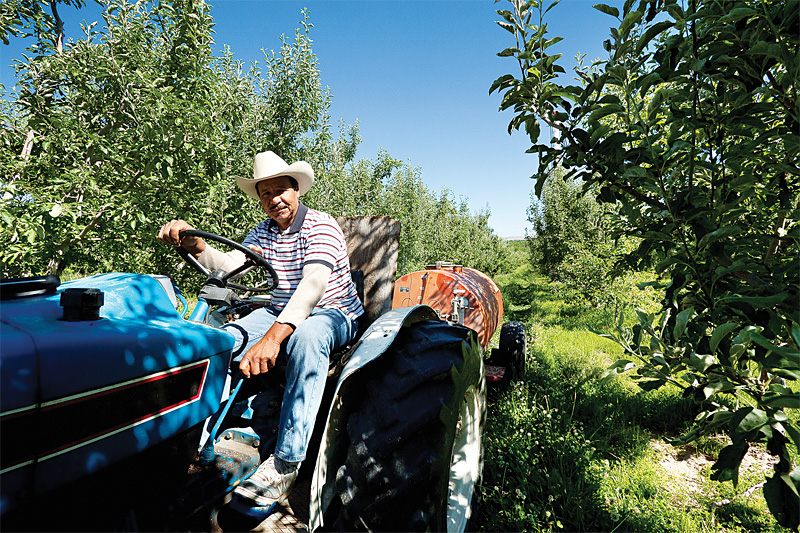
But 33 years later, his life looks very different. He still puts in long hours on the farm—but it’s a farm he owns, all 106 acres of it, neatly planted with rows of Fujis, Cameos, Honeycrisps, Galas, and other varieties. Last year, he says, he made about $100,000 in profit. This year he’s leased another 85 acres, and expects to nearly double his apple harvest to more than six million pounds. During his busy seasons, he employs about 50 workers, nearly all Mexican immigrants like him. Marquez himself became a citizen, thanks to his marriage to a native-born American in 1981. (She later left him, he says).
Gregarious and mustachioed, Marquez (pronounced mar-KEZ) surveyed his orchard on a recent day and reminisced about the path that led him to become his own boss. When he first arrived at this farm as a laborer some 15 years ago, “trees were dying and there were a lot of empty spots,” he says. The owner, John Hunter, had other businesses in town, and, as Marquez tells it, the foreman at the time had neglected the land. Marquez essentially took over, planting many more trees per row to increase the harvest. Impressed, Hunter made Marquez foreman.
Later, when the aging farm owner decided he was too occupied with other affairs to keep up the place—and his children were disinclined, or unprepared, to take it over—he turned to the one man he knew he could rely on: Marquez.
In 2004, Hunter sold his foreman the farm (including all equipment and a modest ranch house on the property) for $400,000, a bargain price. It was still a considerable sum for Marquez, which he raised with help from a low-interest loan program run by the federal Farm Service Agency. When Hunter died a few years later, Marquez, his second wife Lilia (also from Michoacán), and their four children started spending even more time at the Hunter homestead, located a quarter-mile down the road and occupied by 66-year-old widow Judy, a grown daughter, and a 10-year-old granddaughter.
To this day, Marquez cleans the Hunters’ pool, sends his workers over to mow the lawn, and has his daughter babysit Judy’s granddaughter. “He’s family,” Judy says of the man she calls “Sarge” and whom she describes as a “real, honest Christian.” Indeed, Marquez attends Catholic services two nights a week, plus Sundays, in Wapato. On a breezy June evening, he traded his chinos and blue button-down for a black dress shirt and pants, and sat in the parish’s second-from-the-front pew with his wife. They have two sons in college, and their 17-year-old daughter was recently crowned beauty queen in the neighboring town of Harrah.
In other words, you could hardly find someone who better embodies the small-town values of farm, family, and faith than Sergio Marquez. And he’s far from alone. These days, in the Yakima Valley—acclaimed not only for its apples but its cherries, peaches, asparagus, and hops—nearly 20 percent of farmers are Hispanic.
Latino immigrants, of course, have long supplied the grueling, low-paying work that a lot of agriculture requires, and that native-born Americans seemingly find beneath them. Now these immigrants are managing to buy farms and put down roots, just as the American ethos says they should be able to do.
“Latino farmers are taking over agriculture in the state of Washington,” says Malaquías Flores, who runs a program at Washington State University that helps Latinos access farm loans and manage their businesses.
He says WSU started the program nine years ago because it was looking to foster growth in small-scale farming, and found that Latinos were mostly the ones wanting to get into the business. (The program only assists immigrants who are here legally.)
Nationwide, according to the latest figures, the number of Hispanic farmers increased 14 percent between 2002 and 2007—twice the rate of growth among farmers overall, according to the U.S. Department of Agriculture. The West Coast, New Mexico, and Texas saw the biggest increases in Latino farmers, who also have become a presence in Arizona, Florida, Texas, and Hawaii.
“It’s well-recognized by many of us that the future of the industry is with Hispanic—mostly Mexican—immigrants,” says Mike Gempler, executive director of the Washington Growers League, a Yakima-based organization representing farmers around the state. “They know the business. They love it. And that’s who it’s being passed on to in many respects.”
Hispanic immigrants are propping up small-town real-estate markets too, even if they have to dig into what Nestor Hernandez, a realtor and president of Yakima County’s Hispanic Chamber of Commerce, calls their “mattress money.” Indeed, Hispanics are virtually the only people buying property in a whole series of farming towns east of the Cascade mountains.
Meanwhile, many of the politicians who like to celebrate small towns and family farms in their political rhetoric are also the ones calling for a crackdown on illegals. Speaking at the GOP convention in 2008, for instance, Sarah Palin famously declared: “We grow good people in our small towns…They’re the ones who do some of the hardest work in America, who grow our food and run our factories and fight our wars.” (She was, in part, quoting the journalist Westbrook Pegler.) But this May, she stood with Arizona Governor Jan Brewer at a press conference and declared her support for the new state law requiring local law enforcement to question suspected illegal immigrants.
Missouri Congressman Sam Graves, who’s running for re-election this year and whose bios highlight his status as a “sixth-generation, full-time family farmer” from the tiny town of Tarkio, has proposed shutting down even legal immigration until the borders are secure, according to The Washington Post Company website Who Runs Gov.
Here in Washington state, U.S. Senate candidate and Tea Party favorite Clint Didier is playing up his roots as a “Home Town Farm Boy”—indeed, those are the first words to load on his home page. His posted bio lauds him for returning with his family, after a professional football career, to the farming life in eastern Washington that he knew as a child. Yet he suggested last month at the Republican state convention in Vancouver that the U.S. stop granting citizenship to the children of illegals—a position arguably more radical than Arizona’s governor’s. Didier, whose Pasco farm is located roughly 75 miles from Marquez’s orchard, grows grains such as wheat and barley—crops whose harvest is heavily mechanized, with considerably less need for cheap labor.
When the Washington Farm Bureau’s political action committee met last week, neither Didier nor presumed GOP front-runner Dino Rossi managed to get the two-thirds majority vote necessary for a primary endorsement. And Didier’s immigration views might well have worked against him. Steve Appel, a Palouse farmer who heads the Bureau, tells Seattle Weekly that Latino immigrants “are vital to the economies of entire communities” in eastern Washington. “If agriculture dries up and goes away,” he says, “those communities go away. It’s just that simple.”
Bordering the Yakama Indian Reservation, Wapato has for decades drawn Native Americans, as well as Filipinos, Japanese, and Hispanics, many of whom went to work on the surrounding farms. Whites once made up roughly half Wapato’s population, says Mike Gilmore, 59, who grew up in the town and now is the head of the Yakima Valley Savings & Loan.
The demographics of Wapato have changed gradually, Gilmore says, as older whites passed away or moved to nursing homes in bigger cities, while younger ones left for school and never came back.
But the promise of farm work and small-town life never got old for Hispanic immigrants, who kept arriving. WSU’s Flores explains that most of the newcomers hail from rural towns in Mexico. He says everyone there had a plot of land to produce food for the family—”corn, beans, tomatoes, jalapeños, squash”—and make a little money if they had produce left over. So it’s only natural that they should turn to farming here.
In fact, you only have to cross the road from Sergio Marquez’s orchard to find another Mexican-born farmer—and another example of a formerly illegal immigrant turned small-businessman: Manuel Herrera. Speaking through a translator, Herrera says he always wanted to work in the fields—that’s how he grew up, on farms owned by both his parents and his grandparents. The 46-year-old father of seven says he crossed into the U.S. illegally in 1980, but later became a permanent resident through a federal amnesty bill signed into law by Ronald Reagan in 1986. He recently bought a 15-acre plot and leases another 47. [This story has been corrected since it was first posted. It originally gave a wrong year for when the amnesty bill was signed.]
But it’s not just agriculture—the whole town’s economy is built on Hispanic commerce. The signs on the establishments lining Wapato’s handful of commercial blocks tell the story: Jose Hardware, Alfonso’s Sports Bar, Martinez Body Shop & Auto Sales. The town also boasts Mexican-owned bakeries, laundromats, a butcher shop, and a construction company.
The local Catholic church—officially called St. Peter Claver Parish, but known as “San Pedro” to much of the congregation—is also presided over by a Mexican immigrant, who delivers services in both Spanish and English. One Wednesday evening, a Spanish-language mass draws some 50 people, many of whom rise to the pulpit to deliver impromptu words of praise for the Lord—like the woman who repeats “Gracias, Señor” over and over again until her emotion reaches a fever pitch.
Hispanic immigrants do not exactly run the town—but the children and grandchildren of immigrants do. Wapato currently has its first Latino mayor, police chief, and fire chief.
Antonio Delgado Sr. is typical of the town’s small-business owners. Speaking one evening in his grown daughter’s house—located in the nearby town of Moxee and painted in electric shades of red and green seldom seen in the muted Northwest—the 53-year-old Delgado says he too was once illegal and received amnesty in the ’80s. For eight years, he worked as a farm worker, and he put in another 10 years at an apple-packing company. Then a friend and fellow Mexican who owned two laundromats in Wapato offered to sell him one.
To buy it, Delgado got a loan from a Yakima nonprofit called Rural Community Development Resources. Founded in 1991, the organization uses federal grants to help an array of budding Latino entrepreneurs—but only ones who provide identification indicating they are legal residents or citizens, according to RCDR founder Luz Gutierrez.
In time, Gutierrez’s organization dispensed a second loan to Delgado to start a bakery next door to the laundromat, which led him to start two more bakeries in Harrah (not so profitable and eventually closed) and Moxee.
Delgado’s bakeries offer the oversized pastries favored by Mexicans: fruitcakes, cream-filled “tacos” (resembling rolled crepes), fruit turnovers that in Mexico would never hold apples but which in Washington make use of the local bounty.
Delgado’s 20-year-old son, also named Antonio, works full time at the laundromat in Wapato. And though he plans to re-enter school soon, he declares—even out of earshot of his parents—his intention to come right back to Wapato when he’s done. “Everyone’s family,” he says of the town.
And often that’s just about literally true. Mayor Jesse Farias, 65, is surrounded in Wapato by nine of his 11 siblings. The grandchild of Mexican immigrants who grew up in a section of town then called “Tortilla Flats,” he signed up for the military during the Vietnam War. “I thought there had to be a better life,” he explains in Wapato’s one-story, brick city hall.
There was—at least for a while, he says, but he eventually lost both legs in the war. Out of the military and consigned to a wheelchair, he moved to Olympia. He worked for many years at the state’s Employment Security department, then received two gubernatorial appointments, one of which made him the state director of the Department of Veteran Affairs.
In 1999 he returned to Wapato, where he became mayor in 2004.
Why did he trade the state capital for a town one-tenth its size? “This is my home,” he says. “I’ll always come back.”
Similarly, Lorenzo Alvarado, son of a Mexican farm worker and a school principal in nearby Yakima, counts five of his seven siblings as neighbors in Wapato. His wife, a Mexican native, has family in town too.
Every weekend, Alvarado says, there’s some kind of family event: “a barbecue, a birthday party, a quinceañera.”
“All the culture I need is here,” he says.
Flores, of WSU, says he believes immigrants’ ongoing love affair with the valley has kept its housing market afloat. As real-estate values in the rest of the country tanked, the valley’s stayed relatively stable. Local home prices even rose during one of the worst points of the recession last summer. At the time, ABC’s Good Morning America (citing figures from Seattle’s Zillow.com) referred to Yakima County as one of the best places in the nation to sell a home.
And to buy one, too. The median price for houses (excluding new construction) is $147,000, according to WSU’s Washington Center for Real Estate Research. Those prices have been accessible to many of the region’s immigrants, says realtor Hernandez, who estimates that his clientele is 90 percent Hispanic.
Paul Regimbal, president of the Catholic Credit Union in Yakima, says that his business is targeting Latino customers as part of its strategic plan for growth. He notes that many Catholic Hispanics naturally gravitate toward his company, which was originally set up as a cooperative for Catholics in the valley but now serves all faiths. The credit union builds on that affinity by advertising in Spanish-language newspapers and TV and radio stations.
“Any business that is not wrapping their arms around the facts in this valley is missing the boat,” Regimbal says. By “facts,” he means Hispanic immigrants. “These folks are here. They pay their bills. They’re not going away.”
In the years since 9/11, and even more so following the mortgage crash, many financial institutions have effectively made it harder for illegal immigrants to get loans and accounts by requiring a valid Social Security number. The USA Patriot Act required banks to more stringently verify a customer’s identity in order to prevent money-laundering by potential terrorists.
The Patriot Act, though, doesn’t specifically require customers to prove their legal status, allowing them to authenticate their identity with what the Internal Revenue Service calls an “individual taxpayer identification number,” which one can obtain without a Social Security number. That suffices for the Catholic Credit Union. Regimbal says it’s simply not his company’s job to delve into immigration matters.
Hernandez says that’s another reason the credit union is popular among the Hispanic community. Even so, he says, the rule-tightening in the industry overall is partly to blame for the significant drop-off in business he has seen over the past couple of years. Whereas he once handled approximately 10 transactions a month, he now does about half that.
One of his clients, Jesse Anguiano, just bought a $275,000, 3,500-square-foot house on a 1.7-acre plot on the outskirts of Wapato. Anguiano’s father was a Mexican farm worker who brought him here illegally as a child. Later, Anguiano says, the family received amnesty. Now a citizen, he works as the operations manager of a logging company on the Yakama Reservation.
He bought his first house in the city of Yakima nine years ago, but longed for the country. Gesturing on a recent day to the orchards and open fields that surround his new house, he says he loves the place for “the view and the space,” and the chance to get his kids (three of them, with one more on the way) away from the TV. He’s built a chicken coop behind the house, is thinking about buying horses, and is scoping out the best place to build a fire pit for making s’mores.
Only a few miles away from this bucolic scene, in Anguiano’s former home of Yakima, the debate over illegal immigration is still roiling the citizenry. With a population of 84,000—67 percent white, 37 percent Latino, according to the latest census estimate—Yakima is the region’s major metropolis, and there’s widespread resentment between the two communities. Just as in Arizona, whites blame Hispanics for a crime problem: Gang violence claimed 25 lives in the valley during just the first half of this year. And Hispanics accuse whites of bigotry.
Gutierrez, of Rural Community Development Resources, says she originally called her Yakima-based organization the Washington Association of Minority Entrepreneurs, but changed that about five years later to the more innocuous name.
On May 1, a day when pro-immigrant marches took place across the country, 3,000 people gathered in Yakima, galvanized by anger over Arizona’s new immigration law. Gempler of the Growers League marched with them. Like many in the farm lobby nationally, he has long supported so-called “comprehensive” immigration reform, including the “path to citizenship” proposed by Obama.
Yakima police chief Samuel Granato, the grandchild of Mexican immigrants, spoke to the crowd—in Spanish. The chief, who described himself to Seattle Weekly as “just to the left of Attila the Hun” on most issues, announced to those assembled that he didn’t support the Arizona law, in part because he needs the help of all immigrants, legal or illegal, to fight crime. “I don’t need you to be afraid that local police are going to arrest you,” is how he put it.
Granato’s remarks weren’t well received by some in town. The Yakima Herald-Republic editorialized that they were inappropriate for a city official, and Granato came to a Yakima City Council meeting to defend them and assure critics he was speaking only for himself, not describing an official department position.
The council, meanwhile, has been busy recently debating a proposal to require the city and its contractors to vet new hires through the government-run E-Verify system. Designed to ensure that potential employees are legal residents or citizens, it uses federal databases to check Social Security numbers. A growing number of states—including Arizona, California, and Georgia—require contractors, or in some cases all private employers, to use the system.
In Washington state, Lewis, Clark, Pierce, and Whatcom counties have adopted E-Verify, and an all-volunteer group called Respect Washington! tried to get an initiative on the ballot this year that would have required statewide use of the system. (The measure, which also called for local law enforcement to enforce immigration laws, as in Arizona, failed to get enough signatures.) With Yakima’s council scheduled to vote on the issue on May 25, Respect Washington! took out a full-page newspaper ad encouraging its supporters to attend the hearing. Many came, but so did Gutierrez and several other Latino leaders. They cautioned the council that the system was plagued with errors, and warned that imposing the system would further polarize the city. Some council members were concerned about losing Latino cooperation with a major new anti-gang initiative. In a tight vote, the council rejected E-Verify.
But the controversy was still troubling the council a couple of weeks later at an evening “listening session” held at a senior center.
“Please don’t be intimated by the Hispanic community,” said Bob West, leader of a group that agitates against illegal immigration, called Grassroots of Yakima Valley. He was one of several people in the mostly-white crowd that encouraged the council to reconsider E-Verify. And some council members seem inclined to do so.
When another man suggested that the council pass a resolution supporting Arizona’s new law, Councilmember Bill Lover said he’d like to explore the notion, adding “I’m proud of what [Arizona] is doing.” (Last week, the Obama administration filed suit to block the law. The ACLU, in a lawsuit underwritten by Seattle Weekly‘s owner, Village Voice Media, is also seeking an injunction against the statute.)
Another speaker, a retired nurse named Robbie Byrne, bemoaned what she called Yakima’s growing “reputation as a sanctuary city” for illegal immigrants. Chatting with the Weekly after the meeting, she said immigrants “bring crimes, drugs, diseases. The people who are illegal who come here really are a detriment, not only to society but to the economy.”
When asked about all the neighboring towns with economies dependent on immigrants who once came here illegally, Byrne replied that legal immigrants could fill the same role.
Of course, many of today’s legal residents were yesterday’s illegals, as Marquez, the farmer, knows firsthand. He says the crusaders against illegal immigrants don’t see Mexicans as humans, nor understand how crackdowns tear families apart. About three years ago, he says, a friend of his was deported. The friend, a farm worker in Wapato, left behind a wife who was an American citizen as well as three children all born in the U.S. (Changes to the law in 1996 made it harder to get legal status, as Marquez did, through marriage.)
Marquez says that, like all farmers, he worries about potential raids by immigration authorities, which were stepped up by President Bush and have continued under Obama. This past December, U.S. Immigration and Customs Enforcement conducted an audit of employee documentation at a huge apple and cherry orchard named Gebbers Farm, located about 170 miles north of Wapatointhe town of Brewster. Due to improper paperwork turned up by the agency, Gebbers subsequently laid off numerous workers—exactly how many, the farm refuses to say, but local reporters have estimated hundreds, which is a lot considering the town of Brewster has only about 2,000 people. (The farm thengot guest-worker permits that allowed it to fly in replacements fromJamaica.)
Marquez says he requires his employees to provide a Social Security number, but that it’s not his responsibility to make sure those numbers are authentic. He acknowledges that E-Verify could be an effective way of doing so—thereby stemming the tide of illegal immigration in a way that periodic raids have not accomplished. People will stop coming if they can’t find work here, he reasons.
But he calls that prospect “pretty scary. Who is going to help us on the farm?” Even with all the illegal immigration taking place, he says that some years he had problems finding enough labor.
Not in the past two years, though. Where he used to get maybe 10 people showing up at his orchard every day seeking work, he now gets 50.
He attributes this not only to the recession but to an influx of Hispanics from Arizona, scared away from the state by the backlash. The labor surplus allowed him to thin all his apple trees by late June, a time of year when workers typically depart for higher-paying cherry-picking jobs.
You might say that as far as Marquez is concerned, Arizona’s loss is Washington’s gain.
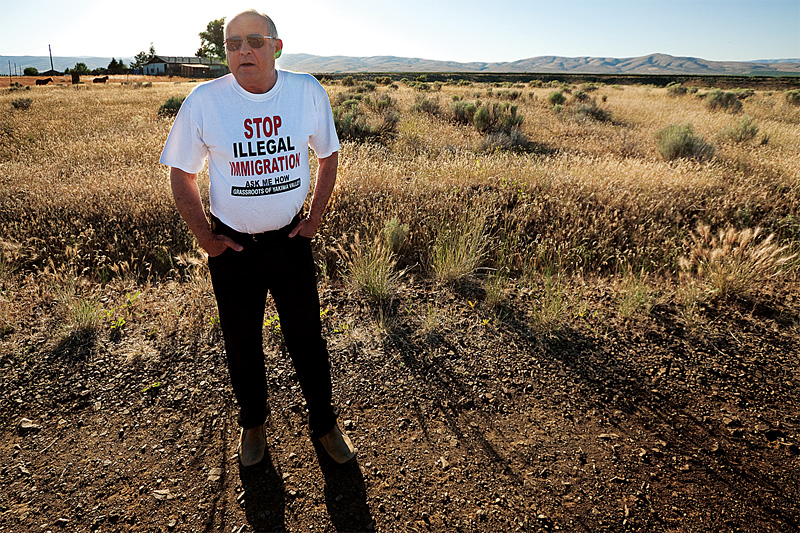
Bob West, leader of Grassroots of Yakima Valley, wants to see E-Verify used.

Bob West, leader of Grassroots of Yakima Valley, wants to see E-Verify used.