EMP: weird, fascinating, and maybe even profound.
Published 7:00 am Monday, October 9, 2006
I HAD A CHANCE to check out the Experience Music project last week, seeing the blob from the inside out. The staff was busy getting ready for opening night, and the place was filled with workers, guards, PR people, sound and light technicians, caterers, VIPs, and media folk, all trying to stay out of each others’ way. Sir Mix-A-Lot was getting a tour, though it was hard to tell who was the guide since Mix was doing all the talking; Frank Gehry, the building’s architect, was climbing a long flight of stairs, trying to explain some of his ideas to a companion. He looked like a tired old Frenchman, kind of like Paul Schell after WTO.
The hubbub was distracting, but only because EMP is an incredibly stimulating place. There is a lot to see, and the couple of hours I spent there didn’t do it justice. I spent virtually all my time looking at the rock ‘n’ roll exhibits, important but only one aspect of the place.
And then there’s the structure itself, which is a dizzying container for a vast array of, well, stuff. The angles, levels, and fluidity, so evident on the outside, are seen in greater variety and detail inside: the bones and guts of the blob itself, very structural but no less eccentric. EMP has the feel of a fun house inside; not exactly the Fun Forest’s old Flight to Mars ride, more like the kind that features squiggly mirrors and banked walkways. Except here the squiggles aren’t images, they are giant steel support beams.
It is a reality-contorting facility. I don’t think I’ve heard anyone say this, maybe because it’ll scare away the grandmas from Hooper Junction, but EMP is a temple to tripping on acid—if not directly inspired by drugs, then inspired by the music of people who were inspired by drugs. The place is appropriately mind-bending for a rock museum and homage to Seattle’s own Jimi Hendrix. Gehry, Allen, and Jody Patton’s brilliance is that they didn’t shy away from putting the essence of rock ‘n’ roll into the building itself. There’s even sex there, if you scope out the plush lines of some of the contours, not to mention the intense energy in some of the exhibits, music, and videos at play inside.
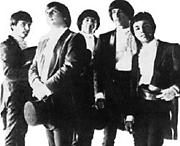
STANDING IN FRONT of the exhibits featuring the early days of Northwest rock, I found EMP’s senior curator, Peter Blecha, whom I only knew by reputation (“the man who knows everything”) and from the liner notes he’s written for reissues of various garage band classics. We started chatting about the museum, the collection, and some memories of our own. I told him that the worst crowd I was ever in at a local concert was a crush of fellow teenagers trying to get in to see Don & the Goodtimes during a Teen Spectaculars at the Coliseum in about 1966, maybe ’67. I was describing the narrow little stage areas the bands were given in what was essentially exhibition space. Blecha says, “Oh, maybe it was like this,” we walk a couple of feet, and there on the wall is a photo of Don & the Goodtimes, playing in top hats no less, in front of a ’60s crowd, crammed into a space exactly as I was describing it.
Now I don’t expect anyone else to give a shit, but I was impressed. A few of you may remember Don & the Goodtimes from hits like “Little Sally Tease,” but this band is pretty obscure these days, steamrollered into partial oblivion by groups like Paul Revere and the Raiders. But they were an essential part of the music I was raised on in Seattle, very much a part of the mid- to late-’60s garage and roller-rink bands that inspired me to do very naughty things. “Louie Louie” was a local anthem; the Sonics and Wailers were demon-gods; hell, everyone knew girls who’d slept with the Raiders. All of it was grooming local youth for spending our nights at Eagles Auditorium, Seattle’s answer to the Fillmore.
The exhibits at EMP are a little like making a museum out of the crap on any teenager’s bedroom floor. Just pick a subculture: early riot grrrl, protopunk, hip-hop, R&B. Because of all the local history in EMP, I don’t entirely know what to make of it: How many cities have hometown billionaires who come along and make a museum dedicated to our local teen idols? It is very strange to see Pat O’Day in a fancy museum, for chrissakes.
Is EMP making a mountain out of a molehill, or did the Northwest rock scene really contribute something important, was it really a player deserving of this treatment? Part of the problem is, like any provincial, I’ve taken much of our local musical riches for granted. A couple of years ago I took a friend, a transplant from DC, to see a Wailers reunion show at the Showbox. I had been turning him on to various ’60s bands by loaning him CDs, trying to point out early grunge influences in various tracks. Grunge comes from somewhere, I would say. Listen to the Sonics’ rendition of “Louie Louie.” My pal, who is much more music-literate than I, was watching the multigenerational crowd that was dancing to the Wailers music: mop-topped pop kids to gray-haired grannies. He said, you don’t know how lucky you are to have this kind of local scene, because most places don’t—three or four generations of nationally important, regionally generated rock.
EMP takes the Northwest scene and places it into a larger, national and international context that includes both rock history and the joys of making music itself. The building and its exhibits seem to embody that exuberance. And for us locals, it helps us see what we have here in a whole new light. A strobe light at that.
For more on EMP, visit our special coverage page.