Phil Chinn’s Ford Taurus moved along with the traffic on Highway 12, heading west in Grays Harbor County and beneath the Devonshire Overpass, where Washington State Patrol trooper Ben Blankenship was waiting. Blankenship put his cruiser in gear and moved down to the four-lane highway, pulling in behind Chinn’s vehicle. Within a few miles, he hit his emergency lights. Chinn pulled over. It was May 6, 2007, early afternoon, the beginning of what the state patrol considers a routine traffic stop, but one that would cost taxpayers a half-million dollars.
A student at The Evergreen State College in Olympia, Chinn and four friends were en route to Aberdeen for a second day of protests against the United States’ wars in Iraq and Afghanistan. They considered themselves anarchists in the Tiananmen Square mold, protesters in a peace movement called Port Militarization Resistance. It comprised mostly Olympia and Tacoma members of revived historic protest groups—Students for a Democratic Society (SDS) and the Wobblies, among others. Many were students at idealistic Evergreen, where the curriculum includes Imperialism, Marxist Theory, and Alternatives to Capitalism.
Beginning in 2006, protesters hoisted antiwar signs, marched arm-in-arm in the streets, and engaged in acts of civil disobedience, which were rewarded with streams of pepper spray and drag-away arrests. They attached their own locks to military gates and sat down in front of the chrome bumpers of Army semis loaded with war machinery. It could be exhilarating. After one demonstration, a 15-hour standoff at the Port of Olympia in 2007, Chinn wrote down his fond recollections:
The most vivid memory in my mind at the moment is huddling under a tarp, in a makeshift tent at 3:00 AM in the pouring rain. I remember being soaked to the bone, drinking hot tea with a few unfamiliar faces. We had constructed the tent out of a tarp and a barricade, which was blocking the street on two sides…We had held the road for nearly 12 hours at that point, with another barricade at the main entrance to the port blocking off every path that military vehicles and equipment could be driven down. Somewhere, between the rain and the cold wind, was a sense of joy. We had turned back police from our barricades, and we were going to maintain them as long as we could. While in most other situations the chant “Whose port? Our port!” would be little more than wishful thinking, for a while, it was true.
Impeded by the activists in sending its convoys to and from the ports of Olympia and Tacoma, the Army was forced to launch Plan C: shipping Fort Lewis Stryker vehicles and other heavy equipment out of Grays Harbor, about five miles from where Chinn had just been pulled over.
Trooper Blankenship came to the Taurus’ window. In his mirror, Chinn could see other state patrol vehicles pulling onto the highway shoulder, along with a Grays Harbor County sheriff’s deputy. As Chinn, now 22, recalled in a recent interview, Blankenship asked if Chinn knew how fast he was going. The speed limit, 55, Chinn said. No, the trooper said, he’d been doing 53, and was hitting his brakes erratically.
Chinn was asked to step out of the car and take a sobriety test. Blankenship would later claim Chinn’s eyes were bloodshot and that he had white spots on his tongue, suggesting he was under the influence of drugs, likely marijuana. Chinn performed the coordination tests successfully, he recalls, but wobbled a bit on one leg due to an ear infection. That was enough for Blankenship: Chinn was arrested for DUI and put in the trooper’s car.
That’s when Chinn noticed, on the trooper’s dashboard, a computer printout with a picture of Chinn’s car—actually, his parents’ vehicle, a Ford Explorer. He’d been driving it the day before. Today he was driving his Taurus. Chinn suddenly realized this was hardly a routine stop: They’d been looking for him, in either car.
Unbeknownst to Chinn and others at the time, Port protesters had a double agent in their ranks. He went by the name John Jacobs and identified himself to fellow demonstrators as a civilian employee at Fort Lewis. When he joined the movement in early 2007, he offered to provide the inside scoop on Fort operations, and over the next two years would prove a trusted, loyal anarchist. He was given access to the activists’ confidential communications, and told his new friends he wanted to start his own faction of war resisters.
Most of his inside information, it turns out, was flowing the other way, according to interviews, court documents, and public records reviewed by Seattle Weekly. He was indeed a civilian employee at the fort—in its Army Force Protection intelligence unit. His true name was John Towery, and his mission was to spy on the protesters from within.
While posing as both sympathizer and faithful organizer, Towery secretly communicated with military and law-enforcement agencies throughout Western Washington. He tipped off the Army about some of the same demonstrations he was helping to coordinate, and at times gave local police play-by-play details on demonstrators’ movements. Protesters believe that collaboration violated federal law.
The state patrol denies activists’ claims that political motives were behind the arrest of Phil Chinn. WSP spokesperson Bob Calkins says the patrol made the stop simply because its trooper witnessed a traffic violation. But he concedes the patrol had received a request that day from Aberdeen police to locate “three known anarchists” who were traveling in Chinn’s car.
A Grays Harbor County police task force had been spying on Chinn and his friends in Olympia that morning, Aberdeen police tell the Weekly. After seeing Chinn load up his Taurus at a carpooling site, the task force requested that the patrol report the car’s location on the highway so Aberdeen police could pick up the trail once Chinn entered the city. (Aberdeen cops were keeping close watch on demonstrators, including trailing them around town.) But, says Aberdeen deputy chief Dave Timmons, his department “did not ask the Washington State Patrol to stop the vehicle or question or arrest its occupants.”
As for the photo of Chinn’s parents’ vehicle, WSP’s Calkins says he doesn’t know how the officers obtained it. Aberdeen says it did not provide photos with its request.
Taken to jail in Montesano—a timber town watched over by a picturesque county courthouse on the hill—Chinn, who has no criminal record, later posted bail and was released. He arrived late for the Port protest. Though lab results clearly showed he had not been driving under the influence of drugs or alcohol, Chinn’s DUI was left hanging in the air for three months before charges were dismissed.
Using information belatedly discovered in a records request, along with other evidence assembled by his attorney, Larry Hildes, Chinn filed a federal civil lawsuit last year for false arrest. After a year of fighting the legal action, law enforcement caved last month. To settle Chinn’s claims of harassment and false arrest, the state patrol agreed to pay $109,000, while Grays Harbor County and the city of Aberdeen each will pay $30,000. The three entities will also pay Chinn’s legal fees, estimated at around $375,000.
The patrol stands by its arrest, claiming it was justified. “It cost less to settle than go to court,” says Calkins, “where a jury, with 20/20 hindsight, might agree with Chinn.” Responds Chinn: “It was cheaper to settle because there was no question it was a false arrest.”
By settling, the agencies did not have to reveal details of the intelligence network that aided the stop. Those details could expose a broader spying operation, says Hildes. He is now trying anew to pry loose those sensitive police and military documents with another federal lawsuit, filed in January on behalf of other protesters. Hildes alleges the Army’s infiltration of the Port resistance group and its military intelligence–sharing with local cops violates the federal Posse Comitatus Act, which bars the military from undertaking any unauthorized role in local law enforcement.
The Army says it is currently investigating whether the actions of its double agent violated the law or military policy. But the service appears to have anticipated and prepared for such lawsuits. A new how-to manual, issued Army-wide to its military police and intelligence operatives, offers advice on how to avoid violating the federal act, citing one of the Western Washington protests as an example. It concludes that such spy activities can be justified.
To Hildes, a Bellingham attorney working with the Seattle office of ACLU of Washington, the arrests of Chinn and others have helped expose the tip of a nationwide effort by police and the military to illegally spy on and preemptively arrest peaceful opponents of America’s wars—not unlike the illegal spying on Vietnam-era protesters and (as the ACLU has documented in recent years) similar spying on antiwar groups after the Sept. 11 attacks.
“It’s an ongoing thing,” says Hildes matter-of-factly. He’s a member of the National Lawyers Guild, and specializes in civil and human-rights cases—an activist attorney who sometimes takes part in demonstrations himself. He suspects the intelligence net stretches from local police stations to military spy ops across the U.S. After all, “Why did the Air Force in New Jersey and the Capitol Police in D.C. want to know about some college kids in Olympia?” he asks, referring to e-mails that are part of another of his court cases. And what, really, goes on behind the doors of those offices in downtown Seattle that some are calling Spy Central?
What until recently was known—at least in intelligence circles—as the Washington Joint Analytical Center was renamed a year ago the Washington State Fusion Center. It is the state patrol’s intelligence nerve center, housed in the Abraham Lincoln Building on Third Avenue in Seattle, on the floor below the FBI’s Seattle Field Office. The Center is one of roughly 75 fusion centers across the U.S., the brainchild of the Bush administration and organized by the Department of Homeland Security and the Department of Justice in the wake of the Sept. 11 attacks. The intention was to collect and distribute civilian, industrial, and military intelligence to keep America safe from criminals and terrorists, replacing the older, less-centralized intelligence ops of local communities.
To critics, the fusion centers represent a de facto national intelligence agency. Opponents worry about privacy invasions and political spying, and suspect that local intel could be shared far and wide, such as with the nation’s biggest spy operation, the National Security Agency (which has a secure listening facility at the Army’s Yakima Firing Center and a massive intel-intercept antenna farm on a mesa in Brewster, Okanogan County).
In an interview, fusion-center critic Bruce Fein, a D.C. constitutional lawyer and think-tank analyst, says the apparently false arrest of Phil Chinn “was not an aberration. It exposes the larger problem with fusion centers. These kinds of efforts to spy on First Amendment activists is a chronic problem with them. Their mission is to ascertain who might harbor resentment against the U.S. government and express it openly. Ordinarily we call that democracy.”
According to the Fusion Center’s charter, its personnel are to operate “in accordance with” the U.S. and Washington state constitutions—”as applicable.” “The laws on privacy prohibit us from collecting info on the activities of individual protesters,” says the Center’s spokesperson, state patrol Lt. Randy Drake.
More specifically, says patrol headquarters spokesperson Calkins, the Fusion Center played no role in the Chinn case. “They [Center officials] have been through the records and say they did not handle that data,” Calkins says.
The Center’s operations are not open to public inspection, but Drake says there’s not much to see. “It’s not like the movies or TV,” he says of the physical layout. No war-room frenzy or dazzling big-screen monitors with flashy graphics. Just “Cubicles and people at computers,” he says. “Office space. Not very exciting.” Funded with both federal and local money, the Center’s 17 employees, says Drake, scour the Internet and sift through e-mails and law-enforcement tips on “suspicious activities, that type of thing.”
Through a series of security corridors, Center employees can also reach the nearby offices of the Puget Sound Joint Terrorism Task Force and the regional FBI Field Intelligence Group. Besides state investigators and analysts, Seattle Police and the King County Sheriff also have full-time intelligence officers at the Fusion Center. Almost every city and county law-enforcement agency in the state is linked to the Center through the secure State Intelligence Network. Operatives also have access to the FBI computer system, and, depending on their security-clearance level and the type of case, can access intelligence from around the globe.
Seattle’s Fusion Center is “a model” for other centers, according to Security Management magazine, an industry publication, which reports that Boeing was seeking to place a full-time company intelligence analyst at the Center. Starbucks, Amazon, and Alaska Airlines “have also expressed interest” in working with the Center, the magazine says.
That’s a proposal yet to be worked out, say officials. But Richard Hovel, Boeing’s senior advisor on aviation and homeland security, told a U.S. House subcommittee last year that “Hopefully, this [Seattle plan] will be the first of many similar efforts across the nation that will establish a collaborative partnership between the public sector and industry, and protect our critical infrastructure more effectively and expeditiously.”
Hildes, the demonstrators’ attorney, is most worried about the military’s ties to the Fusion Center and local police, a bond that seems to be expanding. As Federal Computer Week reported last fall, “Some non-federal officials with the necessary clearances who work at intelligence fusion centers around the country will soon have limited access to classified terrorism-related information that resides in the Defense Department’s classified network.” State, local, and even Native American tribal officials will be able to see pre-approved data on the Secret Internet Protocol Router Network, the magazine reported.
Dennis Blair, President Obama’s former intelligence czar, felt the military should share more of its secrets with federal and corporate entities. The government’s 16-agency intelligence community (with a collective $75 billion budget and 200,000 worldwide operatives) needs to get over “this old distinction between military and nonmilitary intelligence,” as he put it. But that was before his forced resignation last month, due apparently to several intelligence failures and attempted terror bombings, including the Times Square incident last month and the December “Underwear Bomber” arrest.
The problem, says critic Fein, is that fusion centers tend to operate independently, with little review and oversight. “They can just go gather information on anyone, spying on anything unconventional or unorthodox. And to what end? There’s not a single instance I’m aware of where a center has led to the prosecution of any terrorist.”
One of the few known intel operations undertaken by the Fusion Center in Seattle led to a memorable 2007 manhunt for two Arab-looking men spotted on a Washington State ferry. They were reported to police as “looking suspicious” and taking pictures. FBI agents and analysts from the Fusion Center worked together on the case and turned up photos of the men taken by a ferry skipper. The FBI and the Fusion Center issued the photos with a press release seeking the public’s help in identifying the men.
Nine months later, the FBI announced the men had gone to an unidentified U.S. embassy in Europe to clear things up. They were, the FBI said, nothing more than European business consultants who took a ferry ride while visiting Seattle. In a news release, the FBI and the Fusion Center thanked “the many media organizations worldwide that published the photographs and ultimately played a prominent role in resolving this matter…” The agencies did not reveal how much money and effort had been expended on the global manhunt.
The Army also isn’t saying much about its Fort Lewis–based double agent, John Towery, though it confirms he was employed as an intelligence analyst who infiltrated the Port resisters, and that he continues to work for the Army. He was outed last year after protesters obtained public documents from the City of Olympia that contained his name and some of the e-mails he had sent. The Army declined to make him available for an interview.
After his role was exposed, Towery did agree to a short meeting with two Olympia protest leaders, Brendan Dunn and Drew Hendricks, apparently to justify his role. He confirmed he was a spy, says Dunn, and admitted he reported to a network of local police and military intelligence officers. Hendricks, who has spent the past few years delving into U.S. spy nets, says in an e-mail that the experience with Towery shows him that today’s intelligence gathering is “less obvious, more pervasive, [with] fewer conspirators,” but the result is familiar: “We are right where we were in the 1960s with domestic military spying.”
Both Seattle Fusion Center spokesperson Drake and WSP spokesperson Calkins say that to their knowledge the Center was not involved in the Army’s possibly illegal efforts to infiltrate and spy upon protesters. But copies of e-mails obtained by protesters through the Olympia public-records request show that the Army passed intelligence about demonstrators to local law-enforcement agencies that are part of the Fusion Center operation, and attorney Hildes says his research indicates the intel passed through the Center’s network.
For example, Tacoma and Pierce County law-enforcement officials—whose agencies are part of the Center’s nine regional intelligence systems—received messages in March 2007 from Tom Rudd, Towery’s boss at the Fort Lewis Force Protection Center. The heavily redacted documents include instant messages about protesters moving toward a Port of Tacoma demonstration (“You have some of the more aggressive protesters involved, which means Anarchists and SDS folks to say the least,” reads one).
Towery is among the e-mail recipients; he also apparently was passing along info, perhaps from the scene. “Per Towery,” says another e-mail whose sender’s name is blacked out but whose recipients included Rudd, Tacoma intelligence officers, and the Coast Guard, “pro-war counter protesters enroute to POT [Port of Tacoma]. Numbers unknown.”
The Olympian newspaper last year obtained additional e-mails from the City of Olympia (also part of the Fusion Center regional network) that confirm Towery and Olympia police were sent a “threat assessment” by Fort Lewis’ Force Protection unit, outlining demonstrators’ plans for a November 2007 protest and how it could be countered.
“As of 900 [9 a.m.], 14 Nov.,” one e-mail reads, “protesters continue surveillance of the port and appear to be focused on determining rail movement plans. Protesters are comprised of two main groups; the Olympia Port Militarization (PMR) and the self-described anarchists calling themselves the Port Liberation Front (PLF), and various other groups, and individuals who align themselves with these groups or take individual actions based on their beliefs.”
The Army seemed to know a lot about the protest plans. If demonstrators launch their blockade, the e-mail said, “tactics will continue to include the use of makeshift barricades, ‘sleeping dragons’ (chains protected by plastic pipes), and more decentralized staging at intersections along viable routes from port to I-5.”
To Hildes and the ACLU, that e-mail indicates that the Army, likely relying on the intelligence of its double agent, was directly involved in local law-enforcement activities in violation of the Posse Comitatus Act. What’s more, “Unless there is reasonable suspicion of criminal activity,” says Randy Tyler of the Seattle ACLU office, such spying “violates the protesters’ First Amendment rights.”
It has happened before, Tyler notes. In 2005, NBC News reported that the Pentagon had added the names of antiwar protesters to a database of suspected terrorists; the Pentagon called it a “mistake” and apologized. In 2007, an ACLU study showed that the Pentagon had monitored at least 186 anti-military protests in the United States in recent years and had collected extensive information on Americans in a terrorist database. The Bush administration was justifying the “unchecked surveillance” as a national security measure, the ACLU said.
Tyler says the ACLU has now launched a study of government surveillance in Washington state, intending to determine the extent of information-sharing among law-enforcement agencies, the federal government, the private sector, and the military.
The spying wasn’t merely a local op, as the document dump from Olympia shows. Police and military agencies across the nation wanted to know about the protesters.
In a 2008 e-mail to an Olympia police officer, Thomas Glapion, Chief of Investigations and Intelligence at New Jersey’s McGuire Air Force Base, wrote: “You are now part of my Intel network. I’m still looking at possible protests by the PMR SDS MDS and other left wing anti war groups so any Intel you have would be appreciated…In return if you need anything from the Armed Forces I will try to help you as well.”
Also in 2008, Andrew Pecher of the U.S. Capitol Police Intelligence Investigations Section in Washington, D.C., wrote to Olympia police for “any information that you have” on a conference of antiwar protesters held at Evergreen.
Fort Lewis’ tactics in combating protests have apparently inspired the rest of the Army to follow the base’s lead. A confidential 60-page 2009 manual from the Army Military Police School, posted online by Wikileaks, appears to guide operatives around the Posse Comitatus Act. As a kind of hybrid military/police operation, the Army’s Force Protection units can gather “institutional knowledge of threat, physical and social environs, as well as [maintain] long-term relationships with local and federal law enforcement agencies,” the manual states.
As an example, the manual cites a scenario that seemed to come right from the Olympia protest, describing the movement of 300 Stryker Brigade vehicles across eight law-enforcement jurisdictions. “The fusion cell [the intel unit of the Force Protection operation] coordinated police information, intelligence and civilian security with over 22 local, federal, and DoD agencies…The coordinated effort gave law enforcement agencies the knowledge to identify and prevent disruptive actions by violent protesters. The operation was considered by Corps leadership to be a watershed event…”
There’s no mention that the intel for such a move might have come from a double agent the Fort had placed behind enemy lines. But Hildes thinks the manual confirms some of his suspicions about how deeply involved the Army was with law enforcement. It was such intelligence, he adds, that led to the bizarre arrest of some demonstrators for “future crimes.”
In 2007, 41 protesters, mostly women, were gathering and planning a protest on the roadside near a military staging area when they were busted by Olympia police. Police, assuming the group was going to block the convoy, moved in, arrested them all, and bused them to jail for “attempted” disorderly conduct. Hildes and the ACLU filed suit this year against the Army and the City of Olympia for allegedly violating their civil rights. (A similar lawsuit against Tacoma police was filed last September.) Hildes thinks the women were prematurely arrested because Towery had told police what they’d planned to do—peacefully block and protest the war convoy. The Army and police mission was undertaken, says Hildes, because the agencies “did not like the content of the speech involved.”
Of course, government agencies routinely investigate and share info about potential terror threats, Hildes allows. But, he argues, the Olympia and Tacoma demonstrators have an established record of nonviolent protests. “When you consider how many agencies are involved in watching and infiltrating—federal, state, county, local—you have more spies than organizers,” he says. He hopes to determine the true extent of that involvement by convincing the court to order the agencies and the military to reveal more background documents in the latest civil suit, in which Towery is also a defendant.
It was just such a request that apparently prompted a conclusion to the Chinn case.
The U.S. Attorney’s office in Seattle—which was not party to the suit—stepped in late last year and claimed local police and military documents were secret. Assistant U.S. Attorney Brian Kipnis told the federal court that “at least some of the disputed records contain ‘Sensitive Security Information'” and their release is restricted. Which records those were, however, had not yet been decided, added Kipnis. But, he said, “We will certainly advise the court immediately when a decision has been reached.”
U.S. District Court Judge Robert Bryan didn’t intend to wait, however. He ordered the police agencies to produce the records requested by Hildes, and told Kipnis the U.S. might have to do the same “in the interest of justice.” Settlement talks quickly began.
Last week, Chinn was still awaiting his check. But he will eventually walk away with about $170,000, before taxes. Still, who won? Though the Grays Harbor charges were dropped, Chinn has a DUI arrest etched on his state driving record. He hopes that won’t come up as he continues to look for a job around Olympia, after graduating last year from Evergreen. He’s also less active in the protests, which have shifted back to the Port of Tacoma, where turnouts have fallen off.
Tacoma police have been more successful in cordoning off the area, keeping demonstrators at bay. “It’s difficult,” says Chinn, “to have a protest anymore.”
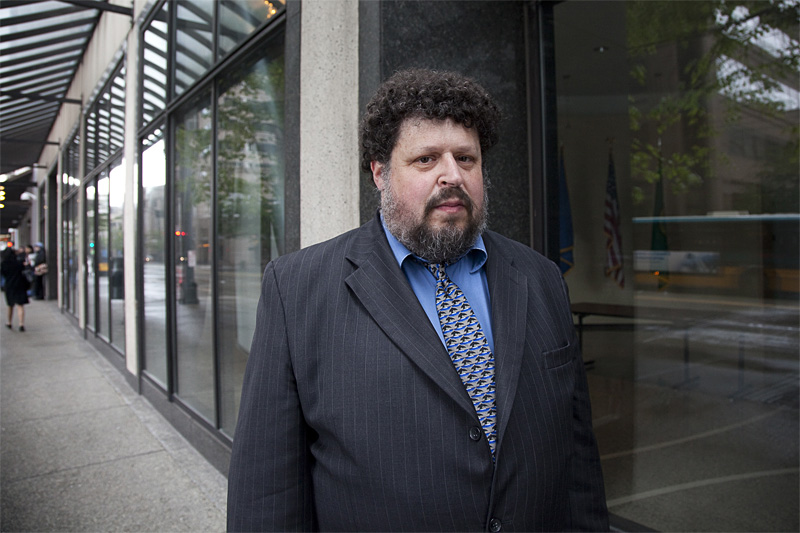
Hildes, an attorney who sometimes joins the protests too.