
Around lunch hour in Vale, South Dakota, on February 5, a 33-year-old cattle rancher finished a morning of blogging, then stepped outside with a bottle of wine and a Flip video camera.
“Hello, my name is Troy Hadrick. I’m a fifth-generation United States rancher in South Dakota,” the man ad-libbed to the camera while standing amid a small clutch of cattle. “I recently found out that Yellow Tail wines is going to be donating $100,000 to the wealthiest animal-rights organization in the world, the Humane Society of the United States — a group who is actively trying to put farmers and ranchers out of business in this country. That being said, I cannot and will not support a company who is doing such a thing. This is the only thing I know to do now with this last bottle of Yellow Tail wine that was in our house.”
In his cowboy hat and Carhartt jacket, Hadrick paused to cock the bottle of white at shoulder height, flick his wrist and send the contents pouring to the snow-covered earth like a stream of piss.
“I hope you will do the same,” he concluded. “Thank you for supporting American agriculture and the family farmers and ranchers in this country.”
Five minutes later, his 54-second “Yellow Tail Is Now Fail” clip posted to YouTube, Facebook and Twitter, Hadrick finished his chores and skedaddled with his family to the Black Hills Stock Show & Rodeo. Back online that night, he was shocked at the viewing stats for his maiden voyage on Internet video.
First it was 500. Then several thousand. The tally kept climbing until, as Jim Klinker, the Arizona Farm Bureau’s chief administrative officer, terms it, “Yellow Tail done turned its tail and run!”
Within two weeks the Australia-based wine giant announced it was rescinding the remainder of its $300,000 pledge to the Washington, D.C.-based Humane Society.
The frustration shared by Hadrick and others had been bottled up for some time, but not in recent memory had a Humane Society donor buckled under such public pressure. Only a week later, Tennessee-based Pilot Travel Centers announced it would stop collecting Humane Society donations at its chain of roadway rest stops. Then the Dallas-based Mary Kay cosmetics company publicly clarified that a personal donation by an employee’s wife to the Humane Society had been misconstrued by the group as a corporate sponsorship.
Hadrick’s social-media sensation seemed to represent a tipping point in a battle that has had modern food producers playing defense for nearly a decade. It’s farmers vs. activists. Agriculture vs. animal rights.
On one side: a phalanx of corporation- and family-owned farms that operate on large economies of scale, raising 10 billion animals a year and producing an affordable food supply for hundreds of millions of people around the world.
On the opposite side: the Humane Society, founded in 1954 as a protector for all animals, from dogs and cats to seals and whales to hens and cattle.
Never known for radical tendencies, the nonprofit had a mild-mannered reputation when it came to farm animals until its president and chief executive officer Wayne Pacelle grabbed the bull by its horns about a decade ago and launched an “End Factory Farming” campaign to wipe out the practice of lifelong livestock confinement in densely packed or restrictive crates and cages.
Under Pacelle’s direction there have been no protests, no threats to human life or other such fur-flinging, none of the shock and awe that has earned notoriety for other animal-rights groups such as People for the Ethical Treatment of Animals (PETA).
Instead the Humane Society has favored a more political route. One strategy has been that of “shareholder activism”: purchasing minority stakes in publicly traded businesses such as Steak ‘n Shake, then pressuring management to alter its buying practices.
But the group’s primary m.o. is even more direct: Ask American voters whether, in Pacelle’s words, “animals built to move should be allowed to move.”
Pacelle (pronounced puh-cell-ee), who got the first so-called factory farm law passed in Florida eight years ago via a ballot initiative, has since chalked up wins in six additional states. Others are taking note: Last year lawmakers in four more states introduced copycat legislation.
Groups like the National Rifle Association have been using the political system for decades with a lot of success, observes Peter Singer, a professor of bioethics at Princeton University and author of the seminal Animal Liberation, published in 1975. “I think the Humane Society finally thought: We’re as big as them in terms of public support; why don’t we use some of that political clout?”
The state-by-state offensive is considered far more winnable than getting a law passed through congressional agriculture committees or a regulation adopted by the United States Department of Agriculture. “[That agency is] concerned primarily with food safety,” Marcia Kramer, legislative director of the Chicago-based animal-advocacy group National Anti-Vivisection Society, says of the USDA. “It’s easier to convince a voting population that this should be changed than a committee and an industry whose livelihood depends on producing as much as fast as they can and for the least possible cost.”
For a long time, the ag industry didn’t seem to see a way to slap away the Humane Society’s whip hand. But within the past year, through social media, influence peddling and, most recently, preemptive political maneuvering, farmers big and small have begun to circle the wagons to protect their livelihood.
In Ohio last year, for instance, commodity groups organized to pass a ballot measure instituting a politically appointed board with regulatory authority over all farm-animal welfare issues. The tactic was a direct response to the Humane Society’s announcement that it intended to make Ohio its next battleground.
This year lawmakers in at least nine other states are considering adopting similar boards. (Washington isn’t among them.)
It won’t be possible for the Humane Society to win over the entire nation via its current tactic, because 26 U.S. states don’t permit ballot initiatives. As the nonprofit continues to strategize, Pacelle is tight-lipped on details. “It’s like chess,” he says. “You have to see what the other guy does before you make your move.”
As the battle goes on, the question remains: Who should decide what we put on our plates? Politicians? The 2 million farmers and ranchers who produce the food? Or the 307 million Americans who buy it?
Frankie Hall figures 1999 marked the first time he and Wayne Pacelle came to the table about legislation to target confinement hog farming. As the Florida Farm Bureau’s director of agriculture policy tells it, Pacelle wanted help passing a law at the state capitol. If that were to fail, Hall recalls the Humane Society’s then-chief lobbyist explaining, the group would seek a vote of the people.
“They got body-slammed in the legislature,” Hall recounts. “But they were very patient. They knew exactly what they was going to do one way or another. Wayne is sharp as a tack — that’s one thing about him. He ain’t no dummy.”
The Humane Society was mobilizing to turn back an industrial tide that had been rising for more than 60 years. Ever since World War II, agriculture in the U.S. had been decreasingly diversified and increasingly consolidated into ever-larger corporations.
As Singer writes in Animal Liberation, “agriculture” had turned into “agribusiness.”
Old-school animal husbandry gradually gave way to higher-tech operations. Livestock that previously foraged for feed were warehoused inside concentrated animal feeding operations, or CAFOs, where food delivery was mechanized and regulated (and manure amassed through the floor).
The system was efficient in more ways than one. It allowed for few variables, lowering costs and virtually guaranteeing that every porterhouse on every American plate could be counted upon to look and taste pretty much the same.
But to make the animals as productive as possible in the modern environment, a few twists of nature were necessary. For one, livestock had to be bred more quickly and slaughtered sooner. Traits like aggressiveness had to be selectively bred out so animals would reside calmly in a cage or crate or on a paved feedlot.
It’s a system that was initially trumpeted for democratizing what previously had been a luxury — and then largely ignored.
Only relatively recently have the perceived horrors of the “factory farm” begun to percolate through popular parlance. Best-selling reportage such as Eric Schlosser’s Fast Food Nation and The Omnivore’s Dilemma, written by Michael Pollan, not to mention the 2009 Oscar-nominated documentary Food, Inc. — all cast livestock confinement in a negative light and sounded alarm bells for human health by showing how CAFOs and the antibiotic-laced diets required to keep livestock healthy in crowded environments may be contributing to the spread of virulent new superbugs.
In the view of the Humane Society, a nation that had lost touch with its food supply was primed for an intervention.
As the stripped-down wording of the public referenda demonstrate, the nonprofit’s current agenda is straightforward: Animals are entitled to a place to “stand up, lie down and turn around freely, and fully extend all limbs.”
Florida made for an attractive guinea pig.
Ranking 33rd in hog production, the state lacked an obvious deep-pocketed opponent for the Humane Society’s “End Factory Farming” campaign. Moreover, its population centers are stacked predominantly on the urban coasts, far from farmlands.
On November 5, 2002, a state constitutional amendment passed with 55 percent of the vote, banning crates for pregnant sows. (The apparatus doesn’t permit the occupant to turn more than its head.)
According to the farm bureau’s Hall, the new law only affected one farm and 3,000 hogs.
Four years later that farmer had abandoned the pork trade for the peanut business. The Campaign for Arizona Farmers and Ranchers reckoned he was the perfect spokesman for its “Hogwash!” commercials opposing Proposition 204, the Humane Society’s second attempted ballot measure.
This time the animal-welfare group sought to criminalize crates for pregnant pigs and calves raised for veal. (The latter, prized for their pale white flesh, typically are tethered at the neck to fencing that prevents them from acquiring any red muscle mass.) For its TV ads, the Humane Society tapped no less a lightning rod than Maricopa County Sheriff Joe Arpaio, often described as “the toughest sheriff in America.”
Arizona was home to zero veal production. It was the nation’s 28th-ranked hog producer. On November 7, 2006, the ballot measure passed by a wider margin than Florida’s: a 62 percent majority.
By all accounts (even those of the opponents) the Humane Society’s political strategy was brilliant. Rather than march straight into Illinois — the biggest pork-producing state that allows ballot measures — the group had gone for what Mace Thornton, spokesman for the D.C.-based American Farm Bureau, calls the “low-hanging fruit.”
While the farm bureau certainly was paying attention, Thornton adds, the Humane Society wasn’t really considered a force to be reckoned with until after Arizona. “The pressure and the importance of the issue has been ratcheted up in each state since,” he says.
Case in point: California.
In February 2008 a slaughterhouse in Southern California shut its doors following a six-week undercover “investigation” by a Humane Society worker. The staffer had witnessed workers dragging “downer” cattle — animals too ill or injured to stand — and forcing them onto the kill line with electrical prods, chains and forklifts, surreptitiously recording the activity on video.
The “revolting” footage, says Pacelle, “made me want to vomit.”
The Humane Society presented the video to state prosecutors, who issued criminal animal-cruelty charges against some of the plant employees. Because downer cattle are considered potential transmitters of E. coli and mad cow disease, the revelation also led to the largest beef recall in U.S. history
It would have been a public-relations coup for any animal-rights group, not to mention one gearing up for its biggest anti-factory-farming showdown yet.
California is the United States’ fifth-largest egg producer, and this time the Humane Society aimed to outlaw not only pig and veal crates, but also “battery cages” — tightly packed pens used in industrial egg production. The initiative was certified for the November ’08 ballot, a day when voters would flock to the polls to pick the next U.S. president.
Russell Simmons, Alicia Silverstone, Hilary Duff, Robert Redford and other A-listers lent their celebrity to the cause. Ellen DeGeneres and Portia de Rossi hosted a Bel-Air gala that netted more than $1 million to finance the campaign.
Californians for Safe Food, the opposition, collected its campaign funds primarily from the egg industry.
Two weeks before the election, Oprah Winfrey featured both sides on her eponymous daytime television show. Prime-time advertisements bombarded viewers. As in the previous race, the “Yes! On Prop 2” campaign showed footage of pigs gnawing at metal crates, veal calves struggling to stand while tethered to their pens and chickens fighting for space to flap their wings. Californians for Safe Food “>countered with warnings that food prices would rise, eggs would be trucked in from Mexico and food safety would be compromised.
By election day the two sides had spent about $10 million apiece.
The Humane Society swayed 63.5 percent of the voters.
As Arizona had learned, you can’t begin to fit 50 years of animal science on a bumper sticker or a 30-second spot, says the Arizona Farm Bureau’s Jim Klinker. “All the other side had to say was, ‘The pig can’t turn around. The pig can’t turn around.’ Their side is so easy to sell to an urbanized public. [People] just don’t think that’s fair for the pig.”
The Humane Society has not been especially active in our state so far. However, the Washington State Farm Bureau, which represents family farmers, did receive pressure from HSUS last year to overhaul egg production. No compromises have been reached. Foie gras has been the bigger flashpoint locally. But those protests have been led by the Northwest Animal Rights Network, which has conducted demonstrations outside of Capitol Hill restaurants Lark and Quinn’s Pub, trying to get them to remove the dish from the menu. Production of foie gras involves overfeeding geese and ducks so that their livers become bloated and abnormally fatty. Legislation to outlaw it was proposed in the state legislature several years ago, but got nowhere.
Fewer than eight blocks of D.C.’s infamous K Street separate the Humane Society and HumaneWatch.org, each home to a 21st-century town crier broadcasting his message far beyond the Beltway via the blogosphere.
The substance of the messages is literally poles apart — HumaneWatch.org bills itself as the watchdog of the Humane Society — but to the analytical eye, the parallels between each blogger’s desire to earn credibility with his audience are strikingly similar.
One points out his Yale University degree, the other his Dartmouth College bona fides. One sports an image of himself cradling his cat. (Though technically he and his ex now share the cat in a “joint custody arrangement.”) The other is depicted getting kissed by a dog. (It’s unclear whose dog; when asked he becomes visibly irritated and refuses to comment.)
Pacelle (the former) and HumaneWatch’s David Martosko (the latter) may author their own blogs, but behind each cyber-outpost is a well-oiled political apparatus. And in their writings and talking points, the men keep tabs on one another like hawks.
Pacelle and Martosko have never met. But they did share the same air three years ago during a congressional hearing on animal welfare. In testimony that day, Martosko offered to treat Pacelle to a meal of the most humanely raised veal “on the planet” — under one condition: Pacelle would have to eat it in front of “a few dozen cameras.”
Martosko knew Pacelle wouldn’t bite. He’s a vegan.
Has been since 1985, when he founded Yale’s first animal-rights group after seeing hog farms with a college buddy from Iowa and mulling over man’s authority to exert power over animals in a way that contradicted the latter’s nature.
“The sentiment was strong from the beginning, from the age of three or four,” Pacelle explains during an interview in the Humane Society’s headquarters. “But there was no epiphany. No moment where I shot a bird and saw the last gasp of the animal as I walked up to him or her.”
At 44, Pacelle is lean and long-limbed, with the facial architecture of a cover boy: dark complexion, a thick, slate-hued mane and a smile that seems to sparkle. He may have experienced an entire spectrum of human-animal interactions, from gliding across ice floes with baby seals to being threatened by bear hunters, but he’s not exactly a spirited storyteller. Universally described as a “gifted communicator,” his speech is measured, his diction precise.
“When he was younger, he was concerned about animal issues, but he wasn’t out there saying, ‘We have to do something radical or violent,'” observes Singer, the Princeton University bioethicist. “I don’t think he’s dispassionate. I think he realizes that to be politically active you have to be calm and take the long-term view.”
After 10 years as its lobbyist, Pacelle became head of the Humane Society in 2004. For decades the group had focused primarily on issues like fur trapping, cockfighting and hunting. His pitch for the top job, he says, centered on “curbing the most serious abuses in the field of industrialized agriculture” by using the political system.
For some activists, spray-painting fur wearers or protesting a biomedical company in the buff might have come easier than scaling the rungs of bureaucracy. But the hardball approach seems to fit Pacelle’s temperament. “My father was a high school football coach, and I was a competitive tennis player,” he explains. “I’m a sore loser.
To hear Martosko tell it, Pacelle draws his sword for the money — $228,981 in 2008, according to IRS records — and the opportunity to “manhandle companies.
In an interview at the Starbucks below his office, having declined a request to meet at work, the 39-year-old Martosko details his own youth in the “Drew Carey suburbs” of Cleveland, opera studies at Dartmouth and a current paycheck that he is “contractually obligated not to disclose,” but one he says doesn’t afford him fancy stuff like foie gras. (He has never tried it.)
Martosko is husky, though not Drew Carey-size, his delivery breathless and buoyant. He is an opposition researcher for Richard Berman, a controversial lobbyist whose firm manages the Center for Consumer Freedom, whose funders come from the food and restaurant industries, though Berman declines to identify them.
CCF hatched the HumaneWatch.org website in late 2008 but let it lie dormant until February of this year, just as the Humane Society’s 2010 legislative push got under way. The site is becoming a clearinghouse for social-media uprisings against the Humane Society, all of which Martosko catalogues in catchy, snarky prose.
He says the animal-rights movement reminds him of a religion. “‘Every animal is a person, and every person is an animal, and we’re no better than they are,'” he mimics. “That’s their creed. I don’t agree with it, but I find it fascinating to watch how they live out their faith.”
The prevailing sentiment among activists and scholars is that man does not have dominion over animals. As sentient beings, they deserve freedom from hunger, thirst and malnutrition; from pain, injury and disease; from fear and distress; and the freedom to express normal behavior.
So: Is that animal welfare, or is it animal rights?
According to Peter Singer, “animal rights” is a convenient catchall for Americans, because, he says, “They imbibe their Bill of Rights with their mother’s milk.” In reality, explains the Australian philosopher, that descriptor is “too absolutist.” Realistic progress for animals, Singer says, can only be “incremental.”
Frivolous though it may seem, the distinction between welfare and rights is important to people like Pacelle and Martosko, for whom message means everything. Pacelle eschews the “rights” terminology.
Which makes Martosko detect a conspiracy.
He believes Pacelle is intentionally softening his rhetoric in order to disguise his belief that animals have the moral right to not be eaten. Pacelle, he is convinced, is an animal-agriculture “abolitionist” who wishes veganism upon everyone.
The rhetoric resonates: Martosko is in demand among commodity groups around the nation to teach the industrial lot that “it’s not enough just to tell the truth about yourself. You also have to tell the truth about your opponent.”
Via blog posts, bus-stop billboards and full-page ads in the New York Times and USA Today, HumaneWatch.org aims to be the go-to resource for that effort, not by offering a defense of industrial food production but by launching a frontal attack on the Humane Society.
Martosko’s favorite nugget so far consists of recent telephone-polling data showing that 59 percent of the 1,008 Americans queried believe the Humane Society contributes most of its funds to shelters that help dogs and cats. Not so, says Martosko, pointing to IRS records showing that less than 1 percent of the group’s expenses go to “hands-on dog and cat sheltering.”
Pacelle counters with a laundry list of HSUS programs dealing directly or indirectly with sheltering and pets, and he challenges Martosko to show evidence of deceptive fundraising practices.
As for the “absurd” notion that he’s out to abolish livestock production, Pacelle is dismissive. “We are an organization with 11 million supporters, and David Martosko gets his money from a handful of animal-abuse companies, and he won’t disclose who they are. His group has not cared for one animal, sheltered one homeless person or provided a cure for one disease. They are an entity that works to subvert the work of organizations trying to benefit a civil society.
“He’s a paid gun.”
Nine hundred miles from Washington, D.C., in the tiny town of New Florence, Missouri (population 735), a farmer is gearing up for his spring lambing season, solidifying plans to sell his product at farmers’ markets in St. Louis 80 miles to the east — and fretting that his state is next on the Humane Society’s war map.
“Taking up this profession, you have to fight the weather, you have to fight disease, you have to fight so much,” says Dave Hillebrand. “You shouldn’t have to worry about the next piece of legislation coming down the pike.”
The Humane Society is seeking a November ballot measure in Missouri — to outlaw so-called puppy mills. But it’s an incursion that has the state’s ag rank and file fearing the group will tackle farming and ranching next. Lawmakers are so rattled that the Missouri House of Representatives has issued a preemptive strike: It passed a proposed constitutional amendment to ban anyone from seeking a ballot measure concerning crops or livestock if it is not “based upon generally accepted scientific principles.”
Hillebrand, though, is no industrial farmer. His 700 sheep nosh on fescue and perennial rye, sea salt and kelp. His operation involves no confinement. For the past ten years, Hillebrand’s flock has had more than 160 acres to mow.
Yet he’s just as scared as his large-scale competitors that broadly written laws formulated by outsiders could spell practices that are cost-prohibitive or that go against the grain of animal husbandry. “If they dictate to me how to treat my animals,” says the sheepman, “I’ll pull the plug.”
It’s not knee-jerk libertarianism, insist fellow small-scale farmers around the nation. “The food system in this country quite frankly sucks in every way possible, starting with food-safety issues, the whole nine yards,” observes Iowa Farmers Union president Chris Petersen, who pasture-raises hogs on the Iowa-Minnesota border. “Now, whether it’s Food & Water Watch or Humane Society at the national level, I think they’re doing a lot of good work. At the same time, though, they’re interfering.”
Politics is a delicate art, Petersen elaborates. Outside groups can’t parade into a state raising hell for old-school animal husbandry. “Let me give you an example,” he says. “Bobby Kennedy Jr., who I am the best of friends with — I can call him on his cell phone! — he came to Iowa in 2002 and stepped in it real bad when he said CAFOs are a bigger threat to Americans than Osama bin Laden. It was a year before we recovered from that deal! Farm Bureau and all them guys were so mad. We lost a whole bunch of meat out of our back-end cheeks for that one.”
Petersen reserves the right to weigh in on the Humane Society’s agenda — he can’t opine before talking to them, he says. But the larger point stands. The activists need to engage all kinds of farmers when trying to cut deals and remember the cardinal rule in politics: The locals know best.
“Look at Ohio,” he adds. “I absolutely don’t like the way Humane Society rolled into that state and basically ignored the people doing things the right way.”
By “the right way,” Petersen means the Ohio Farmers Union. In February last year, the Humane Society asked the Ohio Farm Bureau to help craft an anti-confinement law and shepherd it through the state legislature. The nonprofit didn’t invite the farmers’ union to the table, neither to weigh in nor to help broker a compromise when the talks broke down.
Farm bureau spokesman Joe Cornely recalls the rendezvous with the activists all too well. “Mr. Pacelle basically said, ‘This is what we’re going to do. You can help us or fight us.’ Well, it’s not a negotiation when somebody says, ‘These are the terms of your surrender!'”
The state’s commodity groups decided they weren’t going to play ball. Instead, with the farm bureau’s help, they launched their own ballot-measure campaign to create the Ohio Livestock Care Standards Board, a politically appointed regulatory group with full authority over animal-welfare issues.
The measure passed handily last November, and the tactic is now being copied in at least nine other states.
It’s a development many animal-welfare advocates find troubling.
“The problem is that some of the language in these bills calls for including ‘generally accepted farm-management practices’ — and that includes confinement farming. So they want to codify that as an accepted standard,” says Kramer, at the National Anti-Vivisection Society. “It would make it harder to change later on, or to bring suits against a particular farm that was excessively harming animals.”
Ohio is the nation’s second-largest egg producer and ranks ninth in hog production. Those and other industries last year spent more than $4 million on the standards-board campaign — and they’ll likely have to open their checkbooks once again this election cycle.
“We didn’t spend one dime to oppose [the board],” says Pacelle. “We didn’t like it. We thought it was clearly an attempt to block a constitutional freedom and an attempt to lock up existing practices.” He adds: “They spent $4 million passing it, and there’s still a [ballot] measure.”
As promised.
The Humane Society is currently collecting signatures for a constitutional amendment that would require the Ohio livestock board to enforce anti-confinement standards for hogs, veal calves and egg-laying hens. The amendment would also outlaw dragging around downer cows and require all sick farm animals to be “humanely euthanized.” If it passes, the industry would have to meet all standards by 2016.
Advocates of fair trade decry the populist tactics. “The Humane Society is dividing people and making our jobs a lot harder,” says Tim Gibbons, communications director for the Missouri Rural Crisis Center. “They’re causing the industry to say, ‘You’re either for us, or you’re for the Humane Society.’ And that’s not the truth.”
Gibbons says the D.C. group has put independent farmers, many of whom oppose confinement, between a rock and a hard place. To support the Humane Society would be to incur the wrath of “big ag” in their state and potentially endanger their businesses, Gibbons asserts. But endorsing livestock boards could subject the small farmers to costly, burdensome regulations favored by big ag — and similarly endanger their livelihood.
“You don’t have to be either/or,” Gibbons insists. “There is another position out there, and that’s having independent family farmers raising livestock ethically on open, competitive markets. It’s good for a state, and for farmers, and our national security, and for a whole multitude of reasons it’s good for the economy.”
Troy and Stacy Hadrick’s spiel begins with a photo of a busty babe in a lemon-yellow bikini.
“Do you see this woman in yellow up here, holding the sign saying, ‘KFC tortures chicks’?” Troy asks his audience. “She’s a protestor for PETA, and she’s probably the only chick getting tortured right there. You want to know why? You see that snow on the ground? That’s Juneau, Alaska. Not so warm. And I don’t think she’s got her winter thong on.”
It’s a mild March night on the campus of North Dakota State University in Fargo. Thanks to the forgiving Red River, the Hadricks’ “Real Enemies of Agriculture” talk this year hasn’t been flooded out, and the couple has the next 90 minutes to show the up-and-comer ag crowd the face of the opposition, then equip them with a defense arsenal.
Troy runs down a roster of activist groups — PETA (“They say slavery was as bad as livestock handling”), the Humane Society (“Don’t tell me they’re not a vegan organization! Look at the recipe section on their website”), the Animal Liberation Front (“These are the guys that blow up professors’ houses”) — before Stacy names the ag community’s worst enemy:
“Sorry, guys. No offense to anyone here in the room, but it’s you and me.”
The couple launched its motivational-speaking business, Advocates for Ag, four years ago. The premise is simple: With modern food production under attack, somebody needed to school farmers and ranchers in public relations. As the Hadricks like to say, “Those of us in agriculture are kind of like Sasquatch or Bigfoot: Everybody’s heard of one but never seen one before.”
The couple’s antidote is to “talk, teach and touch.” Stacy tells the NDSU students, “Troy and I truly believe that conversations with one person at a time can change the perception of agriculture.”
The Hadricks came to this vocation after an extended conversation with one influential person in particular.
Back in 2001 their neighbor heard from a journalist friend looking to learn about modern cattle ranching. Before long the New York Times Magazine writer was set up with Stacy’s father and uncle, who own and operate Blair Ranch, on which the extended family lives.
The reporter decided to buy a steer from the Blairs but have them take care of it as they would their own. This way he could follow the typical beef cow from birth to slaughter and gain an understanding of the business’ slim profit margins.
The animal — “No. 534” as the ranchers referred to it — spent its first six months on the grassy ranch in Vale before getting trucked to a crowded Kansas feedlot, where over the next eight months it fattened to 1,200 pounds on a diet of corn and antibiotics.
Then it was off to the slaughterhouse to be stunned to death and processed.
“The opportunity to put beef on the front page of the New York Times — wow!” recalls Troy. “We wanted to do the best possible job that we could.”
But the morning the article appeared in the Sunday magazine, the ranchers felt like they’d made a huge mistake by showing how the proverbial sausage gets made. “It sent shock waves through the entire beef industry,” Hadrick explains to the Fargo audience. “Cash prices dropped. Futures dropped. Packing plants and feed yards worried about protests. And every single person who read that article had their perception of reality shifted in the wrong direction.”
Their phone started ringing. Hadrick recounts how he was called a “rotten, horrible, disgraceful human being” and told he’d rot in Hell. “Somebody wanted to buy a steer and put it on a farm sanctuary in New York to ‘live out the rest of its natural course,'” he says, adding, “We told him the steer was on its natural course. It’s a steer.”
Hadrick had been a 25-year-old ranch hand at the time, taking care of “No. 534” and corresponding regularly with that now-famous scribe:
Michael Pollan.
Adding insult to injury, says Hadrick, are Pollan’s hugely successful Omnivore’s Dilemma — which was derived from the seminal Sunday-magazine article — his appearances on national television programs like The Oprah Winfrey Show and his lucrative speaking gigs across America. (Pollan commands $20,000 a speech; the Hadricks get $2,000 to $3,000).
Perhaps worst of all was the floating of Pollan’s name in the mainstream press as a potential U.S. agriculture secretary. “He’s not an expert,” Hadrick sums up for the Fargo crowd. “You are. And you’ve got to get out and tell your story so some journalism professor at UC Berkeley” — that would be Pollan — “doesn’t do it for you.”
After the session the Hadricks describe how their feeling of betrayal by Pollan propelled them into activism. “He called [the day after the article appeared] and said, ‘I guess you’re not too happy with me,'” Troy recalls. “He ended up talking with my father-in-law and basically admitting, you know, that to make it a good story that people would read, he had to sensationalize it.”
Through an assistant, Pollan declined to be interviewed for this article.
Advocates for Ag urges farmers and ranchers to take every opportunity — at state fairs, meat counters, even at ride lines at Disney World — to tell consumers one-on-one about the animal care and science that go into producing cheap meat. That way when the curtain goes up on a movie like Food, Inc., viewers will have heard the other side from the horse’s mouth.
“Just because you’re a big farm doesn’t mean you don’t care about your animals,” Hadrick emphasizes. Is it negligence when a rancher brings a calf into the house on a winter night and warms it with a blow dryer? Or uses ultrasound to monitor a pregnant heifer? “It’s so frustrating for us to hear people say we’re abusing our livestock,” says the rancher.
The Hadricks say their speaking has accelerated over the past year and a half. They’ve been to both coasts and up and down the nation’s midsection, speaking to meat cutters, veterinarians and farmers of all stripes, handing out “I Met a Rancher Today” stickers at every stop.
Stacy works a nine-to-five job at the state ag department’s extension office, is studying for a master’s degree and keeps house with three kids. Troy toils on his blog, where he runs down press on everything from poverty to activist outrage at the “sport” known as donkey basketball. He has been urged to shoot another clip like the Yellow Tail rant, but the right opportunity hasn’t come along yet.
Though they miss day-to-day ranching, for now this is the right tack, the Hadricks say — even though beef cattle aren’t a current Humane Society target.
“Say tomorrow they got pig crates, veal crates and [chicken] cages banned throughout the country,” Troy posits. “They’re not just going to stop there and say, ‘OK, we met our goals.’ They’re going to say, ‘What’s next?’ If we don’t talk about the care that hog and chicken and veal producers put into their animals, then there won’t be anybody left to help stand up for us when it’s our turn.”
Call it the Colorado compromise.
In early 2007 Wayne Pacelle ran into Colorado governor Bill Ritter and announced his intention to go for the jugular in his state. Ritter persuaded Pacelle to meet with farmers instead. After the first tête-à-tête, at a Colorado steak house, it was clear a negotiator would be needed.
Enter Bernard Rollin.
“They had 12 million bucks allocated to do this referendum, and the livestock association told me that their people told them that if they don’t fight it, they’ll lose three to one, and if they do fight it, they’ll lose two to one,” recalls Rollin, a professor of philosophy and animal sciences at Colorado State University. “They didn’t have the money to fight it, so they asked me to fight it. Well, I had never met Wayne Pacelle. I work alone.
“Two months later I’m on a panel with Pacelle, and he came over and said, ‘I really admire your work, I’ve used it,’ and so forth. And I said, ‘Then with all due respect, don’t screw me in my own state.'”
The conversation eventually concluded, according to Rollin, with Pacelle acquiescing. “He said, ‘OK, if you can broker a deal, I’ll cancel the referendum.’ And 150 hours of unpaid time later, we had the deal. My wife will still tell you how many dinners I ate with one phone in each ear and the face in the plate.”
Rollin is an unusual animal, as it were. He authored the first ethics textbook for veterinarians and was an architect of a federal law enforcing certain standards for animals used in research labs. A New York Jew who settled in Colorado 40 years ago, he’s a weightlifting enthusiast who owns three motorcycles and flips the bird at helmet laws.
When it comes to livestock, Rollin enjoys cred both with the independents and with the industry. “He has some attitude, but he’s a great person, and I respect him well,” says Ivan Steinke, executive director of the Colorado Pork Producers Council. “He’s an ethicist — and when I say ‘ethicist,’ he doesn’t dis. He just believes there’s proper procedures and ethics in production agriculture and whether you’re a cow, calf or dairyman, or hog operator or poultry guy, we have the responsibility to do it in a certain way. [Bernie and I] don’t agree on 100 percent of the issues, but we can debate them.
Ask Rollin whose side he’s on and the response is easy: “I’m in it for the animals.”
He traces his approach back to an ancient, biblical social contract of animal husbandry, suggesting that those who are good to animals will have animals that are productive for them. In Rollin’s view, science and technology have no place in the discussion.
“The example I always use is: Just because I own my own motorcycle doesn’t mean I can ride on the sidewalk at a hundred miles an hour or throw wheelies on Main Street. The line we hear all the time is, ‘I own those animals, I can do whatever I goddamn please.’ That’s not true — particularly not now.”
Societal mores are changing, Rollin notes, and in response some food corporations are beginning to stipulate that livestock be raised a certain way. Smithfield, a hog packer, has a long-term plan to phase out gestation crates on all its corporate-owned and subcontractor-operated farms. Burger King and Wal-Mart are buying more cage-free eggs.
“Life is like an ox cart that’s going to move along. You can stop when it stops, and drink when it drinks. Or you can be dragged and beaten and be bloody,” Rollin sums up. “You can do this on your own or get legislated by people who don’t necessarily understand the issues.”
With Rollin playing referee, Colorado’s pork producers won a few concessions: ten years to phase out the pig crates, for one; and a loophole that allows sows to stay semi-crated until “confirmed” pregnant, which can take a month. The Humane Society also agreed not to push the battery-cage issue, leaving the egg industry unaffected.
For now, anyway.
California agribusiness may have thought it had seen the last of the activists for a while after the ’08 vote. Yet the group returned to the state capitol last year pushing a ban on another industrial practice it finds abhorrent. This time the dairy industry was the target.
And the politicking was successful. In October Governor Arnold Schwarzenegger signed a law banning “tail docking,” the amputation of a milk cow’s tail, which is commonly performed without anesthetic. Some dairymen have long believed tail docking improves hygiene, udder health and the quality of the milk produced, though scientific research has not borne out those theories and the American Veterinary Medical Association opposes the practice.
Meanwhile, after the Humane Society told Michigan’s agriculture industry last summer that it wanted changes there, the large-scale egg and pork producers took a page out of Ohio’s playbook and attempted to put a livestock-standards board in place. But state legislators wouldn’t green light it.
So the industry switched strategies and took a cue from Colorado, brokering a phase-out of crates and cages.
Jim Byrum, president of the Michigan Agri-Business Association, says his members are “ecstatic, very upbeat, very happy, dead confident they did the right thing.”
Byrum adds, “The irony is if [the anti-confinement ballot measure] passes in Ohio, those farmers will have to comply with the provisions quicker than we will here in Michigan.”
Will Ohio be the game changer?
The industry certainly hopes so. One good sign, says Joe Cornely, the state’s farm bureau spokesman, is that neither gubernatorial candidate supports the Humane Society’s campaign.
But Wayne Pacelle says he’s more confident than ever. “We are pro-farmer. And we’re pro-animal. And we don’t see any incompatibility between those two positions.”
According to ag-industry vet Wes Jamison, an associate professor of communications at Palm Beach Atlantic University, the campaign will come down not to facts, but to messaging.
“Animal agriculture has either tried to argue science, or economics, or food security. They’ve done everything but the moral argument for what they do with animals. And if they can’t make the moral case, they will lose in the long run.”
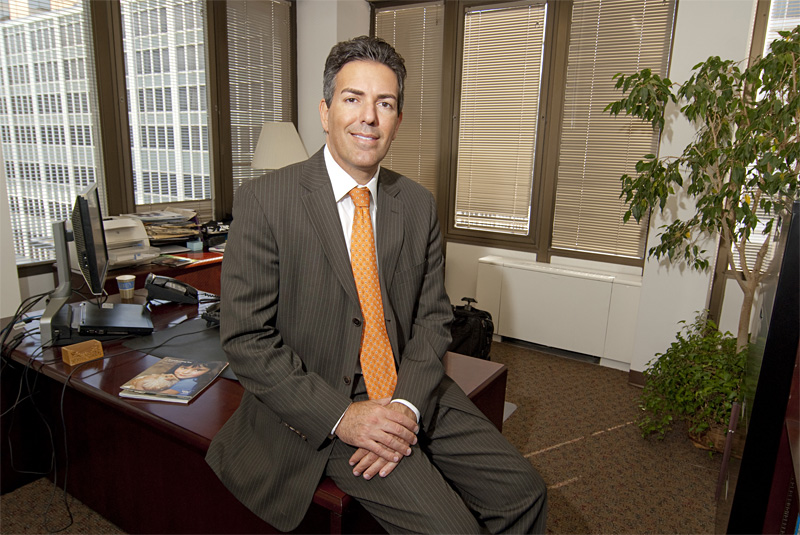
Calm, and taking the long-term view: Humane Society chief Wayne Pacelle.
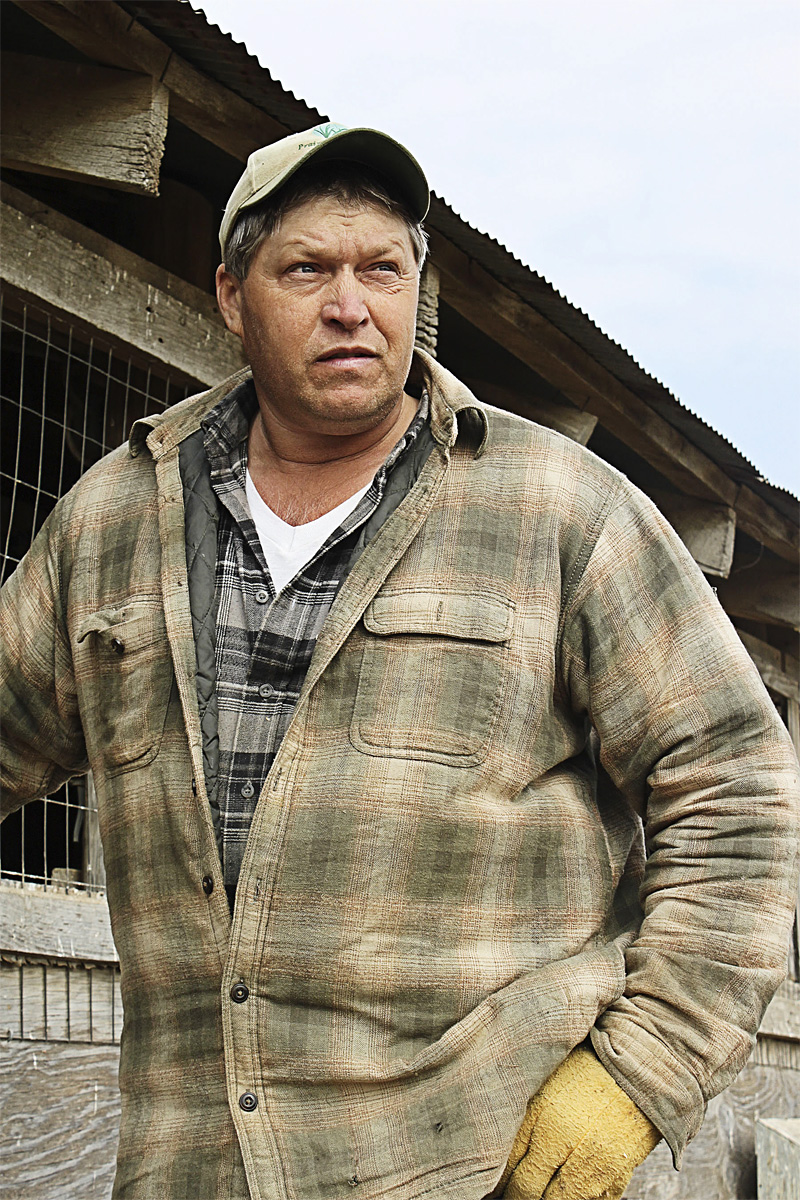
Farmer Dave Hillebrand threatens to “pull the plug.”