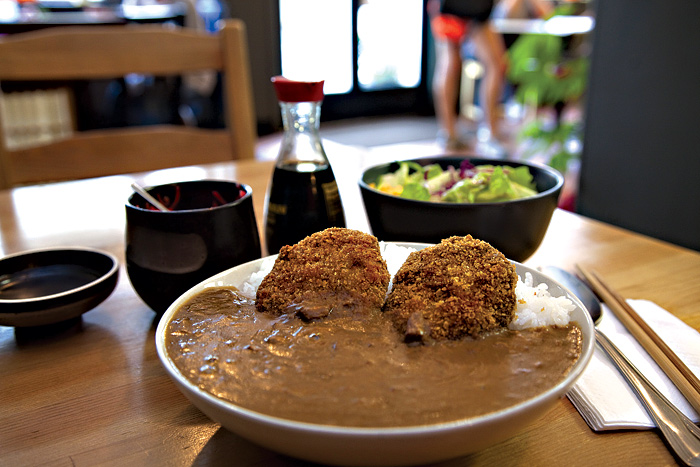
In a city of sushi addicts and diners who think udon-tempura-gyoza combos are the ne plus ultra of Japanese cuisine, The Cutting Board’s kari raisu with menchi katsu—or beef curry with a deep-fried hamburger patty—doesn’t make sense. The dish seems surreal, unpleasantly novel, three kinds of ersatz clumped together in one bowl. Without knowing the dish’s origins, you might read the menu board and think “Smoke another bowl, chef.” But the Georgetown restaurant helped unlock a piece of culinary history I had never considered, and in the process helped me decipher (if not actually enjoy) Fort St. George, a restaurant in the ID that has befuddled me since I moved to Seattle.
Both Cutting Board and Fort St. George serve yoshoku cuisine, a style of Japanese food in which nostalgia, outsiders’ fantasies, and sometimes even good taste come into conflict. Yoshoku dishes are Japanese interpretations of Western ones—hardly surprising or unique, I know. (You over there with your blueberry green-tea latte, you know what I’m talking about.) But yoshoku cuisine, it turns out, is more than a hundred years old.
The gastronomic equivalents of the Seattle Art Museum’s 2007 “Japan Envisions the West” exhibit, some of these dishes date back to the Meiji Restoration. As a 2008 New York Times article by Norimitsu Onishi described, in the 1870s and 1880s, Japan opened to Western trade, sent envoys around the world to glean ideas and technologies, and lifted a 1,200-year-old ban on red meat. In slow and scattershot fashion, Western dishes filtered east. The great-grandchildren of cooks who first tested such exotic flavors begged their mothers for yoshoku food, and restaurant chains such as Shiseido Parlor, Saizeria, and the Japanese Denny’s franchises (for real) specialized in them.
Yoshoku cuisine includes dishes many of us think of as echt Japanese. Ever thought “Hunh, potato korokke look a lot like French croquettes?” Or wondered why tonkatsu tastes just like Wiener schnitzel with Worcestershire sauce? It’s not a case of parallel evolution. Even tempura is supposedly based on Portuguese traders’ recipe for fried fish. But the most elegant instance of culinary circumnavigation is kare raisu, the glossy, mild, allspice-heavy stew with onions, potatoes, and carrots that Cutting Board specializes in.
Those Golden Curry packets containing yellow, cornstarch-bound cubes aren’t some gross offense to Indian cuisine—they’re actually a respectful take on 19th-century British fare. As culinary historian Takashi Morieda has written, when British colonialists first returned to Europe with Indian recipes, cooks at home found them too complicated to recreate, so enterprising merchants concocted an all-purpose spice blend we now call Madras curry powder. That curry powder, stewed with red meat and European vegetables, then traveled back around the world on British trading ships, and struck the fancy of an entire nation.
Any number of Japanese restaurants in the Seattle area serve curry rice—Tsukushinbo in the ID, West Seattle’s Mashiko, Hiroshi’s in Eastlake—but it’s often relegated to a corner of the menu, something you notice only if you’re feeling susceptible to its calling. At the Cutting Board, it’s front and center, flanked by sushi rolls, yakisoba, and teriyaki. The curry by itself over rice is $5.99, and for a few dollars extra the cooks will fry up tonkatsu, shrimp, or menchi katsu to place on top. Inside its panko crust, the menchi katsu, in truth, isn’t the most compelling burger you’ve ever tasted. The curry underneath, however, resembles the boxed stuff about as much as a jar of Prego resembles the sauce you make with September’s reddest tomatoes: It’s more a curry-scented beef sauce, where the meat has braised down into a thick, redolent ragù, with allspice and coriander in its sweet topnotes and only enough heat to warm your lips. Alternate bites of the curry rice with the magenta, electrically charged threads of pickled-ginger garnish, and you’ll be at the bottom of the bowl before you look up.
While the Cutting Board lovingly, specifically, masters one yoshoku standard, Fort St. George, a dingy second-story restaurant on Sixth Avenue and Main Street with a full bar and a college-dorm decor, packs the entire menu with Western-ish dishes. I’ve looked over the menu a half-dozen times, but have never psyched myself up enough to try dishes like doria—baked rice with bacon, mushrooms, and cheese sauce—or spaghetti with meat sauce and garlic mayonnaise. Yelpers, too, seem divided into WTF and OMG camps, usually according to whether they’ve spent time in Japan or not, and from lunch to after-hours, the clientele is dominated by expats and exchange students.
But, armed with research and a surge of curiosity, I ate at the restaurant a couple of times, though I can’t say I’ll ever go back. Was it the overly al dente spaghetti served with an onion-packed hamburger steak, covered with a curry-spiced brown gravy? The salads made of lettuce so wilted that the leaves looked more like mulch? The spaghetti with a decent tomato-meat sauce and enough garlic-spiked mayonnaise to coat a pint of potato salad? There’s a good chance I’ll eat Fort St. George’s doria again, probably during my next hospital stay. Just for comparison, I ordered a bowl of curry rice with potato croquettes, and the curry sauce, barely doctored up from the package, had nothing on the Cutting Board’s.
But that was just me, encountering the food for the first time. I brought co-worker Erika Hobart, who grew up in Japan and who’d been revving up for the meal from the moment I told her Fort St. George served omuraisu, or omelet with rice. She cut through the fluffy omelet, scooping up some ketchup rice along with the egg onto her fork, and put it into her mouth. “Yum!” exploded from her mouth, halfway between a grunt and a shout.
“Is it good?” I asked her, suspiciously eyeing the orange rice.
“Hell, no!” she retorted. “It’s not supposed to be good.”
I thought about Erika’s comment a couple nights later when I was driving up Rainier Avenue to Capitol Hill and passed a sign for Magic Dragon, the cheap Chinese restaurant chain. The craving for crappy Chinese steered my car into the parking lot, and a few minutes later I walked out with stir-fried vegetables and the last pieces of General Tso’s chicken that had been lingering in the bottom of the steam table. As I turned out of the parking lot, I plucked out a piece of the meat. Sticky, sickly sweet, and soggy, the thickly breaded chicken hit me with that ginger-garlic-chile roundhouse that made the Great Wall my favorite restaurant at the age of 6. General Tso’s was an East-West dish whose genealogy was just as old and muddled as that of kare raisu, and its taste was disgusting and satisfying in equal measure. Suddenly I understood exactly what Erika was talking about.
The experience reminded me that memory is the most potent seasoning of all: more potent than cayenne, more potent than asafoetida, maybe even more potent than salt. Because while spices can make something taste better, or even palatable, they can’t make a dish taste like something else. Anyone who’s botched their grandmother’s favorite recipe or eaten an awful version of a beloved dish in another country can tell you the power of nostalgia. And while Fort St. George owes its entire existence to that nostalgia, Cutting Board’s curry rice with fried hamburger is welcome to settle here, breed, and continue to evolve—just one more stop on its round-the-world trip.