
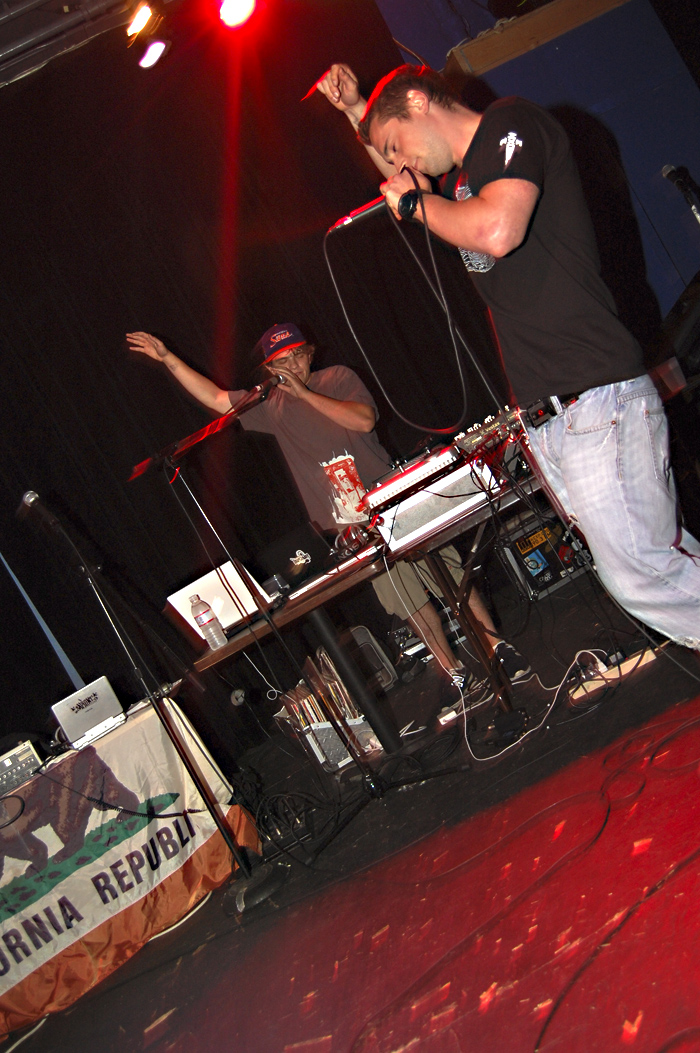
The Mustard Seed is the kind of bare-kneed chug-joint bar you’d expect to find in a muddy ditch in Everett, not in the plaque-free heart of downtown Bellevue. But this makes it the perfect place to talk with local hip-hop duo Rudy & the Rhetoric about their debut album, The Gutterbrook (available Dec. 19), because a juxtaposition similar to the one between this gritty dive bar and its pristine surroundings exists for the boys and their music: They look like the suburban white kids from Bellevue they are, but their songs sound like they sprang from the demented minds of the suburban outcasts who booze at the Mustard Seed.
Imagine that Eric Harris and Dylan Klebold hadn’t stalked the hallways of Columbine High School with shotguns, but instead vented via a dark form of hip-hop. Now you have a sense of the dastardly deeds contained on this disc.
Yet Andrew “Rudy” Willingham and Jon “Rhetoric” Everist haven’t made a self-conscious paean to doom and gloom with all the subtlety of a grindhouse flick. (If that’s how they played the game, then they probably wouldn’t have gotten a mention as the “Best Music on Campus Woodie” in ’07 by mtvU.) There’s something else going on in these songs about psychological torment, zombies, and the hypnotized gaggle of humanity that’s deeper and more ambitious than mere scares and spooks.
In large part, this is because Willingham and Everist take from hip-hop what they need and shun what they don’t. The result is a monster mash of industrial, electronica, and metal overlaid with opaque but effective lyrics that, save for one track produced by the Gigantics, is all theirs.
Sequestered in a corner booth inside the Mustard Seed, Everist and Willingham explain the origins of Rudy & the Rhetoric as after-work stragglers trudge in and out. Although they’d met playing football for Bellevue High School, it wasn’t until the two entered college that Willingham began producing. Once he got his confidence up by his sophomore year, Willingham convinced a skeptical Everist (who had taught himself to produce and play drums before they’d even met) to write lyrics and rap over his beats. The result was a party-hearty album that worked for the college scene but didn’t head in the diabolical direction they really wanted to go.
Producer Rob Castro—whose Beacon Hill ATB Studios serves as a hub for many locally based hip-hop acts—says that when this duo called Rudy & the Rhetoric first came to his attention, “they didn’t really know much about recording in a studio.” So he showed them techniques, such as “how to get your drums to crack a little harder” and other tricks of the trade, to polish their sound.
The lessons and their effort paid off: Willingham and Everist learned both how to work together and, crucially, what worked musically and what didn’t.
Other than the four tracks on The Gutterbrook Everist produced alone, the creation of a track usually begins with Willingham searching for “really weird album covers,” especially from soundtracks and vintage electronica, in order to find an appropriately oddball sample. Once he makes a selection, Willingham will sometimes loop the sample directly (“If it’s an awesome loop, I owe it to the song,” he explains). Most of the time, however, he chops it up, lays drums over it, and then sends it to his partner.
If Everist doesn’t like it, then Willingham trashes it, but if he does they move forward, with Everist using his instrumental and production background to guide Willingham as he further develops the beat, suggesting additional layers until it becomes organized sonic mayhem reflecting Willingham’s primary influences: Radiohead, Tool, Nine Inch Nails, and Portishead.
Willingham confesses: “If I didn’t have Jon to give me suggestions, I would be a significantly worse producer.”
Once the production is completed, Everist starts writing. “Usually I just turn the beat on and start free-styling in my head just to get the kind of flow that I want for that song,” he says. And then, sometimes as much as two months later, he’ll return with the lyrics.
In many ways, the quasi-title track “Gutterbrook (Petulance)” embodies the force of Willingham and Everist’s ambitions and talent. It opens with what sounds like piano and violins and whispers before unleashing a full-frontal assault of synthesizer for the first half that Everist blitzes with his no-nonsense vocals. He says “gutterbrook” stands for an “amalgam of foolish people all traveling down the same path,” and it’s worth quoting the first verse at length, as it’s a good indicator of his lyrical style:
“Laser beam stress in my breath/I grind teeth/Cash calf resident spent/I smell beef/Message from the ‘plex reach the mind, dystopian confined in the flesh—hold breath grit teeth/It’s the Gutterbrook/All aboard the inimical mother-ship/Neon vagabond automaton will still your troubled look/I know I’m scratching etches in this history like on a corner screaming at the sky, and who will listen?”
On the page the lines may read as self-consciously cryptic. But just as Willingham and Everist complement one another in the creation of their music—giving and taking until the track is done—so too do the production, lyrics, and delivery, banding together in (un)holy matrimony. In other words, the songs sound like they went through a process developed by artists committed to the same aesthetic.
Similarly gloomy tracks include “The Graves Are Empty”—a zombie narrative permeated by an electric guitar riff, gun blasts, crashing glass, and evil chanting—and the metallic whoosh of “Bladerunners,” which features the album’s only guest MCs, Grayskul’s JFK and Onry Ozzborn.
Light and levity come in the unlikely forms of “Scurvy” and the bellicose banger “I Kinda Wanna Punch You in Your Stupid Face.” Such tracks give The Gutterbrook a sense of balance, reflecting an understanding by the parties involved that night must eventually turn to day.
And to their credit, Willingham and Everist know they’re the ones ultimately responsible for the album’s success or failure—and that’s just how they want it. “We’re completely in charge of the direction we wanna take,” says Willingham. “I just really wanted to stand out.”


 E-Wallet Purchase (Add Funds)
 Term Subscription