Jack Helsell’s property, located just past West Sound on Orcas Island, looks something like a 19th-century agrarian utopia. The house was built of timbers cut at Helsell’s own sawmill. Horses handle the plows, and Helsell’s wife, Jan, cooks on a wood stove. There are chickens, sheep, geese, a handful of horses, and a husky-mix named Chief. In a barn just south of the house sits a collection of old buggies in various states of disrepair.
On a recent afternoon, Helsell idles his pickup truck just past the barn and walks up to the mill. His sawyer, Benjamin Nuñez, is struggling with the clutch on a dump truck. Helsell watches him for a minute.
“He’s the best worker I’ve ever had,” Helsell says.
The truck safely parked, Nuñez hops down and introduces himself.
Nine years ago, the lanky, crooked-nosed Nuñez struck out from Guerrero, his home state in Mexico. In his pocket was the cash he had saved over 11 years. At Mexicali, he says, he paid a coyote (a people-smuggler) $700 to sneak him into the U.S. Once stateside, he got papers and made his way up to the San Juans, where Helsell hired him. Helsell says his lead sawyer at the time—an American—was lazy, but that Nuñez worked like an ox. When the American quit, Nuñez took over.
The beginning was rough—and Nuñez is missing the tops of his right ring and index fingers to prove it. But he soon mastered the work. The key is to get the most lumber out of each log, Helsell says. A sawyer needs to size it up and look for shape—whether it’s tapered, whether it has large knots, or whether a pitch seam has the potential to ruin the lumber’s integrity. “If he’s not good, he wastes lumber and cuts inefficiently,” Helsell says. “There’s a real art to it.” And there’s not many people left that can do it. Large mills such as Weyerhaeuser use scanning equipment that tells the sawyer where to cut, Helsell says. Those guys sit in a booth.
These days Nuñez runs all the equipment on Helsell’s property: the loader, the excavator to clear a pond (best topsoil on the island, Helsell says), the dump truck, and, most important, the sawmill. He does twice the work alone that he and the other sawyer had done combined, according to Helsell.
But working for Helsell isn’t Nuñez’s only job. He also helps care for an elderly woman named Natalie White. At 80, she still lives on a farm on Orcas Island, along with two dogs, 17 cats, two guinea pigs (she used to have 150), 12 raccoons, and a herd of deer. She says Nuñez spends about an hour a day feeding everybody, watering everybody, and cleaning out the occasional litter box. He also changes light bulbs, tends her vegetable garden, weeds her flower garden, and mows her grass.
When White had a stroke on March 3, paramedics wanted to airlift her in a helicopter, but White refused. “I get deathly afraid of heights and I figured if I went up, I’d have another stroke or a heart attack and that would end the whole thing right there,” she says.
Eventually, she talked the paramedics into letting Nuñez drive her to the mainland. He packed a bag for her (“I told him to get my pajamas because I don’t like hospital nightgowns”) and off they went. At the ferry dock, workers loaded Nuñez’s car last so that White could access the elevator to the second floor more easily.
White says that once the boat docked in Anacortes, Nuñez led her down the elevator, loaded her in his car, and started the engine. They were the last car off the ferry. As they drove off, Nuñez saw the Border Patrol agents.
“They’re going to get me,” Nuñez told White. “Don’t be afraid.”
On Feb. 29, Joe Giuliano had ordered his officers to set up a checkpoint to stop passengers from the San Juan Islands as they disembarked at the ferry terminal in Anacortes. Giuliano, the Deputy Chief Patrol Agent of the Blaine Sector of the United States Border Patrol, had received reports from his superiors in Washington, D.C., that terrorist organizations were exploring the possibility of using established smuggling channels to bring their own trade to the United States. One of those channels, Giuliano worries, is San Juan County.
For generations, law-enforcement officers have struggled to patrol the archipelago; the miles of rugged coastline provide a foothold for those who wish to forgo the formal international entry into the United States. Giuliano recognized that anyone who landed on the islands illegally would have to take a boat or a plane to get to the mainland. To help plug the gap, he ordered his officers to check cars and passengers coming off the boat in Anacortes for signs of trouble. But Giuliano knew the checkpoint was likely to sweep up more than just terrorists. There is a population of undocumented immigrants on the islands as well. And Giuliano, the son of an immigrant himself, knew that they too were likely to be caught in the sweep. He was right. Officers arrested six undocumented aliens that first day. Within two weeks, they caught 18 more—one of whom had a criminal record. They detained no terrorists.
Many of those aliens have since gone underground. And the crackdown hasn’t been warmly received by many of the island’s affluent white residents either—especially those in the hospitality and construction industries. On March 18, the San Juan County Council held a meeting in Friday Harbor and invited Giuliano to speak. Two hundred people tried to pack the 49-person meeting room. Those who couldn’t squeeze in watched on closed-circuit television in the lobby. Giuliano took the podium and addressed the crowd:
“I’m here in full anticipation that we may agree to disagree, but the questions have been asked and I think they deserve an answer,” he said. When Giuliano talks, he doesn’t use government official-speak. He talks like he’s eating breakfast at your kitchen table. Using that voice, he explained to residents the history of the Border Patrol—its authority, its mission. He described how, on the southern U.S. border, checkpoints have been in use for years, and that the idea up here is not so much to catch undocumented immigrants as to dissuade terrorists from using the islands as a staging area. He also said that if the islanders want a change in government policy, they should convince their congressional representatives.
Then it was time for the citizenry. Adam Farish, owner of the Outlook Inn on Orcas, declared: “I represent a large group of people on Orcas Island who feel the same way I do, and I will say we don’t fear al-Qaeda, we don’t fear illegal Mexicans in our community, we don’t fear much of anything at all, but we do fear the government of the United States coming into our community and threatening our way of life.” More than 20 people spoke that day and all but two opposed the checkpoint.
“We’re fully wanting to stop terrorism, but we’re not willing as citizens of the United States to continually give up more and more of our freedom to move around faithfully and freely in the United States of America,” said Kelley Barcomb-Bartok, a Friday Harbor town councilmember, in a later interview.
San Juan County, with 15,000 inhabitants, is perhaps the most isolated in Washington. There are only 175 square miles spread among 176 named islands. The majority of residents live on San Juan, Lopez, Orcas, and Shaw Islands, but there is a smattering on others as well. The people who call the county home are predominantly wealthy (the county is second in the state in per capita income as of 2006) and white—93.7 percent. But over the years a community of immigrants, mostly Mexican, has folded into the area. The border patrol won’t estimate how many are undocumented, nor will residents.
“Understand why,” says Steve Garrison, a retired businessman, Dallas transplant, and vocal supporter of the immigrant community. “If my guesstimate was higher than [U.S.] Customs and Border Protection’s analysis, then we could see an increase in checkpoints. If it’s lower and I say it’s higher, then I’m causing a lot of pain and stress.”
At the checkpoint, White recalls, three officers approached Nuñez’s car. When they asked him his citizenship, Nuñez didn’t lie. “Mexico,” he said.
“No,” he also told the officers, “I don’t have any papers, but I’m driving her to the hospital. She’s had a stroke.”
“Well,” the officers told White, “you’ll have to drive yourself.” This, White says, would have been impossible—even if she’d been in her own car. “My whole left side felt like a wet noodle.”
“Well,” they told her, “just go ahead and try to drive.” Then one of the officers decided he would take White to the hospital himself. On the way there, White says, the man opened up a bit.
“I’m sorry, Mrs. White,” she says he told her. “I don’t really think this is a good idea either, but it’s my job.”
White went into the hospital for three days. Meanwhile, Nuñez was shuffled among holding facilities in Bellingham, Blaine, and finally Tacoma. Helsell hired a lawyer, who rounded up bail for Nuñez and got him sprung about the same time White was released. His court date is in July. On that day, a judge will decide whether Nuñez stays on Orcas or returns to Mexico.
Now, Helsell says, Nuñez just “helps him out,” rather than being an official employee. (Nuñez is under orders not to work and Helsell not to pay him.) Helsell says he could limp along for a bit without Nuñez, but would probably have to shutter his mill for good.
White fears that if Nuñez goes, she’ll have to move into a nursing home with “a bunch of old ladies who wet the bed.”
Nuñez and Helsell stand in the shade of the dump truck, brainstorming. They’ve thought of everything: Adoption could be a possibility, but Nuñez, at 32, is too old. Helsell would sponsor him for a work visa, but it may be too late. What else? Asylum might be a possibility—Nuñez’s mother doesn’t want him to come back to Guerrero. His time in the United States, Nuñez says, would mark him back home as a target for robbery, probably a fatal one. Perhaps their best option could be Nuñez’s skill set: If Helsell advertises the position in the local newspaper and no one answers, perhaps he’ll have a chance of keeping him. Nuñez kicks at a rock and looks up at a visitor.
“Do you have any ideas?” he asks.
Back in the pickup truck, Helsell watches Nuñez amble toward the mill.
“I’m 84 years old,” he says. “It took me nine years to train him. I don’t have another nine years.”
There is no law regarding checkpoints. Rather, as Giuliano explained at the meeting, the Border Patrol can erect one because legislation doesn’t specifically prohibit it.
The issue came to a head in 1976 when Amado Martinez-Fuerte, a green-card holder (i.e., a lawful resident), picked up two Mexican women in San Ysidro, Calif., who had entered the U.S. illegally. At San Clemente, 66 miles north of the international line, they hit a Border Patrol checkpoint. The two women admitted they’d crossed illegally, and Martinez was charged with two counts of transporting illegal aliens. His lawyer moved to have all evidence suppressed. He argued that Martinez-Fuerte’s Fourth Amendment rights had been violated when he was stopped at the checkpoint. The case went all the way to the Supreme Court, where the justices ruled 7-2 against him. Their reasons: First, requiring that border-patrol stops be based on reasonable suspicion is impractical—traffic passes too fast. Second, the government’s interest in making checkpoint stops outweighs the limited intrusions on Fourth Amendment protections. Since then, checkpoints have been OK. There are dozens of permanent ones along U.S. highways near Mexico. Everyone is required to stop.
The checkpoint in Anacortes is only active sometimes, and there is no consensus among the populace about it. In fact, if a poll on Sanjuanjournal.com is correct, islanders are evenly split. The journal—the local publication in Friday Harbor—posed the question, “Should citizen spot-checks on U.S. ferries continue on domestic ferry routes?” On April 3, the vote was 147 “yes” and 146 “no.” The question has since been removed.
Among the opponents is Tamara Joyner, a public-health nurse with the federal Infant/Toddler Early Intervention Program. She says illegal immigrants’ children, who are themselves U.S. citizens, will have trouble getting medical attention they need because of the checkpoints. She recalls a child who arrived at her office recently with severe hydrocephalus, or water on the brain. The treatment, which involves draining the fluid into the child’s neck or thigh, isn’t available on the island—and it also requires parental consent. In this case, she says, the parents risked deportation by leaving the island and attending several medical appointments during one whirlwind day.
“The federal government is funding me to help those kids,” she says. “It’s also funding the agencies that are denying them help.”
Since the checkpoint went up, 49 illegal immigrants—virtually all of them Mexican—have been detained there, according to the Border Patrol. What their fate has been since is difficult to know. The Border Patrol won’t release their names, and once they’re detained, they’re turned over to Immigration and Customs Enforcement, which is barred by U.S. privacy laws from releasing any information either.
Local Mexicans have “gone to the mattresses,” says Garrison, the Orcas retiree. “We can’t even get them to talk to us,” he says. “There’s no way they’re going to talk to you.”
The detentions, and fear of them, are also weighing heavily on local business owners.
“All week, I’ve been working on a job where I need a guy to pick up brush and debris,” says Jeff Bossler, a long-haired, long-bearded, soft-spoken man who owns a nursery on Orcas. “The Hispanics who are here are swamped because the other ones have been picked up.”
Bossler is having to make his own supply runs to the mainland because wholesalers won’t bring him flowers (or anything else) anymore—they’re afraid of having their own drivers busted. “The only people they have to deliver are Mexicans,” Bossler says.
One nursery owner on the mainland, who did not want to be identified, corroborates the statement. He lost an “excellent” worker, he says, when the man went to the San Juans on a vacation with his daughter. “He didn’t show up to work Monday, and I heard later from one of his friends that he was arrested by the Border Patrol,” the owner says.
So will his business deliver again to the islands?
“Hell, no,” the owner says.
Bossler’s drives cost him time and money, which ultimately comes out of the customer’s pocket. “I charge for it, but it sets me behind,” he says. Since the checkpoint went up, Bossler says, he’s had to raise his hourly rate from $30 to $35. He charges $240 as a base fee for landscape work done on the mainland. He used to charge $180.
The work’s getting done, but his days are “extra long and hard,” he says. “More work isn’t necessarily better. Up to a point, it is. But if it gets to be where you’re never home with your family and you’re tired, it just goes on and on.”
Bossler tosses out names of other construction contractors who he knows are struggling with the situation. But none of them return repeated calls. Bossler understands their reluctance.
“A lot of people won’t talk about it, because if you say ‘X company won’t come out to the islands anymore, or is losing workers,’ what you’re saying is: They hire illegal aliens.” Nevertheless, an acute labor shortage exists on the island, he says. The islands have an inordinate number of retirees, who increase the market for manual labor, he says, and most of the time that work comes from Mexicans who may or may not be here legally.
Meanwhile, the islands’ most important industry, tourism, seems to be doing OK. No ferry has been delayed as a result of the checkpoint, says Joy Goldenberg, a spokesperson for Washington State Ferries. And it’s likely none will be. The checkpoint sits perhaps a couple hundred yards up the ferry dock in Anacortes. Giuliano says that if traffic ever backs up onto the actual ferry, his officers have a standing order to open it up and sweep everyone through.
Six weeks after the meeting on San Juan, Giuliano shows up for a similarly angry gathering at the Eastsound Fire Station on Orcas. Again the San Juan County Council has invited him to explain the checkpoint and answer questions, and again the meeting room is packed. Natalie White is in attendance.
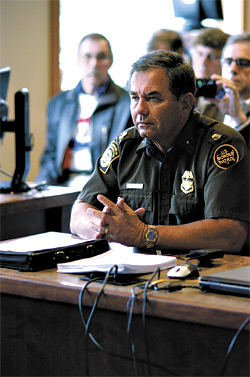
A little after 2 p.m., Giuliano walks in. He’s 63, but looks 10 years younger. He’s been on the border since 1973, and faces mandatory retirement in two years. When that happens, he’ll “probably sit in the audience and harass whoever takes his place,” he jokes afterwards. Right now, he’s sitting at a table between the county council and the attendees, ready to answer questions. The mood today is ugly, to say the least: A man in the back of the room, Jeff Felder, a local emergency medical technician, snorts at Giuliano’s answers until it’s his turn to talk. From the back of the room, he engages Giuliano in a broad, booming voice:
“Do I intimidate you, sir?” Felder demands. “Do I intimidate you?” He takes a few steps closer despite meek protests from council chair Howard Rosenfeld. “How dare you!” Felder screams. He goes on to describe how he and his daughter were stopped at the checkpoint and how the agent pulled a baton on him, despite (and here he yells) his Fourth Amendment rights. Giuliano doesn’t move, doesn’t flinch. His toe begins tapping, and by the time Felder is done it’s beating rapid-fire against the floor. His answer, however, is stoic: He reviewed the tapes, he says calmly, and he’s sure that if Felder were to complain about his treatment, it would…well, it would come out the way it’s supposed to. Felder yells some more about Fourth Amendment rights, and when he’s done, many people clap and cheer for him.
Another man has listed his name as John Doe, “exercising his right to not identify himself at a public meeting,” he explained. When it’s his turn to talk, he wordlessly hands Giuliano a written message with two questions, which Giuliano reads aloud. The first one asks if he, John Doe, looks Hispanic. Giuliano says he doesn’t. The second question asks what happens if this confrontation happened at a checkpoint. The agents would probably run as many checks as they could, Giuliano says, and if everything seemed on the up-and-up, he’d be waved through.
The questions continue for three hours, but Giuliano never shows frustration or anger. Some people are polite. Some aren’t. Natalie White tells Giuliano the checkpoint is stupid, prompting cheers. A lawyer argues the constitutionality of checkpoints, a woman complains that she has been treated discourteously, and a representative of the local ferry committee asks Giuliano if he’d be willing to work to find alternatives when traffic builds up during the summer. (He is.) Others accuse the Border Patrol of racial profiling. The questions are very similar to those asked at the Friday Harbor meeting nearly two months before. So are the answers.
After the meeting, the Border Patrol is checking passengers in Anacortes.
“How are you today?” the agent asks.
“Great, yourself?” I say.
“Good, are you a U.S. citizen?”
“Yup.”
“Have a nice day.”