Back in the 1960s, as he put himself through college by playing piano in New York nightclubs, Howard Levine’s life was a Gershwin tune. By 2007, it had become a Warren Zevon song: Send lawyers, guns, and money. The shit has hit the fan.
Not that you couldn’t have predicted it. The onetime abortion doctor became the Internet’s Dr. Viagra, then attempted to extort a half-million dollars from Jack in the Box, and moved on to selling steroids to gay clients at his neighborhood coffee shop.
“If you are available tomorrow (Monday) evening after 5:30,” typed one of Levine’s Seattle e-mail customers last year, “then we can meet at the regular Starbucks. I can have the cash in an envelope if that works.”
Levine’s Washington state medical license, which he has held since 1982, has been suspended three times and reinstated twice in the last eight years; among other complaints, some patients said his doubtful surgical skills sent them hurrying to the emergency room for repairs. Yet, with revocation considered something of an electric chair reserved for supremely heinous doctoring, the medical disciplinary commission has yet to pull his physician’s license.
But don’t call Levine in the morning: The short, bulky, and graying doctor is literally not free to practice at the moment. In February, Levine appeared briefly in handcuffs before Judge James Robart in Seattle’s Federal Courthouse, where he was sentenced to prison for almost two years.
Levine had pleaded guilty to a single count of illegal steroid trafficking, one of thousands of mostly Internet-based steroid sales he made to customers across the United States since at least 2004, prosecutors say, including some to undercover bodybuilders from the Drug Enforcement Agency. During that time, the medical watchdogs hadn’t been barking, and the feds were especially patient, buying drugs from him for almost two years. Their nearly $7,000 in undercover purchases over 22 months likely helped Levine stay in business until August 2006, when a SWAT team arrived at his Seattle home.
There he was arrested and forced to close his Capitol Hill office—but not indicted. That wouldn’t happen until June 2007. In the meantime, as a licensed physician, Levine continued to traffic in steroids and other drugs from his house on a tree-lined street near Seattle University. He was also apparently cooperating with the feds to build a case against his suppliers, and in court records said he had an “agreement” with the DEA to keep his license. Officials at the state Medical Quality Assurance Commission in Olympia say they were aware of the investigation, but didn’t suspend Levine’s license until he was indicted in June 2007.
It appears no one thought Howard Levine, whether at his office or at home, was much of a threat to society. But when it came time to sentence him this year, federal prosecutors, in court papers, complained he had “no regard for the health of his customers” and had to be locked up immediately to “at least protect the public during the period he is incarcerated.”
The DEA doesn’t want to talk about the case, while the U.S. Attorney’s office claims Levine was an incidental combatant in the war on drugs. “His case was part of a national effort,” says prosecutors’ spokesperson Emily Langlie. “And as often happens, in order to protect a larger case, you sometimes have to not move in on an individual target as quickly as you might otherwise….It’s always a balancing act.”
In the end, it appears Levine effectively blew the whistle on himself. That happened last June 17, Shit-Meets-the-Fan Day (also Father’s Day), when Levine’s 20-year-old son called police to the doctor’s drug-strewn house on 14th Avenue, where the 58-year-old Levine was threatening suicide. Officers restrained him, and would later report that when asked how he might kill himself, Levine told them, “I have the means.” Indeed, a police inventory turned up thousands of pills and drug vials around the house. He wound up in a mental ward, committed for 14 days at Harborview Medical Center. At the hospital, a toxicology screen showed he’d shot meth and swallowed uppers and downers.
At that point, he’d lost his practice, possibly his mind, likely his freedom, and maybe his house (subject to drug-seizure laws). It began to look like the doctor wasn’t much better at crime than he was at medicine.
Levine clearly wasn’t putting up much of a front. “Howard did not try to become wealthy from what he was doing,” says a friend, Michael J. Hobbs. “Honestly, would a drug kingpin be driving a 1990 Volvo?”
And do real doctors keep a pool table and booze in the exam room?
“I have always found him to be a man of integrity in his dealings with other people,” says ex-patient Fred Bard. “Just because he made some judgmental errors, I will not stop being his friend, and I try to support him emotionally at a very bad time in his life.”
But, Bard adds, after three decades as a doctor and drug dealer, Howard Levine is finally washed up. Not that he couldn’t go to prison and start over. He’s donethat before.
His friends could almost see the crash coming, and the doctor might have seen it too but for the haze in which he practiced medicine—induced by pills, powder, needles, alcohol, and severe mood swings. Brooklyn-born, Levine earned a B.A. in biology in 1969 at Queens College, paying his way as a pop pianist at some of Manhattan’s top clubs. He completed study at New York Medical College in Valhalla and was first licensed in 1979, practicing in New York and California before opening the Women’s Health Care Center in Seattle in the early ’80s.
There he did abortions, but not always well. According to State Department of Health records, from 1991 through 1998 at least nine patients accused him of violations ranging from verbal abuse and refusal to don surgical gloves to perforating the uteruses of several patients who later required emergency surgery—in one case, a lifesaving hysterectomy. The complaints led to a suspension by the state medical commission, although the order was immediately stayed if he gave up his gynecology practice.
During that decade, Levine and his wife, with an adopted child, divorced. By 1999, he had reinvented himself as both a gay man and as Dr. Viagra, becoming one of the first physicians to peddle the erectile dysfunction drug over the Internet (he also charged $75 for an “online consultation”). That practice, which in this state requires in person consultation, was shortly shut down by the state because Levine, officials said, had not established a physician-patient relationship with some of his unseen clients. He was also sued by Kansas officials for selling Viagra to a teen; though he won the suit, it was a costly defense.
That was when Levine turned to Jack in the Box for sustenance, devising a cash-flow plan that even his attorney admitted was bizarre: One day, in 1999, he phoned an executive of the fast-food corporation in San Diego, threatening to sue and go public over an allegedly spoiled chicken sandwich he’d purchased.
“Write me a check for $500,000 and I will swear to you I will destroy any lab reports, any pieces of chicken that may be in my freezer, and you will never hear from me again,” he said in the call, which was taped. Most, if not all, of the story was made up, and Levine was convicted of extortion and wire fraud. In 2000, as he went to prison, the state suspended his license for the federal conviction and for improper Viagra sales as well.
Released after serving 21 months at the Federal Detention Center in Sheridan, Ore., Levine’s medical license was reinstated in August 2002, but he was placed on three years’ probation and barred from supplying medicine to Internet customers. (He was also on three years’ federal court probation for the extortion.)
How did Levine dodge license revocation? The state medical commission uses a graduated system of discipline—”the least restrictive action to correct behavior or performance,” says Health Department spokesperson Donn Moyer. “The discipline history on this practitioner,” he says of Levine, “shows that he would be sanctioned for a certain behavior, then would change and come under scrutiny for a different kind of violation. It’s unique.”
.Within a month of his reinstatement, Levine had opened a private “lifestyle” practice just off East Madison Street in Seattle, in an office renting for $2,300 a month, where he would eventually dispense steroids via cyberspace.
It was not a typical doctor’s office. Along with the pool table in the exam room, Levine kept beer in the office refrigerator—both a big hit with some patients. “A pool table is a lot better way to pass the time than reading 10-year-old magazines,” says friend Fred Bard. “And besides, how many other doctors keep a bottle of Scotch in their desk drawers?”
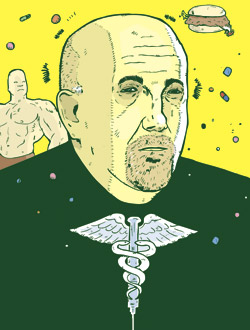
Bard fondly recalls the balding, goateed Levine as “a gay, opinionated New York Jew,” something Bard, 51, from Long Island, considers himself to be as well. “He and I are friends; we never dated or were in any way romantically involved,” says Bard. “But a lot of his clients were from the Seattle gay community, where he lived and worked.”
Living mostly off credit cards, Levine hung out his shingle as the proprietor of Northwest Lifestyle Medicine. His Web site offered clients the opportunity to “slow down and even reverse many of the effects of aging,” as well as to “look better, stay healthier, get more out of exercise.”
He planned to specialize in hormone supplements and Botox treatments, in what his Web site described as “a remarkably comfortable non-traditional environment.” But he wound up mostly supplying steroids and human growth hormone, priced at several thousand dollars for some orders, to customers who included bodybuilders hoping to pump up for the crowd at the bar. For example, a large order of a steroid called nandrolone decanoate (known as Deca) and testosterone cost one customer $3,000.
Levine’s attorney, Jan Phillip Olson of Seattle, recalls that the doctor’s practice lost money from the start, and Levine saw a better opportunity after attending a marketing conference and learning how to easily obtain anabolic steroids in wholesale quantity. “Eventually,” says Olson, “Dr. Levine had patients that were using anabolics for cosmetic purposes.”
Olson, who says he can’t comment further because of a related ongoing civil seizure action concerning Levine’s home, recounts in federal court documents the doctor’s fall to disgrace: “His credit-card debt was staggering. He began to cut corners…[and] sometimes skipped medically necessary procedures,” such as the requisite in-person consultation with a patient. Levine began selling in bulk to commercial gym trainers who’d resell the drugs to persons unknown. “He became anxious that the relationships he developed with trainers would not result in a sustaining referral network unless he more freely dispensed steroids,” and he began handing them out “when the patient simply requested them to ‘feel better.'”
Levine, says Olson, “admits that he began dispensing bodybuilding patients bottles or syringes of anabolic steroids…without an identified need in every case. He knew the substance would probably be resold in some cases.”
Levine’s most popular cure-alls proved to be Deca and testosterone, which are injected into the body to build muscle mass. The federally controlled Schedule III drugs (or “gear,” as users call them), like all steroids and human growth hormone Levine sold, have legitimate medical uses: Bard, for example, is a death-defying AIDS patient, first diagnosed back in 1982. Anabolic (tissue-building) steroids and growth hormones made a healthy difference in his blood work and cell redevelopment. “I personally referred several HIV-positive friends to [Levine],” says Bard.
But steroids can also be the heroin of the professional and amateur athlete or bodybuilder who stacks (i.e., combines) similar drugs in an attempt to bulk up and gain a competitive edge. Abuse or misuse of the drug can be damaging if not lethal. Professional wrestler Chris Benoit, who often appeared in Seattle-area matches, was thought to be experiencing a maddening case of “‘roid rage” when he strangled his wife and child before hanging himself last year in Georgia.
Side effects for what are typically but not exclusively male users (see: Marion Jones) include the risks of shriveling testicles, hair loss, liver damage, impotence, and the production of breasts—or “bitch tits,” as juicers call them. A determined injector can stick himself in the glutes or thighs a dozen times weekly on a regimen to add 50 pounds or more of bulk.
Star athletes found using performance-enhancing drugs can face disciplinary action, fan ridicule, and, as in the famous case of home-run king Barry Bonds, who allegedly lied to a grand jury about such drug use, federal indictment. But their careers aren’t necessarily over: The 80 players named in Major League Baseball’s Mitchell Report on steroid abuse last December were all recently given clemency by MLB commissioner Bud Selig. Among them were a dozen onetime Seattle Mariners, including now–St. Louis reliever Ryan Franklin, as well as slugger Jose Guillen, who today bats cleanup in Kansas City.
No well-known sports figures emerged as Levine’s customers, according to court and police records. He was licensed to prescribe steroids, but not to package, as he did, vials, pills, and needles bought at discount bulk rates and send them off to clients.
With his credentials, Levine could promise expert advice and give a drug deal an air of legitimacy, even if he was selling controlled substances to “patients” he’d never fully consulted or assessed. He developed casual relationships with some of his e-mail regulars from California, Texas, and New York. “I need to have enough to cover my workouts, babe,” an Illinois customer said in his e-mailed order for two steroid products. “Note: My wallet was stolen from the gym the other day….This is my brother’s [credit] card.”
An eye-to-eye visit was optional, depending on method of payment. Responding to a customer who ordered $355 in testosterone, Levine e-mailed, “As far as payment, you can use PayPal if you like….If you want to do cash, I can see you and at the same time I can give you the syringes and needles you will need.” Another customer, who would meet with Levine at Starbucks, wrote on behalf of a buddy: “I told my friend about the injection to bring your balls back, he didn’t know about it.”
Levine fooled himself into believing his cyber-sales wouldn’t be detected by the law, says attorney Olson. Federal agents, first alerted by a criminal informant, went to Levine’s Web page and began sending their own e-mails. Undercover agents also began going to his office on East Olive Street in 2004. They said they received no medical consultations, and told Levine they intended to resell the drugs on the black market. Not a problem, the doctor said.
He “engaged in this dealing knowing full well of the danger faced by people using these drugs,” prosecutors would later say in a sentencing memorandum. Yet by their own count, DEA agents made 16 purchases worth $6,983 total from 2004 to 2006, seemingly ample time to make a case against a doctor who was on federal parole. There were also the 10 months Levine later prescribed and dealt drugs from his home, his license enabling him to work with a California druggist to fill some of his orders, according to a separate investigation by Seattle police.
State and federal officials won’t specify the greater good they were supposedly seeking in not stopping Levine earlier. Sketchy court records say only that after Levine was indicted, he met with prosecutors and the DEA to provide information on a case in Alabama “concerning ordering practices of a particular pharmaceutical company located in that district.” He also agreed to be a witness in any case brought against the company.
The state medical commission also had him in their sights at the time. In January 2006, Levine was brought up on charges for failing to pay a fine and attend medical-ethics classes as required by the extortion disciplinary action. On June 1, 2006, he was censured by the state after paying up and attending classes, records show. Three months later, in August, he was arrested by the feds for the Internet steroid sales, andthe nextyear rearrested and indicted.
“We worked in cooperation and coordination with law enforcement leading up to Levine’s arrest in June of 2007,” says spokesperson Moyer. “And his physician’s license was immediately suspended.” That was about three years after the feds had begun their probe of Levine.
The June suicide threat was the final meltdown of a doctor who’d once been the toast of his med school, where Levine won an ob/gyn departmental award as one of its top doctors. His criminal motivations were a riddle, but his actions weren’t without causes, according to the Harborview psychiatrist who saw him after he was involuntarily committed. Levine was a man with a head full of chemical and mental health issues.
“He is grandiose, intellectualizes, rationalizes, minimizes, and evades answering specific questions,” Levine’s psychiatrist wrote in a report. “He exhibits pressured speech, some mumbling. He is circumstantial and tangential, but more of an evasive pattern than a disorganized one. He endorses anxiety, paranoia, and fear regarding the possibility of him going to jail, not being able to work, and losing everything financially that he has worked so hard to build.”
In the hospital interview, Levine recounted the initial August 2006 steroid-related arrest in which agents and a SWAT team stormed his home. “He has been implicated in some ethical misconduct concerning prescriptions of anabolic steroids, testosterone, and growth hormone,” the psychiatrist’s notes state. “He has an intact WA license, but he is not practicing due to an ‘agreement’ with the DEA. He describes [post-traumatic stress disorder] symptoms regarding that event with horrible flashbacks. He described the SPD responding to his son’s 911 call as a ‘horrible replay’ [of the earlier SWAT invasion].”
Levine said he was crashing financially, almost all his family relationships had slipped away, and he’d recently resorted to having sex with multiple partners. His late father, he said, was “a real manic-depressive.” (The father, according to Levine’s attorney, was at one point treated with last-resort electroshock therapy.) Levine described his own mental swings, from dark inertia to energetic bursts of clarity.
It was clear, the psychiatrist wrote, that Levine’s history of mood changes and impulsive behaviors was in part the result of an undiagnosed mental issue: he was bipolar. Friends would later call this diagnosis a defining moment, flashing back to the irrational fast-food extortion attempt and his steady collapse thereafter. An earlier discovery of a manic-depressive disorder might have steered Levine away from a lot of bad choices, said Levine’s attorney. “The impulsive acts in his background,” Olson contends, “are directly attributable to an untreated condition.”
Unfortunately, part of Levine’s solution became part of the problem when he started to self-medicate with a small pharmacy of mind-altering drugs, none of them friends of bipolarization: A urine tox screen, wrote the psychiatrist, “was positive for methamphetamines, amphetamine, and benzodiazepines. Mr. Levine endorses use of IV cocaine, methamphetamines, MJ [marijuana], and Stadol [a narcotic pain reliever], as well as daily GH [growth hormone]…and alcohol.” He’d recently had a few mushrooms, too.
Depakote, used to treat manic depression, was prescribed, and Levine was well enough to leave the hospital 10 days later. But—talk about mood swings—he was arrested by U.S. marshals on the day of his release, taken to the Federal Detention Center in SeaTac, and charged with illegal distribution of a controlled substance related to the 2004–2006 sales.
It seemed things couldn’t get worse, but police came through: The City Attorney’s office informed Levine it planned to confiscate his aging, drafty five-bedroom house under the state’s drug-related seizure law. There, police had discovered several thousand pills in unlabeled bottles, along with steroids and narcotics—altogether 28 different drugs. They also recovered receipts for Internet sales, Levine’s computer, shipping products, and a credit-card machine. In one three-month period, evidence indicated, he’d written 62 prescriptions, mostly for out-of-state residents. The house, said SPD Det. Linda Diaz, was subject to seizure because it was used “to facilitate the drug trafficking activities of Howard J. Levine.”
Though he was allowed by a court to sell his home last September for $510,000 to help fund his criminal defense, more than $400,000 remains in escrow. A June hearing in King County Superior Court will decide who gets the money. Levine also faces a medical board disciplinary hearing next month, at which his license could finally be revoked. And of course, he’s currently in prison.
For Levine, it’s down to bad luck or no luck at all. How did Zevon put it?
I went home with the waitress
The way I always do
How was I to know
She was with the Russians, too?
Some of Howard Levine’s friends remain loyal, however. Theodore White, a University of Washington biomedical researcher, has known Levine for 12 years, and wrote a letter of support to the court. It was important to know Levine was from New York City, he said, “because Howard can be loud and opinionated and has a quick temper, which is also quick to dissipate,” wrote White, who recently said he didn’t want to comment beyond the letter. “That doesn’t fit with people’s style here in the Northwest. Sometimes he rubs people the wrong way and that can get him into trouble. I am also from the East Coast and I see Howard as rough on the outside with a huge heart and a caring soul.”
Another friend, Dr. Irving Cohen of Seattle, told the court that Levine’s mission was “to enhance people’s performance and reduce the problems in aging at fees and a level of accessibility previously only available to the most wealthy of us. Quite obviously, his desire to serve and provide availability led to some excess and poor choices, which led to his current situation.” But Levine has no hidden bank accounts that Cohen knows of, “nor does he have a sumptuous lifestyle. He is quite literally on the verge of bankruptcy.”
In February, Levine was sentenced to 22 months in prison by Judge Robart, along with three years of supervised release during which he’ll also have to undergo drug testing and mental health counseling. Maybe a bit of good luck had returned: Under the sentencing standards, he could have gotten five years. “Dr. Levine appears to have demonstrated remorse for his conduct,” assistant U.S. attorney Mark Parrent said in a sentencing memorandum, “and has been cooperative in resolving this case short of trial.”
Today, Levine is back where he was a decade ago: looking at the world through the bars of the federal pen down in Sheridan, trying to figure out how to start over. “I talked to him the other day. He was depressed, but he can at least see some daylight,” says Bard, who thinks Levine’s prison term is a waste of tax money. “In any serious gym in the country, half the people in it are doing steroids to some degree. Howard thought they were going to get it anyway, and it was better to get it from a trained doctor.”
Of course, he was breaking the law, Bard agrees. But, he adds, “I think they should be thanking him. He educated people about steroid use. He wasn’t trying to get rich, he’s not a guy who ever tried to hurt anybody or screw anybody.”
Will Dr. Levine ever practice medicine again? “Well, I can’t imagine it,” says Bard. “Can you?”