|
A roundup of some of the new names that will shape the arts life of Seattle this season, plus don’t-miss cultural events. Who’s New MacKenzie Bezos Peter Boal (Q&A) David Esbjornson Wier Harman Chiyo Ishikawa Melanie Matthews What to Do Books Classical Music Film Pop Music Dance Stage Visual Arts |
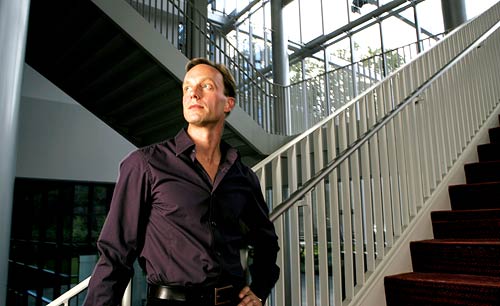
Peter Boal has spent his entire life as a dancer and teacher at New York City Ballet. He takes over Pacific Northwest Ballet from Kent Stowell and Francia Russell, whose craft and aesthetic were shaped more than 30 years ago by the same company. Does this mean business as usual? Anything but.
A dance company is like an impalpable library whose contents are stored in the minds and bodies of the performers—volume after alternate volume of ghostly roles and virtual dances, constantly changing and shifting as one or another volume leaves the shelves or wears out. Somewhere in such a company there must be, like the standard meter stored in its helium atmosphere in a vault in Paris, one who serves as the ultimate touchstone by which all the library’s content is tested.
Even when a newcomer shares as many values with his predecessors as Boal does, his arrival at PNB means that everything to do with the company—the repertory, the dancers, their training—is inevitably going to be measured against a new standard. Unfortunately for stay-at-home Seattle dance fans, that standard is not easy to make out, because it’s inseparable from Boal himself, and apart from the lucky 2,000 or so who’ll attend the PNB gala Saturday, Sept. 17, we locals are unlikely to have much or any chance to see him dance.
We can get some sense of where he’ll take us, though, from the impact his retirement from NYCB last fall had on the public and critics. Though he’s had some recognition—he received a Dance Magazine award in 1996, but only after seven years as an NYCB principal dancer, and his 2000 “Bessie” award was for a guest performance with avant-gardist Molissa Fenley’s company—his gifts seem to have been a bit undervalued until jaded New Yorkers realized they’d soon be without them. In the eight months before his farewell appearances, Boal found himself the object of more plaudits and appreciative analysis of his dancing than he had in the eight years before.
To judge by those tributes, Boal’s dancing is distinguished by its musicality and its purity of line—two of the signal virtues of the style of performance demanded by the NYCB’s resident master George Balanchine. Critic Arlene Croce dubbed this approach “just dancing”—letting music and movement make their point without exaggerating, emoting, editorializing; clothing strength with grace and flair with dignity. Boal probably embodies this ideal as well as any male dancer who ever worked at NYCB.
Far from being old-fashioned, that ideal is probably more influential today than it was 50 years ago, when Balanchine’s mature style first astonished the world of dance. In a way, ballet in contemporary America is Balanchine: Cast an eye over the list of NYCB “alumni” and note how many are heading up American ballet companies (Ib Andersen in Arizona, Suzanne Farrell and Edward Villella in Miami, Daniel Duell in Chicago, Jean-Pierre Bonnefoux, Patricia McBride, and Melissa Hayden in North Carolina, Gen Horiuchi in St. Louis, Helgi Tomasson in San Francisco), not to mention Arthur Mitchell with his pioneering Dance Theater of Harlem and NYCB’s current leader, Peter Martins. Balanchine’s approach to dance and dancing is still a living inspiration. In the 22 years since Balanchine’s death, dancers, choreographers, and audiences have only begun to absorb the lessons of his overwhelming, daunting example.
At Pacific Northwest Ballet, that absorption has been somewhat retarded. Of the nearly 80 works listed as “active repertory” at PNB, 25 were created by Balanchine. But another 18, including all but two of the company’s complement of full-evening ballets, are wholly or partly the work of Kent Stowell. And Stowell’s choreographic style, though couched in the mainstream American ballet idiom ratified by the NYCB, is so different from Balanchine’s as to constitute another dance language entirely. It is an idiom in which grace, fluidity, charm, and personality count for a lot; in which music functions more like a backdrop than a design for dancing. It is in the strongest possible contrast to the musically rigorous, technically exacting, understated elegance of Balanchine’s work, and in the long run, the stretch to accommodate two masters has left PNB’s company stylistically ill defined and out of focus.
Where does PNB go from here? Stowell’s popular and profitable full-length ballets (like Romeo & Juliet and Coppélia) will certainly continue to tent-pole the repertory; but even before the emotional tributes and farewells to Stowell and Russell, Boal has made clear the direction he’ll be steering merely through the new repertory he’s chosen. Three of the four pieces on the company’s opening program are company premieres and derive from the NYCB repertory at its most glorious and demanding. Even more significantly, the first season concludes with Balanchine’s most extravagant tribute to the power of pure dancing, the three-movement, evening-length Jewels, of 1967.
Jewels was a conscious career retrospective for its creator. The first section, to Fauré, paid tribute to the romantic ballet tradition of Paris, where he began his years in the West. The second, to Stravinsky, is hyper-American—”like West Side Story, only better,” opined Joan Acocella—while the finale, to Tchaikovsky, ties Balanchine’s beginning to his ending, with the formality of classic St. Petersburg transformed into glittering 20th-century abstraction. Jewels is an enormous challenge to any company. Even Balanchine’s old company, the Kirov, had problems with its interpretive challenges. Merely by programming it, PNB has stated its ambition to claim an equal place in the central tradition of ballet in the 21st century.
Pacific Northwest Ballet, 206-441-9411, www.pnb.org.