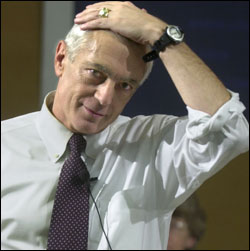
THE GENERAL ELECTION is a mere 286 days away, and the relentless daily need for news outlets to say something new virtually requires horse-race coverage that anoints front-runnershowever prematurelyand then buries them because someone else “has momentum” that the leader is “losing.” It’s sillybut a perfect opportunity for retired Army Gen. Wesley Clark to start “winning.”
Clark joined the race late, as a savior (or at least a running mate) for a weak field. The massive grassroots response for former Vermont Gov. Howard Dean has overshadowed him, but Clark, among the other major candidates, is clearly building the most buzz and enthusiasm on the ground. He’s polled well in New Hampshire, despite two candidates from neighboring states, the sort of can’t-lose horse-race scenario that the media love. And just as you’d expect from a liberal city with a long-standing reliance on the military, he’s the only Democratic candidate other than Dean or Dennis Kucinich stirring many of Seattle’s faithful.
Clark’s perceived strength is the same as Dean’s: He’s not a typical liberal, so he could compete with Bush without being, like Connecticut Sen. Joe Lieberman, Dubya Lite. Moreover, Clark’s obvious strength is Dean’s weakness. Clark trumps Bush in the critical measure of commander-in-chief gravitas. Bush spent Vietnam AWOL; Clark spent decades fighting and leading. Dean was, well, a ski bum. (Hey, nobody ever said Dean wasn’t smart.)
But Clark’s perceived strength as a military man also ought to disqualify him from office.
IT’S A MEASURE of how radically George W. Bush has shifted political dialogue in three short years that Clark could possibly be seen as a “peace” candidate. Because Clark has never held elected office, we can only judge him by his military record and by the carefully crafted public persona he now presents. To get past the Madison Avenue script, one must look at what Clark has done, and what was said about it, before he started running. And Clark’s record is remarkable for its proximity to so many moral low points in a quarter-century of U.S. military history:
*In the 1980s, Clark presided over the incarceration in Miami of Haitian refugees fleeing the odious, U.S.-supported dictatorship of “Baby Doc” Duvalier. That period includes numerous allegations of cruelty and mistreatment of prisoners.
*Clark went from there to Guantánamo Bay, where he was chief of operations of the U.S. Navy’s internment camps and where allegations of mistreatment and abuse grew, including physical abuse and malnourishment.
*In 1993, Clark commanded the 1st Cavalry Division at Fort Hood, Texas, near Waco. His tanks were used in the government’s fatal assault on the Branch Davidian compound. Senior Army officials were part of the planning for that raid, and Clark aides met before the assault with the Texas governor and National Guard head to brief them on possible plans.
*Next stop: head of the U.S. Southern Command, where by 1996-97 Clark was instrumental in implementing U.S. military assistance to Colombia. Paramilitary death squads closely linked with Colombia’s military soon began rampaging through Colombia’s countryside, compiling the worst record of human-rights atrocities in the Western Hemisphere.
*And, of course, there’s Yugoslavia. Under Clinton, Clark became NATO’s supreme allied commander in time to coordinate the bombing of Serbia during NATO’s mission in Kosovo. Serbian officials estimated that more than 1,000 civilians died in a bombing campaign based on dubious claims and which left that year’s designated paragon of evil, Slobodan Milosevic, more firmly in power than ever. His diplomatic performance during his bombing touting KLA opposition figures with dubious human-rights records of their own and sneering at European military, political, and civilian criticswere remarkably Dubya-esque.
During that campaign, syndicated columnist Alexander Cockburn relentlessly depicted Clark as unhinged, criminal, and politically slick. The gist of Cockburn’s various 1999 articles was that Clark presented a very different face to superiors and to the public than he did to the people around him, enabling him to get away with conduct incompetent, erratic, and questionable enough to have ended the careers of other military men.
BUT TEFLON is a critical part of any aspiring American president’s skin. Clark didn’t create the policies that put the U.S. in those troubled placeshe was carrying out the orders of Reagan, Bush Sr., and Clark’s political patron, Bill Clinton. But along the way, Clark was said to have had consistent contempt for civilian life, for the rules of war, and for the law.
This is our peaceful alternative to Bush?
As Bush himself is likely to remind us, there’s no substitute for experience. As he positions himself to harvest that all-important “momentum,” is Clark’s the sort of experience we really want?