Back in mid-Clintontime, it was the fervent hope of liberals, appalled by welfare reform, botched health care, and other ills, that things would be different in Bill’s second term. Clinton, the theory went, would no longer be constrained by the need for re-election and would show his true liberal leanings.
Well, this turned out to be nonsense; Clinton was a triangulating centrist to his core and never pretended otherwise at any point in his political career. But as we wade into the foreboding waters of a second Bush term, last week brought an early indication that Dubya, unlike Clinton, has some scores he wants to settle. We could be in for a long, reactionary four years from an unleashed man who once billed himself as a “compassionate conservative.”
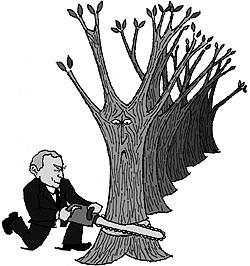
The gesture in question was the rescinding of rules, mostly laid down during the Reagan administration, that provided some measure of environmental protection to the future wood products growing in our country’s 191 million acres of national forests. Two days before Christmas—with the trademark Bush timing that waits for news cycles during which few are paying attention to deliver the worst news—Bush gave the nation’s resource extraction companies a Christmas gift that was more than any of them dared dream possible. No more required environmental impact statements. No more protection for endangered species. No more public comment. For mining and timber companies, the news could hardly have been better.
As with many of Bush’s destructive environmental initiatives, this one was all polished up with the language of environmental protection. The White House claims that its rules change is intended to give local managers of national forests more “flexibility” in deciding how best to steward their lands. But in the real world, where nearly every timber sale on public land is litigated and the national forests are managed by the Department of Agriculture, the changes are an invitation to get out the chain saws. If these rules had been in place 20 years ago, the northern spotted owl controversy would never have happened; the owl would simply have died off. Now, it and various other indicator species are probably doomed.
This brings us to the very relevant question of whether Bush can be stopped, on this or on any of his proposed second-term “reforms” at the behest of corporate America. The national forest rules change brought this rather plaintive e-mail from a reader: “He may be the worst president ever, but I see no resistance, not from the media, not from the politicians, and not from the people who always threaten demonstrations that never seem to happen . . . do you see resistance?”
Well, no, but I do see the possibility of it. Polls consistently show that Americans—all Americans, red and blue alike—want environmental protection. The Bush administration knows this; otherwise, it would not have bothered trying to polish this turd, and it would not have released the news just days before a holiday so as to minimize public outcry. During the two years the administration spent working on these changes, it received nearly 200,000 public comments, the vast majority urging the White House to retain existing protections.
Bush is pointing to his slim electoral win in November as evidence of a mandate for his policies, in the environment as elsewhere. It’s up to the public, us, to prove him wrong. If local forest managers are susceptible to economic pressures from timber companies and the rural communities that rely on them, they can also be made susceptible to pressure from people who want the standards upheld for maintaining healthy and diverse forests.
It’s also not unreasonable to ask that our state’s Democratic senators and representatives step up on this issue. Maria Cantwell, likely facing a tough challenge for her Senate seat in two years, needs to get a spine when it comes to representing the environmental sensibilities of her supporters and her state.
On Inauguration Day, there will be protests, in Seattle and around the country. Do these protests, likely to recur throughout Bush’s second term, accomplish anything? It’s hard to tell. By protesting virtually everything that Bush does, from the war to Social Security to the environment, such demonstrations wind up being about everything and, therefore, nothing. It might make more sense to pick a topic, something that’s winnable, and focus on it, in the courts, in the community, on the streets. The U.S. is not about to abandon Iraq, but forest managers still have the discretion to pay attention to science and to manage forests in a way that preserves vulnerable species and habitat. It has the support of a vast majority of the public. It’s a winnable issue.
All it needs is for the public, and the public’s politicians, to stand up and be counted.