It was called the North Rehabilitation Facility, a nice name for jail. The 300-bed unit of King County’s correctional system in Shoreline was rated minimum security, but there was nothing minimal about the problems that brought its inmates there. Most were serious substance abusers as well as convicted criminals, with discouraging rates of recidivism. “One man while I was there had been to the facility 36 times,” says former NRF administrator Lucia Meijer. “We tried to offer help through education and counseling, but that’s hard to do when the inmate turnover is high, actually harder than in prison, where the inmates are there long-term.”
Meijer was always willing to listen to ideas for improving North’s programs. But when a nurse-practitioner named Ben Turner suggested offering prisoners a 10-day meditation course taught by live-in volunteers, she didn’t think much of the notion. “We would have to create a segregated area for all this meditation, plus housing the volunteers, plus coping with union rules about overtime and contact between guards and prisoners, plus the whole business of sanctioning what I thought of as a religious practice. Ben showed me a video about a very successful prison meditation program in India called Doing Time, Doing Vipassana, but I still thought there were things about it that were so culture specific that I questioned its workability in our situation.
“On the other hand, it was intriguing, just thought of as an exercise in teamwork, bringing together guards, staff, kitchen, etc. There aren’t a lot of programs that can have a noticeable effect in 10 days, and with our high inmate turnover, that was an important pragmatic consideration.
“Then, just about the time I started to get keen on the idea, Ben told me that there couldn’t be a program unless I took a vipassana meditation course myself. Now, it was not in my nature to go somewhere to sit silent for 10 days—a few yoga classes were as far as I had ever gone in non- Western techniques. So I don’t know why I did it, but I did, and it was the most remarkable experience of my life.”
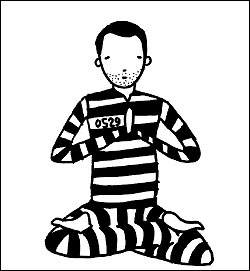
What happens during a vipassana retreat? Externally, nothing. One sits, silent, morning to night (with breaks for exercise and meals), eyes closed, concentrating on nothing more than the mere in and out of breath. At first, “trying to concentrate” is more like it. Ideas, feelings, and distractions pop into the head no matter how hard one tries to ignore them. But after a time—three days is about average, though for some, the moment never comes—a kind of calm appears, often broken by flashes of perception. Desires and distractions don’t vanish, but somehow they cease to matter. They’re happening, and in you, but not to you. You’re in charge, not they.
Meijer’s retreat was not only enlightening for the administrator in her, it was also reassuring. “There wasn’t a trace of religious atmosphere, no trappings, no literature, no recruiting. It was absolutely straightforward, just an absolute laser focus on why I was there. And it was also reassuring to learn that the amount of adjustment we would have to make in or prison routine was minimal.” With volunteers performing most of the work, it was also inexpensive: “The biggest adjustment was providing vegetarian food. Our head cook found himself ordering ingredients he couldn’t even pronounce.”
The first round of meditation at NRF took place just two months after Meijer’s “sit.” It was the first of many, occurring an average of four times a year from 1997 until 2003, when the county closed the facility. “And—this is not for a moment to denigrate other programs we had in play—vipassana had what I thought was a more significant and sustained impact than anything else we tried, and we tried a lot,” Meijer says.
“These people who all their lives had believed that something outside themselves—whether drug, relationship, religion—was going to make everything all right at last, for the first time this experience gave them something from within themselves, something they could do for themselves, finding an ethical foundation for life within themselves rather than just following or fighting rules other people impose on you. We saw inmates become much less needy and resentful and begin taking responsibility for themselves. They became more accessible, easier to work with, more interested in other rehab programs, just generally easier to manage.”
From society’s point of view, the real payoff was “a real reduction in recidivism. We did an internal study, looking at people’s record for the two years before they came to us with two years after they left. Compared to inmates who didn’t have the experience, there was not only a significant reduction in recidivism but in the number of times they were booked. I know the numbers we were working with weren’t statistically significant, but I trust them. That man I mentioned who’d been through North 36 times? He never came back, and he’s teaching vipassana himself now.”
North was closed because it was riddled with asbestos, but budgetary considerations played a part, too. Despite its success, there’s been no attempt locally to build on the program, the first of its kind in North America. But Meijer, now retired and program director for the North American Vipassana Prison Trust, hints that a facility in an Eastern state plans to mount some rounds of meditation this fall, so the idea’s still alive. And, of course, Northwesterners are well positioned to learn vipassana‘s benefits for themselves. The local center in Onalaska, Wash., where Meijer was trained, offers nearly two dozen 10-day sessions a year.
But of course, the number of us willing to give up 10 days out of our busy, fulfilling lives to eat vegetables and sit in silence is limited, especially if it might mean learning that we’re not as busy or fulfilled as we thought. “We are all in prison, all condemned to a life sentence,” said a wise man once. Ironically, it’s those literally in prison who may be best positioned to learn that it’s not just a useful metaphor but literally true.
For more information about meditation in prisons, go to www.dhamma.org/prisons.htm. For more information on vipassana meditation in the Northwest, go to www.kunja.dhamma.org. For more information about the program at North, see Linda Meijer’s article for the July/ August 1999 issue of American Jails magazine at web2.dhamma.org/vnl/AJart99.pdf.