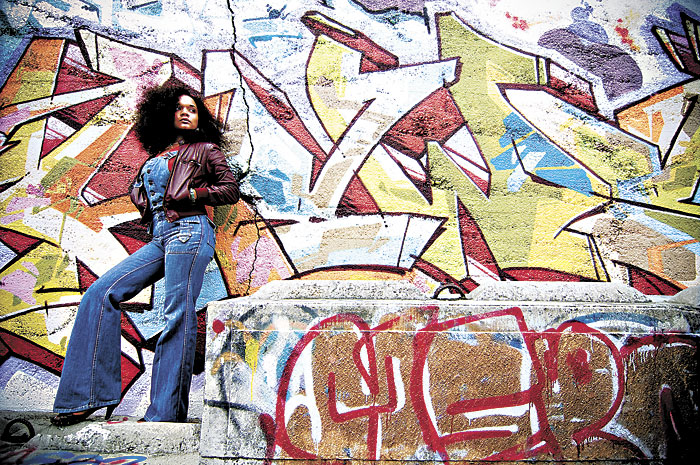
Two years ago, somebody broke into Laura “Piece” Kelley’s car and stole her bag. Inside was her journal, filled with poems, songs, and intimate details of her pregnancy and of falling in love with her now-husband. Anyone would be upset to have something so personal fall into the hands of a stranger, but for a spoken-word artist like Piece, the loss hit especially hard.
“I fell into a really bad funk and stopped writing for awhile,” she reflects. “I thought maybe this is the universe’s way of telling me I’m not supposed to be a poet.”
Piece turned to composing melodies and beats in a modest production studio in her Burien home. A moment born of both inspiration and desperation came several months later, when she decided to attempt to rewrite all her lost material—from memory. “I realized that I had everything I needed inside of me,” Piece says. “I own my experiences. You can take my notepad, but you can’t take away what my body and being have been through.”
From her gallant effort emerged Street Smartz: The Story of a True School B-Girl. Released in 2007, it’s an articulate album that shows off Piece’s silky vocals and tight rhymes. Highlights include the title track, “Street Smartz,” in which Piece raps about growing up in the Central District at the height of gang violence, and “His Hands,” a sultry, slow-tempo R&B jam.
It’s another achievement to add to the highly respected 31-year-old’s already impressive résumé. Earlier this year she performed a poignant poem, “Begin to Give,” alongside the Dalai Lama at KeyArena—which he requested a copy of. She’s also performed with the likes of Common, the Roots, and Blackalicious. Next she’ll travel to and perform in Philadelphia in support of Barack Obama.
You’d never guess, looking at Piece now, that she had an especially difficult childhood. But soon after she was born, Piece’s parents separated and the family relocated to a one-bedroom apartment in the Central District, where Piece’s mother worked long hours to support three children. Gang violence and drugs plagued the neighborhood. “People would steal your paychecks from your mailbox,” Piece recalls. “We had to get a P.O. box in Pike’s Market and go down there every day to check the mail.”
Piece began riding the bus and meandering around Pioneer Square and First Avenue by herself at age 13. She remembers drug use and prostitution being more prevalent in the area than it is today. Most significant, she remembers wanting to be like the young men she heard rapping in the streets.
“I’d started writing poetry and rapping when I was really young,” Piece says. “There’s video out there of me performing when I’m in seventh grade. Once I got a hold of this alternative, deep-down, dirty hip-hop culture in our city, I knew I wanted to be a part of it.
“I wore big oversized jeans, a tight little shirt, and shell-top adidas,” she adds, laughing. “I was one of the only girls out there, but I’d freestyle and battle with all the boys. Sometimes I’d sneak into nightclubs so I could rap onstage. It was all very empowering.”
But eventually the lack of adult supervision in Piece’s life caught up to her. She rarely went to class and dropped out of school in ninth grade. At 17, she moved into her own apartment, and weeks later discovered she was pregnant.
“There was very little stability in my life,” Piece says. “I tried to be too independent too fast…but writing and music saved me. No matter what was going on in my life, I always had a notepad and a rhyming dictionary to help me cope.”
When she isn’t working on her music, Piece teaches media literacy and creative writing in the city’s colleges and juvenile detention centers.
“I see kids like me today over on Third Avenue and Pike just kicking it,” Piece notes. “They don’t have any real destination. They’re the kids trying to figure out who they are while living in small, cramped apartments.
“We need to get them into recording studios, give them notebooks and turntables. If they’re expressing themselves through art, that means they’re not picking up a gun or dealing drugs. Music has the power to help heal the issues on our streets. I want to give these kids the chance that it gave me.”