WAR WOULD SEEM to offer a ready-made plot. Isn’t it the earliest source of storyline? But Israeli filmmaker Amos Gitai has managed to make a war movie with no plot to speak of, just a cumulative repetition that seems tedious at first, then ultimately develops a grim and exhausting power.
KIPPUR
directed by Amos Gitai with Liron Levo and Tomer Ruso runs January 26-February 1 at Broadway Market
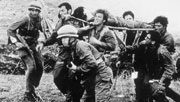
Kippur is set during the 1973 Arab-Israeli war, which began with a Syrian invasion on the holiest day of the Jewish year. Two young Israeli men, Weinraub (Liron Levo) and Ruso (Tomer Ruso), are assigned to a seven-man helicopter medic unit with the task of retrieving injured soldiers from the front lines. And that’s what we watch them do, over and over, from the unblinking middle distance of Gitai’s camera, tanks and trucks forever rumbling across the foreground, the waiting helicopter smothering the air with its drone.
These soldiers never see combat, or the enemy, and neither do we. They arrive always in the subdued and tattered aftermath, pulling dazed and bloodied men from the tanks and trenches and rushing them on to the chopper. The din of military machinery alternates with silence and a single eerie musical theme from Jan Garbarek and Ralph Towner.
The characters don’t say all that much, and when they do, it’s a strangely wooden contrast to Gitai’s super-naturalistic visual style (and I don’t believe subtitles are the culprit). Battlefield yelling (“We’ve got to unload them as fast as we can!” “We have to find the others!”) alternates with equally unconvincing philosophical ruminations back in the quiet of the base (“Sometimes I think we’re trying to escape something that will happen anyway. . . .”). But it’s the amazing physical performances that make the film so gripping, as we watch the crew become ever more desperate and exhausted, seeking strength and solace from one another until, inevitably, they also are in need of rescue.
For a movie concerning the recent history of the Middle East, Kippur is unexpectedly free of politics. In contrast to the heavy-handed antiorthodoxy of Gitai’s 1999 film Kadosh (which played here last March), Kippur seems neither angry nor judgmental. No one is condemned, nor is war itself. (Gitai himself served as a medic during the conflict.) The film stays intent instead on the simple sensory depiction of an extreme experience—the slight muffling of the helicopter rotor as a door is slammed shut, the intense modulations of sunlight on Weinraub’s face, the sexual charge from blood and pain, and the pure physical burden of carrying war’s anguish back into the kinder, peaceful world.