Nowhere-Near-the-Border Patrol in Forks
Published 7:00 am Tuesday, July 26, 2011




One day earlier this May, Benjamin Roldan Salinas and Crisanta Ramos decided to explore a new area of the Olympic National Forest. The Hispanic couple was looking for salal, a green, oval-leafed plant that is prized by florists around the world for its ability to stay fresh for weeks. It grows like a weed on the mountainsides around Forks, a tiny town on the Olympic Peninsula that once proclaimed itself “the logging capital of the world” and has since become better known as the setting for the popular vampire romance series Twilight.
As they were loading their van, Salinas and Ramos spotted a Forest Service officer driving by. Speaking through an interpreter, Ramos today says the couple knew instantly that they were in trouble—by the terms of the permit they had purchased, they were supposed to pick elsewhere. They had only planned to buy a different permit if the new area proved rich in the valuable plant.
Ramos says the officer didn’t stop them then. But he was waiting on nearby Highway 101.
The ensuing deadly encounter involved the Border Patrol, a federal agency that would seem to have no business in Washington anywhere but near Canada, and was covered by newspapers and Spanish-language TV stations from here to Mexico. Yet those reports have left out a crucial fact—one that elucidates a larger story about the Border Patrol’s role, and tactics, in places across the country that have never before considered themselves part of the border.
According to Ramos, the Forest Service officer who stopped her and Salinas was already on the phone when they first spied him parked on the side of the road. Minutes later, a Border Patrol agent arrived.
In other words, according to Ramos, the officer seems to have summoned the Border Patrol before talking to the couple. That’s important, because the Border Patrol, whose agents are required to speak Spanish, would later say that it had only been called in to interpret.
Not only couldn’t the officer have known at that stage that he would need such a service, but when he finished the phone call and pulled over the couple, Ramos says, he communicated just fine on his own.
“Permiso?” the officer asked.
When Salinas indicated they didn’t have a permit, the officer, speaking English but using gestures to make himself understood, asked for an ID. Salinas handed over his driver’s license and Mexican identity card.
Ramos and Salinas waited for the inevitable ticket. Then Ramos saw the Border Patrol car. “La migra is here,” she said.
Salinas opened the door and ran down an incline that led from the highway to the raging Sol Duc River. Ramos followed, but stumbled. After catching up, the Forest Service officer grabbed her by the hair, got her against the ground, and handcuffed her, according to Ramos. By the time she looked up, Salinas was gone.
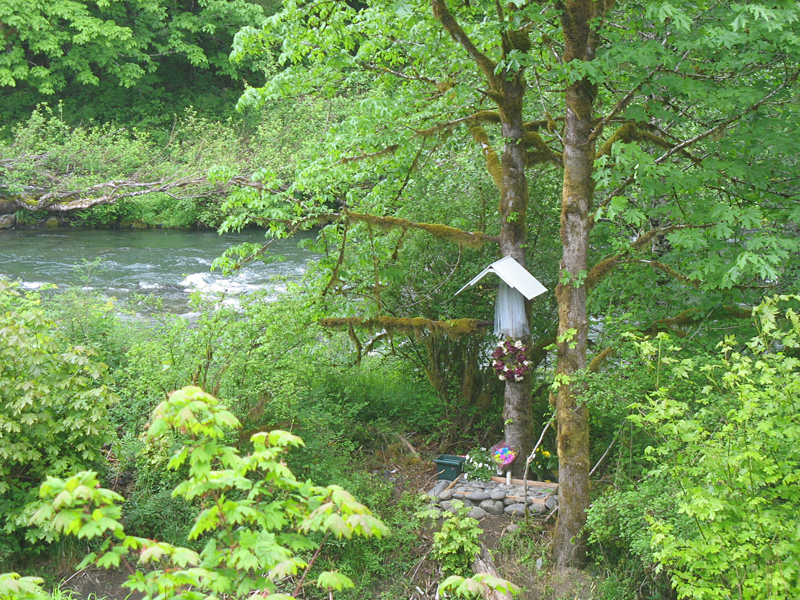
For three weeks, an ad hoc search party of local Hispanics—on some days 150 strong—went through the woods, calling his name, although they feared he had drowned. The Border Patrol issued a statement saying that Salinas, who couldn’t swim, had jumped into the river. On June 5, a friend who had joined the search party spotted Salinas’ body caught on a log at the river’s edge. He was 42 years old and left behind three grown children locally and two more in Mexico.
Salinas’ death traumatized the Hispanic population of Forks—about a third of the town’s 3,500 residents—and cast light on the Border Patrol’s aggressive presence in town. Agents have stopped and questioned Hispanics paying their water bill at City Hall, filling up at the gas station, leaving the grocery store, and riding their bikes. High-school students as well as adults have been asked for their papers, according to the Forks Human Rights Group, which has compiled nearly 80 stories of such encounters.
Agents also hover in the woods for hours, sometimes deep into the night, says Mayor Bryon Monohon. “It’s creepy,” he says. “People just disappear and we have no way of tracking them.” (The nearest immigration detention center in Tacoma, roughly 160 miles away, does not readily provide information about detainees.)
Just as troubling to the mayor is what the Border Patrol is doing in Forks in the first place. The town is nearly 60 miles from the nearest port of entry from Canada, in Port Angeles, which is served by a small ferry that travels between the Olympic Peninsula and the picturesque city of Victoria on Vancouver Island. The nearest land border crossing, much more heavily trafficked, is 200 miles away, in Blaine.
The Border Patrol, however, claims jurisdiction over all territory 100 miles from an actual border. Federal law has long granted the agency the authority to work this far inland. But it is only since 9/11, as the federal government has granted the agency more money and manpower, that its resources have matched its ambitions. The change has been especially noticeable on the northern border, where the number of agents has increased exponentially.
In 2000, there were a little more than 300 agents patrolling up north. By last year that number had ballooned to 2,263, an increase of more than 700 percent.
Even along the southern border, where the number of agents has more than doubled over the past decade, the Border Patrol has less to do on the actual border than it has in some time. Illegal immigration from Mexico has dropped dramatically as the U.S. economy has faltered, according to research from the Mexican Migration Project at Princeton University. The northern border is sleepier still. And the confluence of the Border Patrol’s additional funds, along with recession-era cutbacks to local government, has produced some strange results—in certain Washington towns, for example, a call to 911 is no longer answered by a local dispatcher, but by an employee of U.S. Customs and Border Protection, which encompasses the Border Patrol.
Mike Brasfield, the recently retired sheriff of Jefferson County, south and east of Forks, suspects that the Border Patrol “needs to be producing something” to justify the money it’s been getting. Hence, he suggests, the agency has reached further afield, knowing it can find illegal immigrants who have settled amid the foraging and logging communities of the peninsula.
Across the country, it’s a similar story. “They don’t seem to have a lot to do,” says Michele McKenzie, speaking about the Border Patrol agents who in the past few years have been fanning out across rural communities in Minnesota and North Dakota. McKenzie is a lawyer with The Advocates for Human Rights, a Minneapolis group that provides legal services to immigrants. Reading the case files of detainees, she has observed that agents are spending time listening to local police scanners, and showing up unbidden.
In New York, agents have been boarding domestic trains and buses, says Udi Ofer, advocacy director for the New York Civil Liberties Union. That’s been happening on the Olympic Peninsula too, as agents have hopped on buses heading from Port Townsend to Forks, according to Monohon and residents of both towns.
Ofer asserts that such practices go “way beyond the mission of the Border Patrol,” which he describes as “making sure no one is sneaking through our borders,” not doing “general immigration sweeps,” which are the domain of Immigration and Customs Enforcement.
It’s not just a matter of which agency is doing what. The agencies use different tactics, and those employed by the Border Patrol veer into questionable legal territory. Law-enforcement officers are not supposed to randomly stop people and interrogate them. “Reasonable suspicion” is required. Nor are they permitted to target people because they look Hispanic, or fit any other ethnic description, as Ramos alleges happened to her and Salinas on that fateful day two months ago.
Yet numerous accounts of Border Patrol encounters told to Seattle Weekly suggest that agents are routinely doing both those things.
To the casual visitor, the story of Forks might seem to begin and end with its connection to Twilight, the Stephenie Meyer series in which young Bella Swan moves to town and falls in love with a 104-year-old vampire named Edward Cullen. “Welcome to Forks, WA, the Twilight Capital of the World,” a sign proclaims near the entrance to town. There are Twilight tours, “Bella Burgers,” and espresso specials like “New Moon Mocha.” A store offering Native American products—the town lies near several reservations—calls itself “Native to Twilight.”
But the vampire veneer doesn’t reach very deeply into the town’s DNA. Locals have more interesting stories to tell.
Eighty-one-year-old clerk Merle Watson recalls that in the ’60s and ’70s, a group of hippies began camping in the woods outside town. “One night, a bunch of ’em were hanging around downtown,” Watson says. “Some people called the fire department.” The firefighters duly “sprayed ’em all down.” Another time, he says, two locals knocked down a hippie who was wandering around town. “A third cut his hair off with a power saw.”
“I thought it was hilarious,” Watson says. Eventually, though, Watson had a change of heart and offered one of them a job at the shingle mill he managed. The hippie proved a good worker, and Watson hired dozens more.
That, of course, was when logging still reigned supreme. In the late ’80s and early ’90s, after a bitter fight between environmentalists and the timber industry, the federal government declared the spotted owl a threatened species and ordered the bird’s habitat—the forests of the Pacific Northwest—protected. Loggers could no longer work in much of the forest around Forks. Many of the town’s mills closed and families left in droves.
Forks remains surrounded by dense forest. But while the environs look much as they did decades ago, the demographics have changed.
Manuela Velasquez’s home sits in one of several trailer parks in town populated by Hispanics. A patch of peonies front her tidy trailer, where she raised five children. Now 59, she and her then-husband came to Forks from Mexico in 1979. A relative ran a garage, she says, and he sponsored her family.
There were hardly any other Latinos in town then. Her son Victor, now a 32-year-old administrator for the nearby Quileute Tribal School, says kids at school would push him into lockers and tell him to “go back to Mexico.”
But there was work. While logging “was a job for the whites,” according to Velasquez, Hispanics could get hired on in the mills or set themselves up as “shake bolt cutters,” who roamed the forest for the remains of trees already felled and cut them into blocks used for roofing and other construction.
In time, word got out among Mexicans, and later Guatemalans, that a different type of work was available—one that required no green card. Clearing the “brush,” as locals call the fern, moss, and salal that lies on the forest floor, was always something people did around Forks for a little extra money, according to 72-year-old Hop Dhoogie, who says he started picking brush before he could count.
Fern was then the most popular commodity. But fern doesn’t keep like salal, a fact eventually recognized by florists throughout Europe and Asia as well as in the U.S. Demand for salal skyrocketed. Dhoogie, whose business dates back to 1967, says he sold perhaps 350 cases of salal a week in years past. Now he sells more than twice that number of cases every day.
Dhoogie buys the brush from self-employed pickers—these days, almost all of them Latino, as one might guess from a blackboard near his warehouse office offering instructions in Spanish—who spend up to 16 hours a day in the woods, in part to maximize their return and in part to avoid the agents who prefer staking out the area during the day. One of Dhoogie’s longtime pickers was Salinas, the man who drowned in the Sol Duc River. “He was a real loyal picker,” he says.
Dhoogie is a man of few words, who strokes a cat sprawled on his desk and plays country music in the background. This is the slow season for him; salal picking peters out in May and then picks up again in late summer. Crates of moss, which he sells in the meantime, are piled outside.
Asked about the changing demographics of pickers, Dhoogie turns more animated than usual. Latinos, he says, “come here to work. When white people come, they want to know when the coffee breaks are, they want to know how they can get in on Labor & Industries [the state agency that offers workers’ compensation].”
Among a certain set of old-timers in town, a blue-collar ethos reigns supreme. As one puts it: “If you put out hard work, you’re accepted.” That’s why Dhoogie seems less than pleased to see the Border Patrol crack down on people he sees as living up to that ethos. His business is also at stake—Dhoogie says he’s lost half of his pickers, who have numbered 200 in peak times, as people have fled town looking to escape the Border Patrol.
In 2008, the Border Patrol set up checkpoints on Highway 101 outside of Forks and Port Townsend. While shocking to locals, the same thing was happening in border states around the country, on stretches of road miles away from Canada or Mexico. Brianna Twofoot, field director for the Maine Civil Liberties Union, says a checkpoint went up in the Bangor area, about a two-and-a-half-hour drive from the border. Another appeared in the White River Junction area of Vermont, a similar distance away from Canada, according to Chris Calabrese, legislative counsel for the ACLU in Washington, D.C.
Given the libertarian impulses of many Americans, the stops ticked off a lot of people. One Arizonan started filming his testy encounters with the Border Patrol and posting the videos to a website whose motto is: “exposing the police state one checkpoint at a time.”
Another man in the Forks area decided to irritate the Border Patrol in return. He would go through the checkpoint, turn around and head through the stop again, according to Mayor Monohon. The Forks City Council asked the Border Patrol to come to a meeting and explain itself. The agency faced more questions at a town meeting near Port Townsend. Remarkably, considering the enduring presence of checkpoints elsewhere, the Border Patrol withdrew its roadblocks on the Olympic Peninsula.
But that didn’t mean the agency was moving out of the territory. Far from it. In 2006, the agency’s Port Angeles station, which oversees the Olympic Peninsula, had four agents. By last August, the number had increased to 25, according to the Peninsula Daily News.
Recently, the Border Patrol bought an old Eagles lodge in Port Angeles that it plans to turn into a new headquarters. The 19,000-square-foot facility will have the capacity for 50 agents and will be surrounded by razor wire. “It’s going to look just like a prison,” says Jaime Peterson, who lives across the street. She says she can’t really figure out why a facility of that scale is necessary. “Why are they spending $8 million?”
In an Edmonds Starbucks on his way back from the Border Patrol’s Blaine headquarters, Jason Carroll, the agent in charge of the Port Angeles station, sketches a map of the Olympic Peninsula. The salient feature is the Strait of Juan de Fuca, which, as Carroll points out, runs across the entire northern border of the peninsula, separating the U.S. from Canada and running into the Pacific Ocean.
“It’s a blue highway,” he says of the strait. “If you get in a boat, you can go anywhere you want.”
Once in the country, he continues, people can hop on Highway 101, which loops around the peninsula’s outer edges and heads south, toward Oregon on the western side and Olympia on the eastern. Therefore, Carroll maintains, it makes sense to place his resources in strategic places on 101. He points to two spots on either side of the highway as it begins to head south, one of them near Forks.
“Cross-border activity,” he reiterates, is what his agents are looking for. He mentions Ahmed Ressam, the would-be al-Qaeda bomber who in 1999 was intercepted by a Customs inspector after coming off the Port Angeles ferry with explosives in his car and a plan to bomb Los Angeles International Airport.
Yet those aren’t the kind of people Carroll’s agents are intercepting—unless you count border crossings that took place five, 10, or even 32 years ago.
That’s how long Velasquez has lived in the area. She had a run-in with Border Patrol agents last June.
A preschool teacher, Velasquez serves as a den mother to local Hispanics, helping them with government paperwork and acting as an interpreter. She has a friend from Guatemala whose adult daughter just arrived, and she took them last month to get the young woman a Social Security card in Port Angeles.
As they left the Social Security office, which shares an entrance with the Border Patrol station, Velasquez was talking with her friends in Spanish.
“Excuse me, ma’am,” said a woman standing outside, who a moment earlier had been talking on her cell phone. “Where are you from?”
“I’m from Forks,” Velasquez responded.
“Yes, but originally, where are you from?
Velasquez looked at her, thinking the question was odd. But she answered it. “I’m from Mexico.”
“Right then, she got out her badge and identified herself as a Border Patrol agent,” Velasquez recalls. Another officer joined them. The agents asked for identification and peppered Velasquez and her friends with questions: How long had they been here? Were they legal residents?
Velasquez told them of her three decades in the States, and that she had become a citizen in 1996. Finally, the agents told her and her friends that they were free to go.
Velasquez says she drove away, found a place to park, and started crying. “The humiliation,” she says. “It got to me.”
Told of this interaction, Carroll says he “can’t speak to the facts.” He maintains, however, that agents would not need reasonable suspicion in such a situation. They, like anyone else, are free to walk up to someone on the street and start a conversation. This, he says, is a “consensual encounter.”
It’s a justification immigrants’ lawyers frequently hear for the questioning of their clients. Yet Jorge Barón, executive director of the Northwest Immigrant Rights Project in Seattle, says that many people questioned don’t understand their rights. “The key thing is that the person is not required to answer.” One can simply walk away.
It takes a lot of courage, however, to walk away from someone with a badge, notes Calabrese of the ACLU. And sometimes there’s nowhere to walk away to, as when Border Patrol agents question those on buses.
In any case, it’s something of a legal trick, because once people answer that they were born in another country, that can be used as reasonable suspicion to press for more information, like documentation. (Hence the agent’s identification of herself after Velasquez said she was from Mexico.) At that point, someone’s refusal to cooperate is taken as further grounds of suspicion.
The Border Patrol insists that it does not racially profile. “There is no one prototypical subject for whom Border Patrol agents are looking,” reads a statement by the Customs and Border Protection. Illegal aliens come “from all nations and ethnicities.” Therefore, the statement says, racial profiling would be “counterproductive.”
Rather than ethnicity, Carroll says he directs his agents “to look for suspicious behavior.” Asked what that might be, he mentions “erratic driving” and then drifts off into a vaguer explanation. “There are a lot of physiological things,” he says. “Say you’re driving down the road, and you’re speeding. All of a sudden you see a Washington state trooper behind the bushes. What happens to you?”
The repeated references to bad driving are interesting because agents, according to CBP spokesperson Kerry Rogers, are not empowered to enforce traffic violations. “Those are state and local laws,” she says. “We are immigration only.”
That’s not what Agent Brandon Brown seemed to think. On May 17, around 8 a.m., Brown stopped a car full of Hispanics heading out of Forks. The reason given—well, allegedly, that changed, but the two versions both had to do with driving offenses.
The driver was a Mexican shake bolt cutter named Juan. (He requests that his last name not be used, on the advice of Barón, his attorney.) He and two friends were heading for the forests of Amanda Park, which lies on the southern end of the peninsula.
He says he saw the agent’s car following him as soon as he left town, and therefore took extra care with his driving. But the car kept following him for 25 or so miles. (Brown’s report, obtained by Seattle Weekly, puts the figure at 10 miles.)
Suddenly, Juan saw flashing lights on the agent’s car. He pulled over. “Your taillight is not working,” Juan says the agent told him.
Then the agent asked: “Do you have papers?”
None of the men did. Brown’s report said all three admitted that they had illegally come from Mexico. They were handcuffed and piled into Brown’s car.
Driving to the Border Patrol station in Port Angeles, the three Mexicans pressed the agent on why he had stopped them. Juan says they didn’t believe the taillight explanation because it was a particularly sunny day, making it hard to see whether the light was working.
The agent said then that he thought Juan was drunk because he was weaving. Brown’s report sticks with that justification, saying that Juan was driving “erratically” and needed to be stopped for “public safety reasons.”
“If I’m drunk, why he don’t stop me right away?” Juan asks. Barón further observes that the agent didn’t give Juan a breathalyzer or a field sobriety test. He suggests the agent was coming up with pretexts, and has therefore filed a complaint with CBP charging that the stop was illegal.
Juan, a 38-year-old father of three American-born children, pleaded with the agent not to take him away because his wife was undergoing treatment for an advanced stage of breast cancer. He was sent from Port Angeles to the Tacoma detention center. He spent 22 days there before being released on bail, and now faces deportation proceedings.
Barón has not charged the agent with exceeding his authority by enforcing traffic laws, in part because the Border Patrol has an explanation for that. According to Richard Sinks, a spokesperson for the Blaine region, Juan was “pulled over on federal land within the Olympic National Park, which is an area of exclusive federal jurisdiction.” So agents do feel entitled to use traffic violations as reasons for stops on federal land, which may also explain why Brown followed Juan for miles: He was stopped only after he had reached federal territory.
When Border Patrol agents got involved in the case of Salinas, the Forks man who drowned, they could rightly say that they weren’t the ones who initiated the stop. They were only “interpreters.” Yet Barón argues that that, too, was likely just an excuse to justify the Border Patrol’s questioning. (When asked to comment on the incident, Donna Nemeth, a local spokesperson for the Forest Service, said she was not able to get approval from her superiors to talk about it because it was under investigation.)
The case is far from unique. Kendra Anderson runs a project for the immigrant advocacy group OneAmerica that is documenting what the organization sees as Border Patrol abuses in the northernmost counties of Washington state. Among the 30 or so cases compiled so far is that of an El Salvadoran resident of Bellingham who went out to get milk for his family one day and never came back. Two days later, he called home from the detention center in Tacoma.
A police officer had stopped the man and questioned him about whether the van he was driving was really his. The officer called the Border Patrol, ostensibly to interpret. Yet when the agent arrived, according to Anderson, he asked no questions about the van. Instead, he asked “Tienes papeles?” (“Do you have papers?”)
Peter Mares, a Catholic Charities manager in New York who runs a house for migrant workers, and McKenzie, the human-rights lawyer in Minnesota, both say that similar scenarios are playing out in their states.
The phenomenon speaks to the complex interweaving of relationships that has sprung up between the Border Patrol and other law-enforcement agencies. Strapped for resources in an age of government cutbacks, other agencies frequently rely on the one law-enforcement entity that isn’t short on cash—the Border Patrol—to provide backup in all sorts of ways.
CBP staff now handle the 911 dispatch for north Whatcom County, which include the pastoral towns of Blaine, Lynden, and Sumas. Twenty–four hours a day, when a resident of one of these towns calls in an emergency, they will get someone on the other end of the line who works for an agency devoted to immigration enforcement.
Sinks, of the Border Patrol’s Blaine sector, says that the CBP’s dispatchers usually refer the calls to the appropriate local law-enforcement agency. But Border Patrol agents have been known to trail along.
One day last year, a 911 call came in from the small town of Nooksack, according to Anderson of OneAmerica. A woman with a Spanish accent reported that her 4-year-old daughter had fallen while playing between some parked cars during a barbecue.
Two sheriff’s deputies and two Border Patrol agents arrived in response, Anderson says. The Border Patrol agents started to wander around the party, which was populated by Hispanics, many of whom ran into the house upon sighting immigration authorities. Continues Anderson: “The agents tried to engage people in conversation: ‘How old is your daughter? Where are you from?’ “
Anderson says no one was detained, but a message was received. “After that incident,” she says, “everyone at that party knows that if you call 911, the Border Patrol is going to come.”
Sinks says he is not familiar with that incident, but denies that agents would ever “bomb a birthday party. That would be highly inappropriate.” He says that agents will “never, never, ever ask citizenship questions of victims or witnesses.” But, he adds, if agents arrive on a scene and suspect someone is an illegal alien, “they have a duty to ask.”
It’s conceivable that some of the officers who call the Border Patrol may simply want backup. Others, though, are overt about wanting to enforce immigration laws. McKenzie says she is representing one Honduran woman who was the passenger in a car stopped for speeding by local law enforcement in North Dakota. The officer didn’t just ask for the driver’s ID, as is typical. He also asked for McKenzie’s client’s. When she presented her Honduran passport, McKenzie says, the officer told the woman she was going to jail because she was illegal. He then called Border Patrol.
In fact, a host of law-enforcement agencies across the country are paid to cooperate with the Border Patrol under a Department of Homeland Security program called “Operation Stonegarden.” The feds award tens of millions of dollars every year to agencies that agree to “jointly secure U.S. borders and territories.”
In 2009, Brasfield, the retired sheriff near Forks, turned down the offer of what he calls “free” money. “My primary concern was that [agents] were disruptive to my community,” he explains, speaking from Alabama, where he now lives. In contrast, the sheriff’s department of Clallam County, which encompasses Forks, signed on for Stonegarden. Last year, the department received a half-million dollars in federal funds.
Clallam County Sheriff Bill Benedict says he supports the Border Patrol’s mission. And in any case, there’s little required in exchange for the money—just “extra patrols, extra deputies looking for criminal activities.”
He adds that it’s not within his purview to have deputies go out searching for illegal immigrants, but if they happen to arrest one, Border Patrol will be notified. The sheriff has also provided radios to the Border Patrol that allow agents to scan his department’s frequencies.
The realities of Stonegarden, however, haven’t filtered through to the sheriff’s man on the ground in Forks, Sgt. Brian King. “There’s been no mandate at the operations level,” he says. As it is, he worries about the perception that his office is in league with the Border Patrol. “It’s created some obstacles,” King says. “Mostly, it’s just the mistrust, the fear that when we’re having contact with the Hispanic community, whether it be through domestic violence or random traffic stops, the Border Patrol will be in tow.”
One morning last month, Mayor Monohon plopped into his chair in his Forks City Hall office. He had worked late the night before due to a City Council meeting. The big issue on the agenda was drag racing, which had been going on at an old and otherwise seldom-used airport for private planes. The Federal Aviation Administration wasn’t happy with the practice.
Talk of the Salinas drowning was reverberating through town and in the press. Yet there had not been one word at the meeting about it. Aside from the discussion about checkpoints back in 2008, the council has remained mum on the subject of the Border Patrol.
It’s too touchy a subject, Monohon says. “As soon as it comes up, people have strong feelings. It’s easier just to stay quiet.”
Monohon, who has been mayor for a year and a half and describes himself as a “Democrat in a Republican town,” expresses dismay at the lack of public discussion about Border Patrol activities, noting the big effect they have had. It’s not only Hispanics who have been stopped: “We’ve had a lot of problems with the Border Patrol harassing Natives,” he says.
As the mayor sees it, the Border Patrol has swooped in on Forks because it is easy pickings, with its diverse population beaten down by years of economic distress. “Downtown Seattle is within 100 miles of the border,” he observes in a rough estimate. But he says agents “would not dare” plant themselves in Washington’s major metropolis.
And while agents are “roaming all over town, doing what they want,” he says, they have failed to explain their game plan to him or other local officials: “We have one branch of government that has no idea what the other is doing.”
Even Sheriff Benedict says he doesn’t understand why the Border Patrol is putting so many resources on the peninsula. “Is it a wise use of tax dollars?” he asks. Yet Monohon is not itching to have the council air this specific issue. Much as some people in town admire what they see as the Hispanic work ethic, others support tough immigration enforcement. It’s this latter camp that council members generally belong to, a political reality likely linked to the extreme dearth of Hispanic registered voters. (There are precisely three, according to the mayor.)
Councilmember John Hillcar, asked about Border Patrol activity, certainly doesn’t seem inclined to discuss the matter at length. Mentioning that he normally carries a copy of the U.S. Constitution, he says: “We are a nation of laws. If laws are written, they are to be enforced.” He also says he’s sure that “what the Border Patrol does, it does under its authority.”
But he maintains that he hasn’t noticed the agency’s expanded presence, saying he sees agents maybe “once a week.”
On the evening of Sunday, June 12, a text went out via a phone tree of Forks’ Hispanics and activists who have been monitoring the Border Patrol’s presence: “BP in town. Spartan Avenue.”
Velasquez, who is participating in the phone tree, says she was afraid because her teenage grandkids were out walking. Although born in this country, she says, “They’re brown. They don’t have paperwork with them.”
The very next evening, more texts went out. At least five Border Patrol agents had been spotted. The following morning: yet more texts.
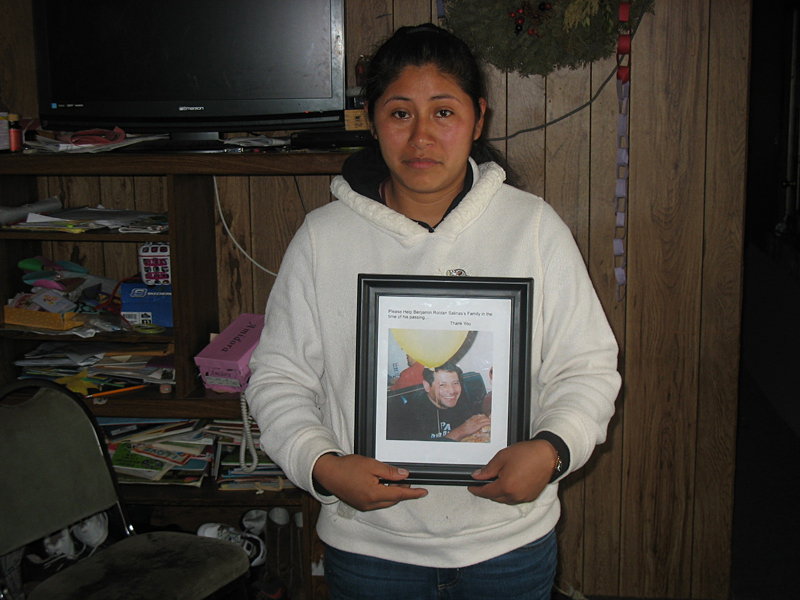
Thus it happens that Velasquez gets a text on Tuesday, June 14, in the late morning, just as she is interpreting for Ramos, who is relating the events that led to her boyfriend’s drowning while sitting in Velasquez’s trailer. Ramos’ 5-year-old son plays across the room with blocks while his mother, a 27-year-old with a jet-black ponytail and mournful eyes, talks, her voice shaking. The night before, she had seen Salinas’ body. He was a good man, she says, who taught her how to pick salal and never went to the store without bringing back a treat for her two children.
“I will never find a person like him, never,” she says.
Ramos says she is also hard-hit by the loss of Salinas’ income. And she is facing deportation proceedings. (On the advice of her lawyer, she declines to say exactly where she’s from or how she came to be here, though The Seattle Times has reported that she is Guatemalan.) Originally taken to the Tacoma detention center, pleading with friends as she went to take care of her kids, she was released pending the outcome of her case.
The text about agents in town creates a momentary panic. Ramos, for now, is free to come and go as she pleases, but in Salinas’ absence she has been driving without a license and fears being stopped. Velasquez drives her home to a rundown trailer guarded by a rooster.
They are outside the trailer when Velasquez gets another text. Border Patrol agents are now across the street, at the grocery store. Ramos has an errand to run, and looks questioningly at Velasquez, who reassures her that it’s OK to go out as long as she’s not driving. Ramos, looking unsure, heads back inside the house.