In the quiet pre-opening hours at Ballard’s Staple & Fancy on a Friday afternoon, chef/owner Ethan Stowell sets his Pandora app to play Abba and their ilk. The bespectacled 36-year-old nurtures nostalgia for some of the frothier cultural products of his childhood; he’s watched Airplane and Blazing Saddles more times than he can count.
The lighthearted music does nothing to take away from his intensity, though. Elbow to elbow, he works the pasta station while his three line cooks devote themselves to appetizers, meats, and sides.
As he starts making gnocchi, Stowell pulls a sheet of plump potatoes, glistening with olive oil, from the oven. “I don’t believe in boiling them,” he says, alluding to the common way gnocchi is made. “The idea is to make as concentrated a potato flavor as possible.” It therefore “makes no sense,” he says, to drench the potatoes in water.
One by one, he puts the potatoes through a little contraption that turns them into threads resembling shredded cheese. He adds an egg for each potato. “I like it to be rich,” he says. He sifts flour over the mixture.
Trying to explain why he likes cooking as he begins to knead the resulting mass of dough, he says: “It’s working with your hands. You get to produce something every day.” He adds that he “doesn’t think cooks are artists; they’re more like craftsmen.” But he credits his ballerina mother—who later in the evening will come for dinner with Stowell’s father, the two of them just back from Venice—with teaching him a vital lesson: the importance of technique.
“There is a correct and an incorrect way to do things,” he says. In cooking, that means you need to learn “how to butcher things the right way, how to slice things the right way”—and how to roll gnocchi dough into perfect, rounded strands, ready to be cut into bite-sized wedges. He demonstrates, explaining how you have to avoid too much pressure as you rock the dough, instead gently spreading the palms of your hands outwards.
His attention to detail has paid off. Stowell is one of the most celebrated chefs in Seattle. He’s the owner not just of Staple & Fancy but of three other acclaimed restaurants: Tavolata, Anchovies & Olives, and How to Cook a Wolf. It’s a veritable “mini-empire,” in the words of Antoinette Bruno, editor of the national culinary website StarChefs.com. She credits him with “doing more than any young restaurateur in the city for making a difference in the culinary scene in Seattle.”
Flash back just a year ago, though, and Stowell was in turmoil. Union, then the chef’s flagship restaurant—the one he had started at the improbably young age of 28, the one that had earned rave reviews, the one into which he had poured his heart and soul—wasn’t doing well.
Stowell had taken himself out of the kitchen in order to keep his line cooks employed. But still Union was a quandary that kept him up at night. Did it need to be more hip? More fun? Was it the recession that was killing Union, or the refined, high-end concept?
An opportunity to start Staple & Fancy settled the matter. With Staple & Fancy to run, he had a place to put his Union cooks without losing them. He held a closing dinner at Union and prepared to move on from what he calls “one of the proudest things I’ve ever done—and one of my biggest failures.”
Yet in some ways that failure seems to have been the making of Stowell. It forced him to chart a new style of cooking. In the process, he created a signature brand on a scale of which Seattle has really only seen once before.
“He’s kind of the new Tom Douglas,” says Eli Dahlin, a cook who has worked for Stowell at several of his restaurants. It’s a common refrain, albeit one sometimes said in jest. “You’re a Mini-Me Tom,” Tamara Murphy, the former Brasa chef who now presides over the two Elliott Bay Cafes, sometimes tells Stowell.
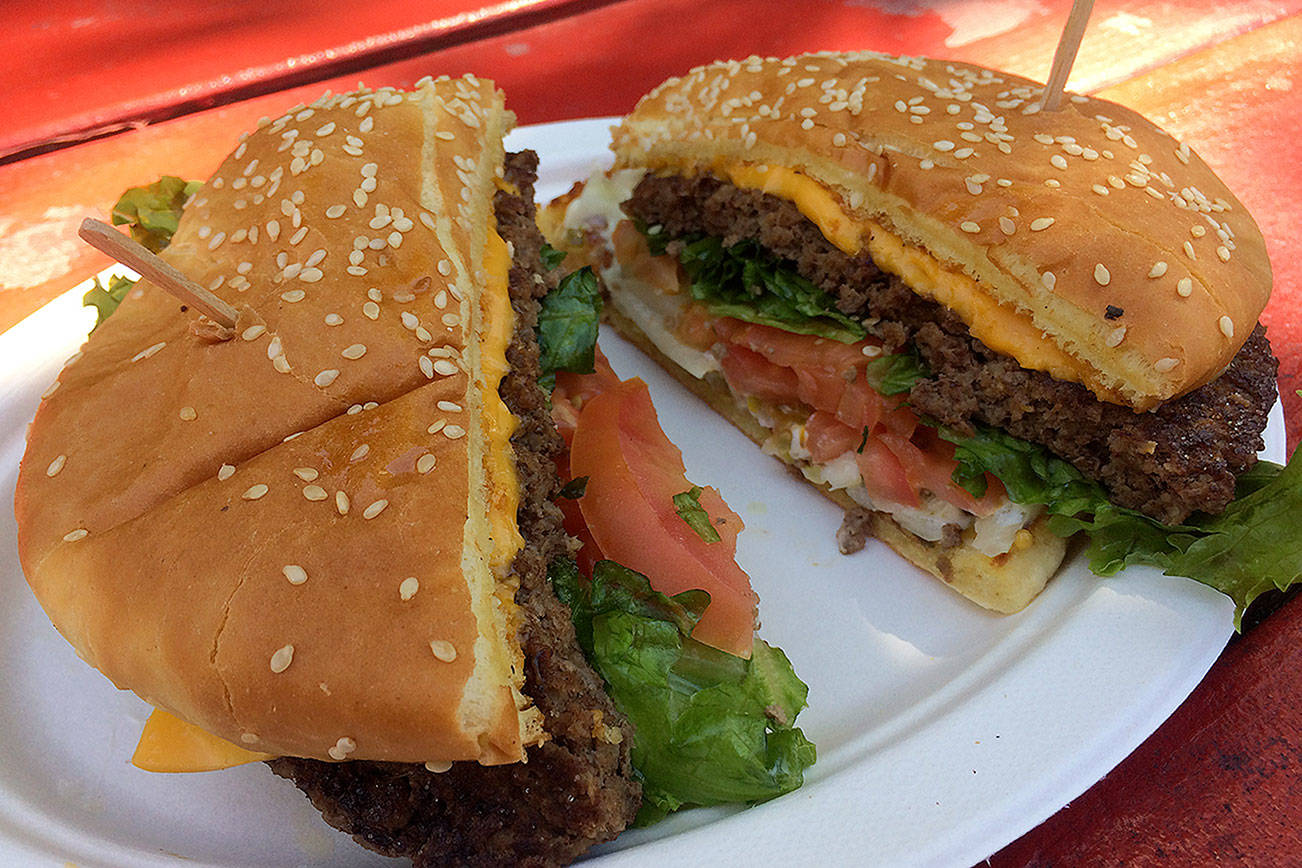
Stowell, like Douglas, not only runs his restaurants, but markets himself in other ways. In the fall, Stowell released a cookbook on “new Italian” cuisine. He’s selling handmade pasta, under the trade name Lagana. And just this month, he opened two concession stands at Safeco Field, one offering crepes and another grass-fed burgers.
Also like Douglas, Stowell is piling up the accolades. Last year, Bon Appetit named Anchovies & Olives one of its 10 best new restaurants in America. In March, the James Beard Foundation listed Stowell as a finalist for Best Northwest Chef. In the days leading up to the finalists’ announcement, though, Stowell confessed he was hoping for a bigger win. Staple & Fancy was a semifinalist for Best New Restaurant nationwide, not just in the Northwest, but failed to make the next cut. No Seattle restaurant, in fact, has ever won that category; the foundation typically favors establishments in New York City and other locales anointed by East Coast critics as food towns.
However, Douglas—who runs 10 restaurants including Dahlia Lounge, Etta’s, and Palace Kitchen—was able to transcend that bias and place as a finalist in the national Outstanding Restaurateur category. The different showings stand as a reminder that Stowell, for all his cachet and entrepreneurial drive, stands on the precipice of Douglas-like fame but has yet to achieve it.
To do so would probably necessitate some big changes for Stowell. Consider the model set by Douglas. “He’s a marketing machine,” says Patric Gabre-Kidan, a chef who has previously worked with both Douglas and Stowell and is currently general manager of the Book Bindery. “Tom’s job from 7 a.m. to 9 p.m. is to make sure his name is out there.”
Douglas appears on TV (beating Iron Chef Masaharu Morimoto in 2005), develops cookbooks (he has three), hawks his spice rubs (too many to count), and has even designed kitchens for a Bellevue subdivision. What he doesn’t do is cook in any of his restaurants, except for charity events and special projects.
Would Stowell, a man who only found himself when he found cooking, be willing to give up the kitchen? And even if Stowell tried to follow in Douglas’ footsteps, could he pull it off?
The cherubic, curly-haired Douglas is Clintonesque in his ability to press the flesh and smooth-talk just about anyone. Stowell is extremely talkative too, and remarkably open. But he has a fast-talking, slightly sardonic way about him that is more New York wise guy than glad-handing schmoozer, an impression enhanced by a cabbie-style cap he’s taken to wearing recently after receiving it as a gift during a pig-cooking competition.
One night in Staple & Fancy’s kitchen, when a request comes in for a variation upon a dish, he recalls how a woman once sent back a plate of pasta puttanesca with instructions to remove the garlic. His response, albeit probably not exactly in these words: “Lady, there are like 25 pieces of garlic in there. How about I just make you a new one?”
“I’m not the kind of guy to go on Top Chef or Iron Chef, ” Stowell says on another day, over lunch at one of his haunts, a stellar, unpretentious Mexican restaurant called La Carta de Oaxaca, situated just a couple of blocks from Staple & Fancy. He’s ordered way too much food—a stew called posole, tacos, tamales, and a lamb dish—seemingly so he can sample a little of each.
Asked why he wouldn’t want to raise his profile by going on TV, he stops eating and ponders for a moment. “I don’t know,” he says. “I guess I’m uncomfortable with not having me being in charge of how others perceive me.”
Stowell is the third son of Kent Stowell and Francia Russell, for many years the co-artistic directors of the Pacific Northwest Ballet. Both charming and driven, with an international sophistication derived from stints abroad, the couple shone brightly in the local arts scene.
As if that weren’t enough to live up to, his older brothers seemed to have it all together. “Chris was going to be a ballet dancer from, like, the age of 8,” Stowell says. Chris now serves as artistic director for Oregon Ballet Theatre. Darren, now a Teach for America executive, was “the jock of high school.”
“I was the dorky younger brother,” Stowell says. “I was a little gangly, a little uncoordinated. I didn’t seem to be good at much.”
“We were always working with his self-confidence,” says Russell. “It was hard to know how to help him.”
He did dally in cooking as a kid—making shake-and-bake chicken, orange floats, and Peter Pan pancakes from a Walt Disney cookbook. But he didn’t think much about that until after he had drifted though two community colleges and, still searching for a vocation, asked his parents to put him through cooking school.
“He had had a few brainstorms in the past,” Russell remembers. They didn’t pan out. So rather than immediately acquiesce, “Kent said, ‘Ethan, fine. We’ll send you anywhere you want. But first you have to work in a real restaurant.’ “
Some 15 years ago, the elder Stowell talked to Joe McDonnal, a ballet supporter and owner of The Ruins, an exclusive Queen Anne dining club which has served as a proving ground for many an up-and-coming chef, including Christine Keff of Flying Fish, Craig Serbousek of Crow and Betty, and Philip Mihalski of Nell’s Restaurant. At Kent’s request, McDonnal (now deceased) made room in his kitchen for one more—which only made Stowell more insecure. He worried that staffers would consider him a “snotty kid” thrust upon the kitchen by his famous dad.
“The first thing I needed to do was to figure out how to make their jobs easier,” he recalls. “Who wants to take out the trash?” someone would ask. “I’ll do it,” Stowell would pipe up.
He loved it there. Like a lot of creative occupations, cooking attracts a range of misfits. “Everyone was awkward,” Stowell says, “and the more awkward you were, the cooler you were.”
Mihalski was at The Ruins when Stowell arrived. The Nell’s proprietor was then already talking about starting a restaurant, and he served as a mentor to the inexperienced Stowell.
Fired up by his new job, Stowell immersed himself in food books. A favorite was Andrew Dornenburg’s just-published Culinary Artistry, which introduced to him the idea of seasonal cooking. He learned that lamb is most tender in the spring and that oysters are best in the winter, when the waters in which they’re found are coldest.
To supplement his research, he ate his way through the city. “Back in the day, there was a big Asian thing,” he recalls.
Certainly, that was true at Wild Ginger, the upscale Asian-fusion restaurant that was in its heyday. It was also true at Dahlia Lounge, Douglas’ first restaurant. Mihalski, who worked at Dahlia in the early ’90s, remembers a whole section of the menu devoted to barbecued meats and fish with hoisin sauce. They often came accompanied by fried rice. Etta’s, which Douglas opened in 1995, served tilapia—a fish favored in Chinese cuisine—with black-bean sauce.
It was a time when Seattle was basking in its identity as a Pacific Rim locale. The forum known as Asia-Pacific Economic Cooperation—sort of a mini–World Trade Organization for countries on both sides of the Pacific—held one of its first meetings in Seattle in 1993. The city was hyper-aware of its large Asian immigrant population, which had given rise to a fantastic array of Chinese, Vietnamese, Thai, and Japanese restaurants.
Yet, muses John Sundstrom, another Dahlia veteran who now owns Lark, non-immigrant Seattleites weren’t always willing to venture into the International District, where many of these restaurants were located. And so, he says, Douglas brought Asian food—or at least Asian influences—to a mainstream audience.
Stowell didn’t need the introduction, though. In his late teens, he starting doing some odd jobs for another ballet enthusiast who knew his parents: John Pomfret, the former general manager of The New York Times. Pomfret and Stowell began having lunch every week at a different restaurant in the International District. In all, they went to about 65, Stowell reckons, each time using a grading system Pomfret had developed. “I still have the scorecard,” Stowell says.
It was his experience with genuine Asian food that he says kept him from falling in line behind the fusionists. “Why mix it up?” he thought.
The leap from Stowell’s first grunt kitchen job to the status of restaurateur came remarkably fast. In some half-dozen years, he cycled through stints at the Alexis Hotel’s Painted Table, Lampreia (now Bisato), an Atlanta restaurant called Seeger’s, and Nell’s, where he became sous chef for his old mentor. “He was young, bright, and energetic,” Mihalski recalls.
Stowell had also, at last, developed confidence.
“He clearly had a sense of what he liked,” Mihalski says. The Nell’s proprietor describes Stowell’s favored style, in tune with Mihalski’s own, as centered on the freshness of ingredients. Stowell also “had a sense of the whole,” according to his former boss—an understanding that the feel of a place can be as important as the food.
On the side, Stowell often catered functions for PNB board members. They encouraged him to start his own restaurant, recalls Russell. When a site opened at First Avenue and Union Street, they offered funding, as did his parents.
Union—a simply adorned, 85-seat space offering high-end, French-inspired cuisine—opened in 2003. It was an auspicious time, says Stowell’s father, who likens the vitality then happening in Seattle’s restaurant scene to the energy starting to percolate in the arts community when the elder Stowells hit town in the late ’70s. In that earlier era, the ballet (thanks in large part to the Stowells), the Seattle Symphony, and the theaters all were in the process of transforming themselves from second-rate to nationally known institutions. And around the time Union was opening, a whole host of new, ambitious restaurateurs seemed bent on proving that San Francisco and Los Angeles weren’t the only serious food cities on the West Coast.
In the space of a few years, Sundstrom opened Lark, Maria Hines opened Tilth, Matt Dillon opened Sitka and Spruce, Jason Wilson opened Crush, and Rachel Yang opened Joule, to name a few of the chefs who were making their mark. They cooked not so much in Douglas’ style but in that of the Herbfarm’s former chef Jerry Traunfeld, who famously used ingredients from his own garden (Traunfeld has since opened Poppy). The locavore movement was getting underway.
This new crop of chefs also, for the most part, drew inspiration from Europe rather than Asia. The shift has been so pronounced that Korean-born Yang says she found the local dining scene “really homogenous” in its Western orientation when she came here from New York City four years ago and founded Joule, which draws upon the cuisine of her homeland.
Sundstrom explains that he sees an affinity between this region’s ingredients—the mushrooms, the cheeses, the fruit—and those of Alpine terrains like France and Switzerland. Stowell also says using local ingredients is “huge” for him. That’s why, he says, he chooses not to focus on salmon. “If you order King salmon at a restaurant, there’s a 75 percent chance it’s from Alaska,” he says. That’s about as close to Washington state as Massachusetts is, he points out. He considers shellfish more authentically local.
Part of what distinguishes Stowell, though, is that he’s far from a purist about his local fixation. At Union, recalls former staffer Dahlin, who now works next door to Stowell’s Ballard place at The Walrus and the Carpenter, a seafood “delivery would come in on Wednesday, and all of a sudden there would be eight different fish.” There was cobia and pompano, both found on the East Coast, as well as what Dahlin calls “a really ugly fish” from the Northwest called wolf eel. “I’d never seen a lot of that stuff before,” he says.
Stowell’s decision to cook in the French tradition was therefore not really about local affinities. It was about his newfound ego. “I was trying to do the fanciest food out there,” he says, adding that he worked with “all the dream products—foie gras, caviar, truffles.”
A grilled squab breast with bruléed fig and sautéed foie gras topped with 100-year-old balsamic vinegar “was our perfect dish,” Stowell says. And it was glorious. “Clean” is a word often used to describe Stowell’s cooking. “He lets the ingredients shine,” Yang says. “I can taste every single thing.”
That’s not to say the preparation was simple. At Union, Dahlin remembers, the staff would poach vegetables in a machine called a Gastrovac that creates a vacuum in which the produce cooks without losing its juices. It’s therefore no coincidence that the Book Bindery’s Gabre-Kidan, a onetime pastry chef who in Union’s later years became Stowell’s business partner, says of his former collaborator: “He can make a piece of broccoli taste amazing.”
After amping up the flavor of each ingredient, Stowell would juxtapose them in interesting ways—putting a poached duck egg on top of a creamy pea soup, for instance.
“Beautiful, vibrant, and fiery” is how StarChefs’ Bruno describes the food she had at Union in 2009, when she came to town to do research for her organization’s “rising chef” awards, one of which was bestowed upon Stowell.
So why didn’t the crowds come? Gabre-Kidan surmises that Union was a tough fit for Seattle’s sensibility. “It’s hard to get people on board with that kind of expensive, fussy experience,” he says. At least the kind of people Union was pitched at—foodies, but not necessarily “fine diners.”
Stowell tried to play down the fussiness factor. “Stowell insists that Union is not a fancy restaurant,” wrote The Seattle Times‘ Nancy Leson in a 2003 piece. The prices, in fact, were not that high—at first. When Union opened, its five-course tasting menu cost $45, far less than what it would in New York or San Francisco. Given the price of his dream products, Stowell says, he wasn’t meeting his food costs. So he raised the price, gradually, to $60.
Still, he struggled with finances. In 2007, he opened a restaurant that was meant to be an income-generating sideline: Tavolata in Belltown.
Tavolata was to be Stowell’s casual place, one where he could relax without sweating over the intense preparation that Union demanded. Simple, family-style Italian fare—that was Tavolata’s brief. Seattle loved that concept. “It was always busier than Union ever was,” Stowell says.
That’s when he says he discovered the ultimate pleasure for a restaurateur: a full house. “The dining room is vibrant, people are having a good time.” Moreover, he was having a good time. “You know what,” he says he thought to himself, “I’m having more fun working at Tavolata than I am at my supposed flagship restaurant.”
Italian food was not the path he had seen for himself, but he was not unfamiliar with it. “The first thing I ever made at a restaurant that I truly understood was pasta,” he says. “How much you knead it, how much water it needs, the feeling of the dough.”
With two styles now in his repertoire, he felt it was important to pick one moving forward. He wanted, he says, “something we could be identified with.”
As the recession kicked in, Union’s higher-priced model suffered even more. So Stowell chose Italian, but with a twist: He would blend Italian cooking with Northwest products. Gnocchi and chanterelles, tagliatelle and clams, geoduck crudo (a kind of Italian sushi)—these are the kinds of dishes that Stowell decided to make his new life’s work.
In quick succession, he opened three more restaurants that offer variations upon the theme. Queen Anne’s How to Cook a Wolf specializes in small plates. A sliver of a place with only 30 seats, named after a book by his mom’s favorite food writer, MFK Fisher (for whom James Beard’s Distinguished Writing Award is named), Stowell envisioned it as a little post-retirement project for his dad. Père Stowell says he hosted for only a couple of weeks before finding out that he had too much on his plate even without PNB.
Anchovies & Olives on Capitol Hill focuses on seafood, Stowell’s own culinary love. And Staple & Fancy, located in the neighborhood in which Stowell resides, reprises the tasting-menu concept, but with a distinction. As Stowell puts it, “You don’t get to pick what you eat.” Rather, diners must completely put themselves in the chef’s hands, without even seeing a menu of the night’s food.
Stowell attributes his proliferation not so much to empire-building but to a desire to create jobs for cooks who would otherwise leave town. Until recently, he says, there simply weren’t that many places for ambitious chefs to go. It’s this observation that particularly impressed Bruno when she interviewed Stowell. “For a young guy,” she says, he had an “astute” understanding of what it takes to make a lively restaurant scene in a city.
With an expanded stable, his approach is shaped by the lessons learned at Union. “We’re not serving foie gras and caviar, but we’re keeping the price affordable,” he says. The tab for what the Ballard eatery calls its “fancy menu” (you can still order a la carte) is $45, the original price at Union. “That means I have to be super-efficient,” he says. For instance, he doesn’t throw out odd bits of fish too small for an entrée; he uses them to top bruschetta.
Since he knows he can’t afford super-pricey ingredients, he looks elsewhere for unique flavors: lamb tongue, fried pig ears, and sweetbreads. “I actually think that plays to my strengths,” he says.
He’d like to use geoduck too, but he’s mindful of the price tag. On a recent afternoon at Staple & Fancy, a man known to all as “Oyster Bill” stops by. He’s a rep from Taylor Shellfish Farms, the local seafood company. He and Stowell disappear for a huddle.
“Geoduck mostly all comes from the Northwest,” Stowell says when he gets back, by way of explanation. “Yet there’s zero representation in restaurants. Why? Because it’s crazy expensive.” It costs him $7 or $8 a portion, he says, which means that he has to charge $25 once labor and other costs are added in. And that’s for an appetizer.
“I told him we’re not going to buy any more until we have a conversation about price.” They’ll have to have more than one, apparently, since today’s discussion didn’t resolve anything.
Speaking from his office above Belltown’s Palace Kitchen, Douglas says he tells the many young chefs who ask his advice about opening a restaurant that they need to learn “how to run a cash register.” Restaurants, he says, “are a small-margin business,” something he says many newbie chef/owners don’t realize until they’re under water.
“One of the reasons I got a jump-start is that I was chef and general manger at Cafe Sport before I opened my own restaurant,” he says. The now-defunct Cafe Sport was located in the space that now houses Etta’s. The position made him “well known around town” even before he started Dahlia in 1989, observes Mihalski.
Douglas is a self-trained cook, and a good one, according to those who have worked with him. But within a handful of years of opening Dahlia, he was phasing himself out of the kitchen in order to concentrate on expanding and marketing his brand. Sundstrom, who worked at Dahlia in the ’90s, remembers Douglas cooking only twice a week. “I think fairly early on Tom decided that he wanted to have a good-sized business,” he says.
Yet Douglas recalls that his start as a restaurateur was rocky. A recession was just starting to take hold, and Douglas says he was undercapitalized. “We struggled like crazy that first year or two. We had to lay off half the crew.”
He recovered. But while it now seems that Douglas’ expansion was inexorable, it actually moved at a slower pace than Stowell’s. He didn’t open his second full-fledged restaurant, Etta’s, until more than five years after his first. And while he opened Palace Kitchen a year later, he waited eight years to open the fourth, Lola.
By then, Douglas had refined his strategy, one that relies heavily on tourists. “Without tourism, we wouldn’t have half the restaurants we have,” he concedes, though he counters that he opened Palace Kitchen, a pulsing late-night spot, for locals. And where do tourists look for a place to eat? Downtown, near their hotels. That’s where Douglas wants to be. “I love the energy,” he says.
His restaurants thus lie, like a constellation, across the urban core—the northern part of it, to be specific, from Etta’s at the far reaches of Pike Place Market through Belltown, site of numerous Douglas eateries (including Dahlia), to his three just-opened restaurants on South Lake Union: Ting Momo, Cuoco, and Brave Horse Tavern. (His other restaurants are Seatown and two Serious Pies.)
The recession brought with it a dwindling of tourists and a slashing of corporate expense accounts, traditionally another big source of revenue for downtown establishments. Such is the Douglas name, however, that he’s barely been touched by the scaling-back. Business, he says, “died down for about three months.” That’s when the recession was just starting to be felt in Seattle, at the end of ’08 and beginning of ’09. Now, he insists, “our numbers are better than ever.”
Stowell’s experience was very different, of course. And another lesson he took from Union’s demise is that downtown is a fickle friend whose favors vary with the economy. While his casual Belltown spot continued to plug along, he looked to the neighborhoods for his other restaurants. In Queen Anne, Capitol Hill, and Ballard, he didn’t have to worry about the city’s tourist count and making sure he was cozying up to hotel concierges. His market would be his neighbors—people who came home from work and then realized they didn’t want to cook, or parents who wanted a night out but only had a babysitter for a few hours and didn’t want to waste time schlepping downtown.
Neighborhood restaurants that make “exceptional food,” that don’t put on fine- dining airs but don’t churn out “Coastal Kitchen crap” either—this is the contribution that chef Matt Dillon sees Stowell as making to Seattle. (“You can think what you like,” says Jeremy Hardy, owner of Capitol Hill’s Coastal Kitchen, upon being told of Dillon’s dig.) A lot of the city’s newest restaurateurs seem to be following suit, hence Dillon’s Corson Building in Georgetown, Lark’s location in Capitol Hill, and Joule’s in Wallingford.
Many of the restaurants now winning raves are also small—another trend Stowell has helped forge. In part, that’s due to the recession; small spaces cost less. Also, Stowell says it’s because he has learned that every restaurant has what he calls “its appeal scale.”
“You could take the seats at all my restaurants and fit them into Dahlia,” Stowell remarks. Douglas’ appeal scale is a lot bigger than his, a fact Stowell attributes in part to the famous chef’s marketing.
In truth, Stowell is uneasy with the Douglas comparison. He circles around the notion during several days of interviews, each time coming up with more things that differentiate them. He seems skittish about offending Douglas.
“Tom’s Tom,” Stowell says. “He’s the big guy—kind of the guy you don’t speak to unless you’ve been spoken to.” That hasn’t happened. In fact, Stowell thinks Douglas hasn’t even eaten in his restaurants.
Stowell is wrong. “I’ve eaten in all of them,” Douglas says. “They’re delicious.” Douglas doesn’t elaborate. He doesn’t seem thrilled, either, with the idea of a younger him. “How old is he?” he finally asks about Stowell, a rare hint of annoyance in the 52-year-old’s tone.
For Stowell, the comparison irks for another reason. “I’m not sure if I even want that,” he says, meaning an empire of Douglas proportions. “He’s got a bandwidth I don’t have,” Stowell says.
Although he’s mulling over other ventures, possibly in collaboration with other chefs, he mainly talks about stepping back from his frenetic pace so that he and his wife Angela, a former wine rep he met at Union, can start a family. And he’s cooking more now, not less, after closing Union and opening Staple & Fancy. Angela and a recently promoted general manager have taken over many of the management duties at his various restaurants.
“I’m trying not to have my days on the line be less than four days a week,” he says. “That’s the part that I enjoy the most.”
When a group of real-estate investors bought a cavernous, vacant warehouse at the industrial edge of Ballard and approached Stowell about opening a restaurant there, he hesitated. He loved the building, which has an old-fashioned brick look that dates back to its days as a turn-of-the-century grocery store. But it was too big. He says the investors approached Renee Erickson of the Boat Street Cafe, who felt the same. Then he and Erickson went out for a drink and hit upon the idea of sharing the space.
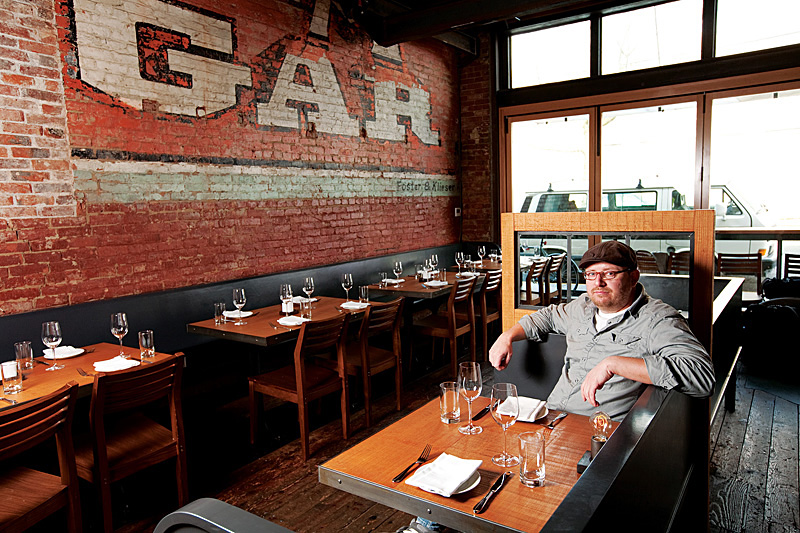
Glass panes now separate the 1,500- square-foot Staple & Fancy (which takes its name from a sign describing the old grocery’s offerings), fronting the building, from Erickson’s even smaller The Walrus and the Carpenter. Working in the kitchen, Stowell can see Erickson’s staff shucking the oysters that are The Walrus and the Carpenter’s métier. The restaurateurs further share the building with a bike shop.
In times past, Stowell had a reputation for being a demanding boss. Dahlin says, however, that by the time he arrived at Union, the chef “had mellowed out.” On the night Stowell demonstrates how to make gnocchi at Staple & Fancy, a line cook knocks over a tray of the finished product while Stowell has stepped away. Stowell comes back and casts an arched eyebrow. “Who dropped the plate of gnocchi?” he asks. But his tone is wisecracking, and his cooks dodge the question with evasive jokes.
Yet as Stowell has mellowed, has he also scaled back his culinary ambitions?
Gabre-Kidan—who parted ways with Stowell prior to Staple & Fancy, looking for something uniquely his—contemplates the difference between his former partner’s pre-Union and post-Union styles. “It’s just a different level of execution.” At Tavolata, he recalls, “there was a rigatoni dish they had on the menu forever.” It was, he says, “super-simple,” requiring browning some Italian sausage and mixing it with tomato sauce and pasta.
Stowell’s own website repeatedly uses the words “simple” and “rustic” to describe his cuisine. Asked if he feels as though his current cuisine is a step down, he replies, “I don’t look at it like that. There’s always something for me to find joy in.”
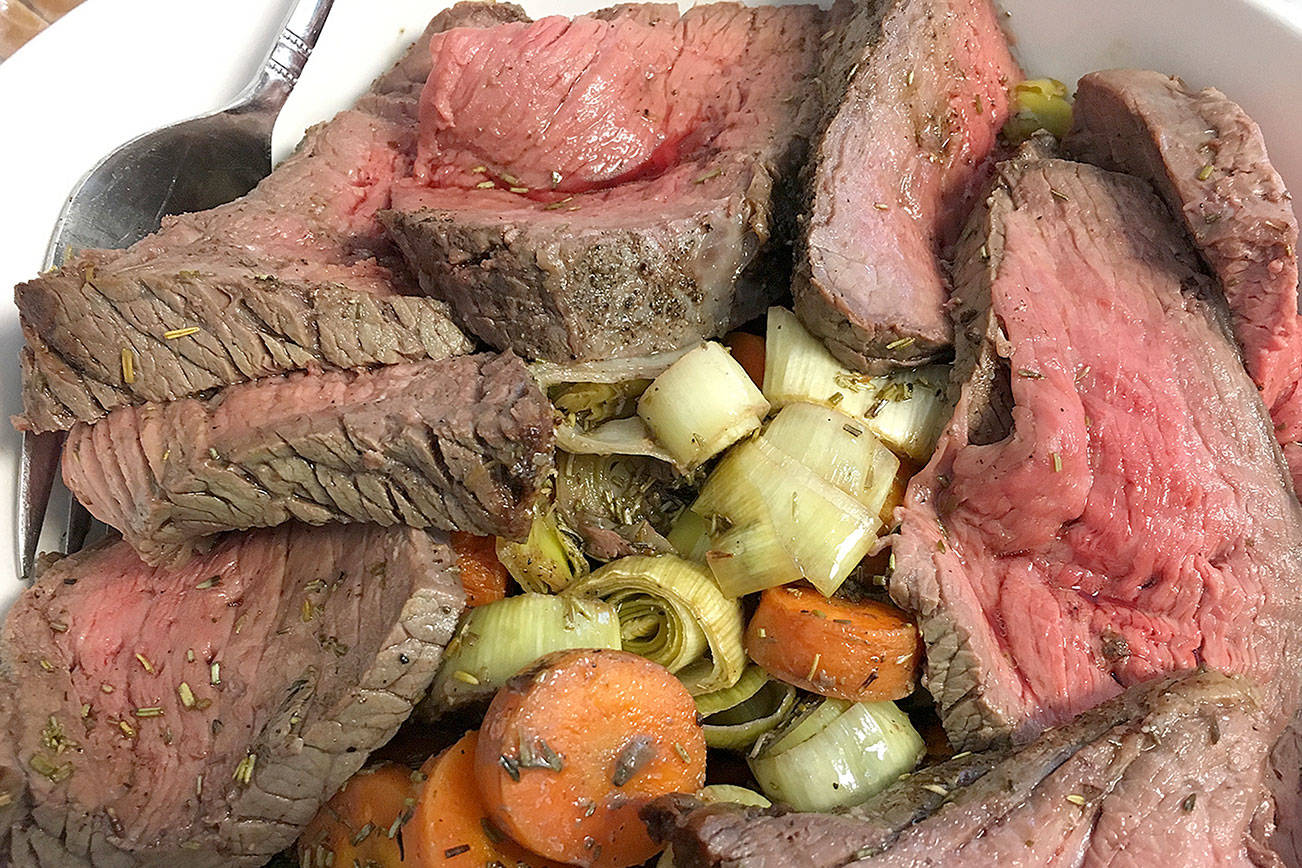
On this evening in Staple & Fancy’s kitchen, he looks toward the wood-burning grill, where a leg of lamb lies crackling. “The best way to cook lamb is whole,” he says. Yet he never got to cook it that way at Union because he didn’t have the certainty of knowing that all the meat would be used. That’s the benefit of the chef-controlled fancy menu, he says.
To order it is to know that Stowell is still operating at a very high level. After the a la carte menus are whisked away, a whirlwind of impeccably prepared appetizers descends upon your table. Among them on a recent Sunday night: smoked-halibut bruschetta, fried oysters with aioli, a soft-boiled egg topped with white sardines, and a crudo made from a white fish called escolar. The latter, perched on avocado purée and topped with the tiniest slivers of salted cucumber, is a study in refinement.
The entrées—homemade chicken and sage ravioli and pork loin encased in piquant herbs—are both tender and toothsome. A delicate, creamy lemon tart finishes the meal.
Stowell’s mother wonders whether her son has yet to achieve the height of his ambition. “I think some day he will have a small place, with a set menu and things he really wants to cook, that are absolutely top-of-the-class,” Russell says. “It’ll be a little bit like Staple & Fancy—but on a different plane.”
Yet Stowell says he’s arrived at an ideal place with the fancy menu, which gives him both freedom and flexibility. He envisions a day when the recession is over and “we’ll be able to raise prices and start doing more expensive things.”He also says he’s enjoying himself at Staple & Fancy. Later on in the evening, he tries to think of ways to get diners to watch sous chef Jon Silveira expertly flip flatbread dough as if it were pizza. As the dough begins to fly, he bangs two sauté pans together like cymbals, which generates an embarrassed smile from the sous but little attention from those immersed in their food and conversation.
The restaurant is pleasingly full, with a varied crowd that includes 30-ish hipsters and 60-ish retirees. The kitchen feels relaxed, Stowell spilling salt on the floor as he seasons his sauces and taking a moment to talk with his parents, who peer over the kitchen counter after their meal.
“What’s with the hat?” his mom asks. His dad, with a wink, quips to an observer that his son’s profession is “more sissy than the ballet.” Stowell smiles, reminds them that they’re having dinner with him and his wife on Sunday, and walks them out.

The Ballard Avenue exterior of Staple & Fancy.