
Some months ago, Ron Davids noticed that Robbie Keys liked to open car doors. Keys—a tall, dark-haired 47-year-old who moves quickly but with stooped shoulders—is developmentally disabled, or what used to be known as mentally retarded. Except for the occasional exclamation—often “Hot!”—he doesn’t speak, and can’t easily communicate his likes and dislikes. According to his parents, he spends most of his time walking around, gazing out windows. So when Keys grabbed a key ring and opened the door of Davids’ white Honda Accord one day, Davids saw it as a clue. “I sensed he was a tool user,” Davids says. He thought he could work with that.
Davids, a loquacious, grey-haired former pastor, is on the front line of a 3-year-old state policy that encourages all developmentally disabled people to find paid employment—no matter how profound their disabilities. As an employment consultant for a Bellevue organization called AtWork!, Davids’ task is to identify skills in people who were long thought to have none, and to match those skills with jobs in the real world. Keys is one of the most challenging people on Davids’ caseload, but because of the epiphany about tools, he says, “there’s a chance.” Maybe Keys could assemble something—at some point way down the road. For now, Davids has to see if he is right about Keys’ mechanical inclination.
One recent Tuesday, Davids picks Keys up at the Bellevue group home where he lives and takes him to the AtWork! offices. On a conference-room table, Davids sets down a small, crude wooden box, and Keys fingers it like a foreign object, making his typical guttural noises.
“You can’t open it with your hands,” Davids says, and he holds up a screwdriver. Keys grabs the tool and immediately inserts it into one of the screws that holds the box together.
“OK, that’s making it tighter,” Davids says. Keys continues regardless.
“Robbie, stop—go the other way,” Davids says. Instead, Keys puts the screwdriver down and starts twisting the screw with his hand. When that doesn’t work, he tries the screwdriver again.
“Go the other way. Go the other way, please. Stop!” Davids says. Finally, Keys does. The screw pops out.
“All right!” Davids exclaims. “Got one.” Keys sits back and puts his hand on his chin.
“Hmmm,” Davids says, “can you go for two?” Keys does, and then tries another and another, but he periodically gets frustrated and stops. He rubs his eyes. He stretches his foot underneath the table and taps Davids’. As if preparing to leave, he puts his arms in the jacket he’s brought (despite the 80-degree heat).
“We can go to the car when we’re finished with the box,” Davids says.
Keys works with several more screws, but keeps reaching for his jacket. Finally, with Davids still urging him on, he abruptly stands up, puts on his jacket, and shoots out the door.
“So, it looks like I’m taking Robbie back,” Davids says. The activity has lasted about 20 minutes.
“It’s a noble effort,” says Robert Keys Sr., reflecting on Davids’ work with his son. He notes that Robbie used to split firewood and feed pigs and cows on the multi-acre Whidbey Island plot where he grew up—when he wasn’t jumping into a bulldozer or car and wreaking havoc. In recent years, though, his father says, he can’t get him to do anything. Robbie’s mother suspects her son may be prematurely aging, as people with developmental disabilities sometimes do. For whatever reason, his attention span is limited to a few minutes. “It’d be a miracle if they could find anything that he could do [for work],” Keys Sr. says.
The government officials who pay for services like Davids’ don’t see it as a miracle, exactly. They see it more as a civil right. “Everyone in the U.S. should have the opportunity to work and make a real wage,” says Ray Jensen, director of King County’s Developmental Disabilities Division, which doles out state money to individuals to fund their employment training. He and others in the field are trying to change the focus from what developmentally disabled people can’t do to what they can. It’s part of the broader movement of “inclusion,” which aims to take developmentally disabled people out of segregated facilities—historically prone to instances of abuse, and lacking role models—and integrate them into regular community settings.
The state’s Department of Social and Health Services intensified this effort three years ago when it decided that all the activities it funded for developmentally disabled adults under age 62 would be related to finding and keeping jobs. Previously, the state had offered a recreational program as well, which involved activities like swimming, bowling, art classes, and outings to the mall.
Priority was also placed on jobs in the real world, as opposed to so-called “sheltered workshops.” Often run by nonprofits, these workshops pay developmentally disabled people nominal salaries (most recently, an average of $2.20 an hour) to do rote assembly and other tasks for various companies. Although the state continues to fund support staff for sheltered workshops, social-service agencies that work with the developmentally disabled have gotten the state’s message and are phasing these facilities out. Their focus now is on finding their clients jobs in places like Fred Meyer, Starbucks, and PETCO.
In fiscal 2008, which ended a year ago, the state spent about $50 million on employment-related services for the developmentally disabled. Some 3,700 such people currently hold paying jobs in Washington, but most of these are relatively high-functioning. Among the developmentally disabled with more severe disorders, just 17 percent, or 406 individuals in Washington, have found work. The state does not set any particular deadline for people to achieve employment.
“We have had individual successes,” says Linda Rolfe, director of the state’s Division of Developmental Disabilities. But, she concedes, “I don’t think we’re as good at working with people with intellectual and physical impairments.” The task is doubly hard during a recession, when there’s little hiring of any kind going on.
“The economy makes it so that all those unskilled jobs will be filled by others,” says Cindy Christensen, whose 21-year-old son with Down syndrome is now looking for work.
Even if it were the best of times, some families wonder whether local officials have taken “inclusion” too far. They assert that the goal of a real job with a real wage is unrealistic for people who may not be able to talk, go to the bathroom by themselves, or eat independently. Karen McNerney’s 24-year-old daughter Megan is an example. She “functions about like a 2-year-old,” says McNerney, and like any 2-year-old, she wants to socialize, not work.
“It’s their agenda,” she says of government officials. “It’s not my daughter’s agenda.”
The state does allow people to apply for an exception to its policy and participate instead in recreational activities. But the state has not handed out many exemptions—35 to date, according to Rolfe, who says she does not keep a record of how many applied—and parents believe they are hard to get. After many complaints from parents, and spotty success, the state is now revising its exception policy to state that people who have made no progress after a year of employment services would be eligible for recreation instead. Families are waiting to see the fine print.
The third alternative for parents is to send their child away to a full-time, live-in institution—which, ironically, the state will pay for. That’s what McNerney ultimately chose for her daughter. “We didn’t have any other options,” she says.
Kathy Watson, a nurse who works at the University of Washington’s Center on Human Development and Disabilities, also laments the lack of options for her 38-year-old daughter Amanda, who suffers from Angelman syndrome, a severe neurological disorder that leaves her unable to speak or walk easily, and gives her the jerky movements commonly associated with cerebral palsy. “If she is too disabled to work, then she doesn’t get [state assistance],” Watson says. “If you think about discrimination against people with disabilities, you expect that from the outside world—not from people in the disability community.”
Still, Watson has decided to give job development a try with an open mind. “I believe she deserves to get out in the community and have something to do,” she says of her daughter.
Employment rates for the severely disabled are better around Seattle than statewide—30 percent compared to 17. “In King County, we live in the best place in the country for someone with disabilities to get a job,” says Margaret-Lee Thompson, coordinator for the King County Parent Coalition for Developmental Disabilities, an arm of the non-profit Arc of King County. The average work week is 10 hours.
Thompson’s son Dan, born with Down syndrome, worked at Microsoft for 14-and-a-half years, mostly in the mail room, before his death four years ago from a congenital heart defect. A state-funded job coach visited Dan once or twice a month at Microsoft. Otherwise he was on his own—and flourishing. “He became one the fastest, most accurate sorters,” read an obituary about him in Micronews, the Microsoft newsletter. “If you asked Dan who he worked for, he would stand proud and tell you he worked for ‘Bill,’ ” his supervisor, Denise Reubens, told the newsletter.
Some families point to an organization called Aaron’s Place as a model of what they believe the state should be funding. Aaron’s Place has three branches in the region, including one adjacent to Blanchet High School in Seattle, taking in about 25 developmentally disabled adults. According to founder Darcy Doyle-Hupf, half the program is focused on vocational training, some of which takes place in the community, such as at grocery stores where her clients work on “go-backs” (putting away items customers don’t want). The other half involves outings to parks and movies, and learning life skills such as shoe-tying.
Martha Schulte, whose 27-year-old son Nathan attends Aaron’s Place, says she likes the all-day programming and the fact that there’s more going on than employment training. “There’s socialization that’s needed, life skills that’s needed,” she says. “It’s not just, ‘Can you put this in a bag?'”
Doyle-Hupf is now applying to the county to be a vendor eligible to receive state funding for employment services. Her chances look slim, however, because Aaron’s Place congregates developmentally disabled people.
“That’s no longer desirable or allowable,” says Jensen. “I can show you law after law that says we can’t segregate people.”
To Schulte, that seems like “an extreme definition of ‘inclusion.’ It’s not allowing the identity of a group of people.”
Jensen, who has been in this field for more than 30 years, seems somewhat baffled by the opposition he is encountering from families. “Everything’s backwards,” he says. “People should be demanding that we find their kids normal stuff to do. I would accept that as a challenge.”
And to parents who contend that some people are simply too disabled to work real jobs, he says go see Jeffrey McNary.
On a vacant floor of the Exchange Building, an ornate old office tower in downtown Seattle, a sign stuck to the wall points the way to “Doc Destruction,” a paper-shredding business. Down the hall, a 56-year-old man with long brown hair and a bushy mustache, who makes loud humming sounds because he can’t talk and sits on a walker because he has trouble with his balance, operates a big shredding machine that occupies most of a small room. This is Jeffrey McNary, born with a diagnosis of profound mental retardation, and Doc Destruction is the business that his family started for him.
McNary takes paper from a bin by his side and places it on a conveyor belt that feeds the machine. Sometimes he takes a stack, sometimes just a page, ripping it up first. He doesn’t have to, but McNary has always loved to rip paper, according to his sister Sherry McNary, who is visiting today.
In a few minutes, the paper jams. Jeffrey presses a yellow button, reversing the direction of the conveyor belt. He takes a few pages off and presses a black button to feed the remaining paper. It gets stuck again, and he repeats the process, until the stack is thin enough to go through.
“He’s learned to problem-solve,” Sherry says. He’s also learned, since Sherry periodically brings visitors to show them what her brother can do, to ham it up. He rolls up a sheet of paper and blows through it. He brings some paper shreds back on the conveyor belt and throws them up in the air like confetti. He giggles.
Even when visitors aren’t here, Jeffrey seems to be having a blast, according to Sherry. He shreds Monday through Friday from 9:30 a.m. to 3 p.m., with only an occasional break for a snack or lunch.
“Bottom line,” Sherry says, “he’s a person who nobody thought would be able to do anything—including our family.”
Jeffrey spent 30 years in a sheltered workshop at the Northwest Center, an organization for the developmentally disabled that his parents helped found. In the early years, he did some shredding. Workers at the center told his parents he was so enthusiastic about it that he didn’t want to stop for lunch, Sherry recalls. But when the facility got a bigger shredding machine, it was judged unsafe for Jeffrey. He tried a variety of other tasks—smashing aluminum cans, for instance—but Sherry says nothing ever took. “He spent a number of those years pretty much not doing anything but sitting in a foyer with his coat under his arm, waiting to leave,” she says.
Consequently, about eight years ago, the facility told the family it couldn’t serve him any more, according to Sherry. The family contacted Jensen to see if he could intervene. He put them in touch with a nonprofit called the Washington Initiative for Supported Employment (now Sherry’s employer), which encouraged them to think about possible jobs based on what Jeffrey liked to do. The idea for a shredding business was born.
With tears in her eyes, Sherry says she wishes the family had tried this tack much earlier: “I can’t believe he had to wait so long in his life to have all of us hear him.”
It does, however, come at a cost—literally. Jeffrey has an assistant with him at all times: Mark Pain, a state-funded job coach who works for Highline Community College. Often working in a room next door, Pain opens the boxes full of documents to be shredded, takes out the paper clips and binders, refills the bins that sit by Jeffrey’s side, empties the shredder when it is full, takes phone calls from clients, helps Jeffrey with personal needs like wiping his nose, and takes him to the upstairs coffee shop for soy lattes and blueberry muffins. He costs the state approximately $2,750 a month. (Sherry also helps out, periodically renting a U-Haul truck to pick up documents from Doc Destruction’s approximately 30 clients.)
The concept of “supported” work for the developmentally disabled, as it is called, is that job coaches will “fade” over time—checking in only once or twice a month. That cost is balanced, as Jensen points out, by the Social Security tax disabled workers pay.
There are no plans for Pain to fade, however. Jensen says that Jeffrey needs intensive support “regardless of the situation. It makes sense to invest in something that returns something back plus enhances his personal status.” Sherry says she hopes, in time, that the business will grow enough to enable hiring another disabled worker who can share Pain’s services.
Cindy Christensen has reservations about the cost of supporting her son in a job. “It’s tough having society pay for someone to work with Kevin,” she says. She’s the kind of person who hates seeing taxpayer money wasted; she says she blanches when she sees someone who can really work receive disability payments. She points out that sheltered workshops cost less money because supervisors look after a group of people—about $7 an hour, compared with $25 or more for one-on-one support, according to county figures.
She talks wistfully about sheltered workshops for another reason as well: “They did provide somewhere for all of the adults to go.” The reality of empty time is kicking in for Christensen. As she speaks, Kevin is about to graduate from the Issaquah School District’s post–high school transition program. “It’s just going to come crashing down, and [Kevin and his peers] will have nothing to do,” she says.
Like Robbie Keys, Kevin is working with Ron Davids, who has lined up a job of sorts. Davids talked an old friend of his, the pastor at Redmond Presbyterian Church, into letting Kevin do light janitorial work at his church a couple of days a week. The job for now is a volunteer position, but Davids has proposed that the church phase into paying Kevin.
“I really don’t hold out a lot of hope for this one,” his mother says. “Kevin’s skills lie in his friendliness. He can remember anyone’s name he’s ever met. He would be able to work as a greeter at a restaurant.” But the job at the church strikes her as a “make-up job”—the church already has a janitor on staff—and it’s one he would potentially do on his own without any supervisors or peers around. “Kevin likes to be praised,” Christensen says. “If he’s doing it by himself, it’s not going to happen.”
Other challenges emerge on Kevin’s first day of work.
Davids picks him up in Issaquah at his tan rambler about 9 a.m. Kevin emerges from the front door in gray cargo pants and a navy polo shirt. He has glasses that darken in the sun, a little mustache, and a bowl cut of red hair.
“Pay close attention!” his mother calls as he gets into Davids’ Accord.
“Yes, Mom,” he says.
At 10 they arrive at the woodsy, one-story church. Davids takes from his trunk a plastic bag of Windex, paper towels, and dusters and walks in. Kevin marches behind, swaying slightly side to side.
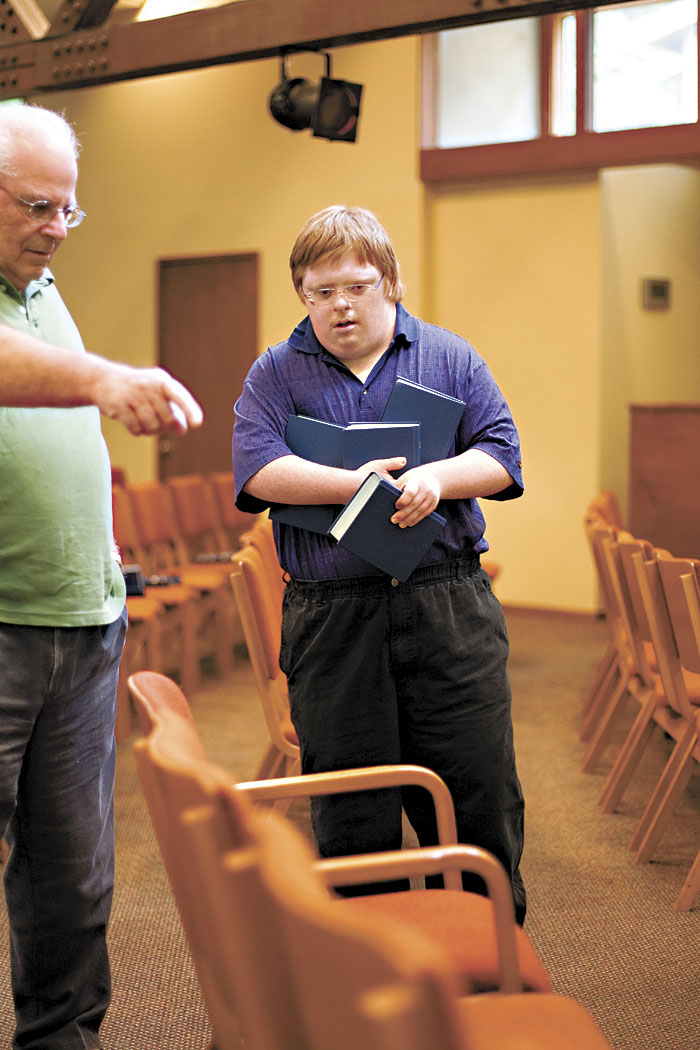
Davids surveys the sanctuary and decides the place to start is to straighten up the hymnals and Bibles. “You can see the difference between the Bible and the hymnal,” he says, holding up one of each. “Can you read that?” he asks, pointing to the Bible. “Holy Bible,” Kevin responds, his speech somewhat slurred. Davids demonstrates how to slip the hymnals into holders tucked between the seats, and to lay the Bibles flat alongside them. Kevin quickly gets the hang of it.
“How’s that?” he asks, putting a hymnal in place. “Very good,” Davids says, “keep going.” “OK?” Kevin asks after the next one. “OK!” Davids says. “Keep going down the row.” And so it goes, seat by seat, until at 10:40 they are done with the rows.
They try dusting next, but Kevin starts to look short of breath. He doesn’t have much stamina, according to both Davids and his mother. “Do you need to take a break?” Davids asks. “Yeah,” Kevin says. Sitting side-by-side a few minutes later, Kevin asks: “Could you sing?”
“Could I sing?” Davids repeats.
“Yeees,” Kevin says, laughing.
“I know you like country music,” Davids says. “Who’s your favorite country singer?”
“Toby Keith.”
Apparently not knowing any Toby Keith songs, Davids launches into “Hey, Good Lookin'” and “There Was an Old Lady Who Swallowed a Fly.”
Then they get back to work. With the sun pouring in, Davids abandons dusting and starts cleaning windows and the glass panes of the doors. He brings a stepladder over so that Kevin can reach the highest panes. Kevin puts one foot on the bottom step, then stops and gets down again. “Can you put both feet on the bottom step?” Davids asks. Kevin does, but he holds onto the stepladder’s handle for dear life. Kevin has trouble with depth perception, his mother says, and for him such an exercise is “like he’s standing on the top of a 15-story building, out in the middle of nowhere.”
He steps down again. “Take a deep breath,” Davids urges. “I’m right behind you.” Kevin puts one foot on the step, then another, gripping the handle all the while. “Let go!” Davids urges. Kevin lifts both hands, then quickly puts them back and steps down.
“No,” he says finally. When they return several days later, they use a pole.
Davids says he’s done the best he can to find a suitable job for Kevin, but it’s not easy. In truth, he says, it’s not easy to find a job for anyone in his 12-person caseload—especially in this economy. He got a job offer for one client at Northgate Mall’s Auntie Anne’s Pretzels, passing out samples. An hour later, he says he was told there was a franchise-wide hiring freeze. Something similar happened at the Snoqualmie Casino, where he had lined up a few jobs cleaning the kitchen and slot machines.
In January, he was excited about his first successful placement: a client with Down syndrome who got a job at Fred Meyer in Issaquah returning carts from the parking lot. According to store manager Pete Laudadio, students often take the job on weekends but are unavailable during the week. It didn’t work out, though, with Davids’ client. He kept getting stuck in the break room, reluctant to go back to work; then one rainy day he sat down outside on the curb and declined to move. The job lasted about three months. And that was one of his higher-functioning clients.
Davids keeps trying but says the high frustration rate leads to burnout in the field. “We get weary,” says Davids. “We get very weary.”

Robbie Keys, 47, tries his hand at disassembling a box.
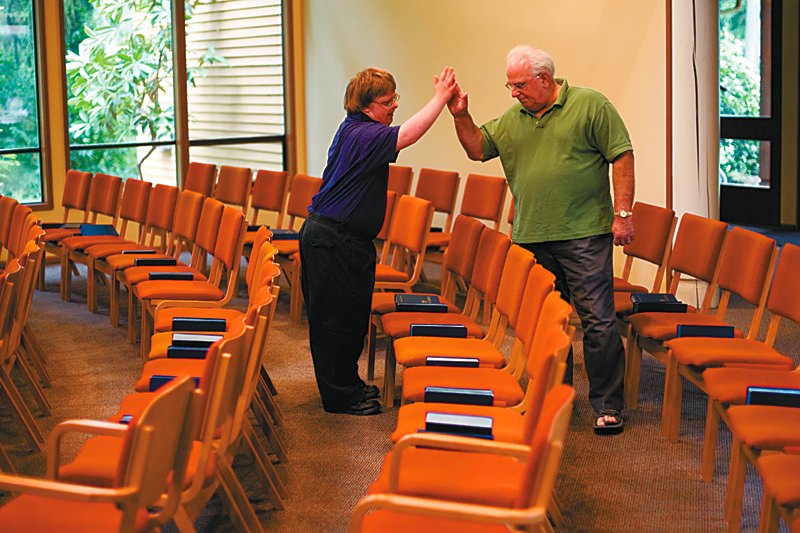
Davids and Christensen work the pews.
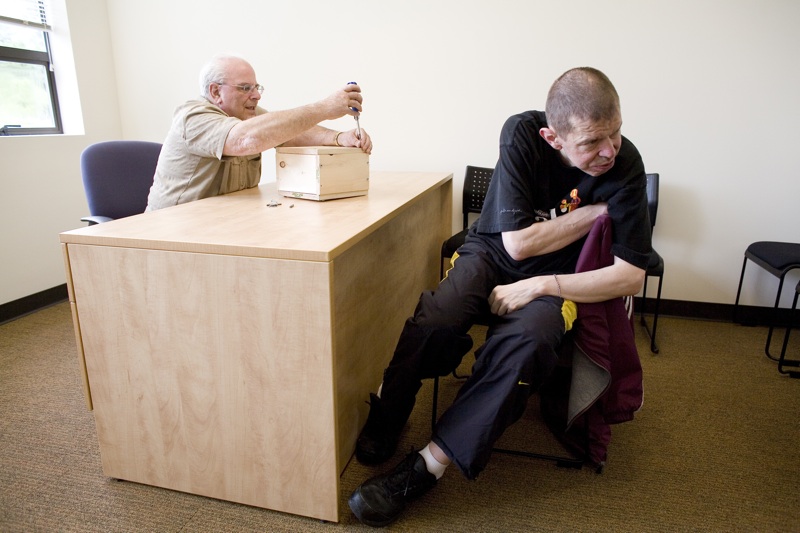
For unknown reasons, Keys’ attention span has been limited to a few minutes.

Professional document shredder Jeffrey McNary, 56, with his sister Sherry.