Wednesday, June 10
7 p.m., Harvard Exit
The Fortress
One of several films about illegal immigrants in Europe at SIFF this year (see also Welcome and The Escape), this Swiss documentary scrutinizes the apparatus often called “Fortress Europe.” It’s a system designed to reassure Continental consciences—surely we’re treating those people humanely—and yet also keep those people out. Given near-total access at one refugee facility, director Fernand Melgar treats everyone fairly (this being neutral Switzerland). Detainees from Bosnia, Kurdistan, Eritrea, Togo, and beyond are all sympathetic. If they exaggerate a little bit about the threats they face back home—well, wouldn’t we do the same to get asylum? One of the Swiss magistrates says of an immigrant’s tale of woe, “It’s just a bit stereotypical.” This is the problem: All the stories sound alike, perhaps because they are, perhaps because some refugees are exaggerating for effect, or perhaps because the whole system at “La Centre”—and in Europe as a whole—produces the same meta-narrative of immigration and exclusion. The Fortress isn’t a film of outrage; this Wiseman-style doc is all about process. But unfortunately, not a particularly interesting process. As one polite, well-meaning bureaucrat complains to a superior about the detainees, “Excuse my language, but they’re so damn bored here.” The most dramatic thing in the film is a statistic: Of 10,000 who filed for Swiss asylum in 2007, only 1,500 were granted that status. And 2,750 are still in a system that, properly speaking, also includes us. (NR) BRIAN MILLER Also: 4 p.m. Fri., June 12.
7 p.m., SIFF Cinema
PICK: Garbage Dreams
Adham wants to get married. He’s only 17, but that hardly seems to matter. He needs a wife. Weddings, it turns out, are one of the few bright spots in the otherwise difficult existence of the 60,000 Zaballeen living just outside Cairo. Each morning the Zaballeen flood the city to collect bags of trash. Their income comes from recycling nearly everything they find. But then the government privatizes some of its trash collection, and European-owned companies with large trucks and enormous bins threaten to make the Zaballeen obsolete. Garbage Dreams traces the story of Adham and his friends—the handsome and artistic Nabil and the shiftless Osama—as they try to imagine a future with no garbage. Without the trash, hopes for weddings are quickly dashed. Director Mai Iskander’s documentary makes a few rookie mistakes—every time the garbage trucks show up, cue the ominous music. And at no point does the film consider how a more efficient trash system might benefit teeming, chaotic Cairo, a city of 16 million. Neither does it explain why, in a Muslim-majority country, the Zaballeen are from its tiny Christian population. Still, the film isn’t mired in tragedy. Adham and his friends are shown in moments of often hilarious teen angst, coping with universal emotions. Garbage Dreams strikingly exposes a world most of us have never seen or considered. (NR) LAURA ONSTOT
9:30 p.m., Uptown
PICK: Three Blind Mice
The three Australian sailors on shore leave in Sydney are self-aware enough to make On the Town jokes, and some SIFFgoers will also be reminded of The Last Detail. In the one long night before their ship returns to active duty in the Persian Gulf, prostitutes are summoned, parents are visited, poker played, girls picked up, lives reappraised, and one Very Big Secret avoided—until it absolutely must come out. Writer-director-actor Matthew Newton plays the cleverest of the trio, a cardsharp officer with a cheeky wit; Toby Schmitz plays the (seeming) straight arrow, with a rich fiancée to please; Ewen Leslie is the enlisted man without a university degree who bears fresh, ugly scars on his body. Even if Newton excessively underlines a few big speeches, his writing gives a big cast of Aussie TV talent ample room to display their chops. (Heather Mitchell is a boozy hoot as the straight arrow’s mother.) The handheld camera chases after our three troubled musketeers, who quarrel, separate, and return to the same hotel room at dawn to debate the price of military discipline. (Recall Churchill’s famous description of the Royal Navy.) Thankfully, as it proceeds by its own fitful rhythm, Three Blind Mice isn’t just another one of those antiwar Iraq War movies. But it makes one think about the psychological injuries of friendly fire, without an enemy in sight. (NR) BRIAN MILLER
Thursday, June 11
6:30 p.m., SIFF Cinema
PICK: Afghan Star
Slumdog Millionaire, the documentary. Deservedly a Sundance prize-winner, Havana Marking’s film follows the American Idol knock-off produced in Kabul for a newly unified national television audience. Viewers from Afghanistan’s major ethnic groups vote for their favorite singer by cell phone, watching from satellite dishes rigged with chicken wire. This is a case of entertainment chronicling entertainment, and Tolo TV—a post-Taliban startup with several English-speaking producers—undoubtedly shapes the narrative and grooms its stars for Afghan Star. Each finalist from the tribes represented—Pashto, Hazara, Dari—parrots the Tolo TV line about uniting the country. Claims are made for cross-ethnic voting, but these are impossible to verify. (SIM cards are bought and sold in blocks, the film acknowledges, making it possible to stuff the ballot box.) But you know what, who cares? This isn’t Frontline. Rather, Marking gains remarkable access to reality TV in the Third World, dramatizing her real-life story with a quartet of funny, flawed, likeable, and ambitious young singers. It’s like The Hills interwoven with life-and-death politics. Fatwas are issued against one contestant, a woman who dares to dance on stage. (Slut!) Another finalist politely applies the verbal stiletto to his male rival thusly: “You don’t have a voice, but you have beauty.” Afghan Star has its limitations, but it’s truthful and fun. (NR) BRIAN MILLER Also: 11 a.m. Sat., June 13.
7 p.m., Pacific Place
Don’t Let Me Drown
And the 9/11 movies keep coming, this one from Hispanic Brooklyn. Teenage Lalo (E.J. Bonilla) is the American-born son of Mexican immigrants, fluent in English, happy and well-adjusted enough that his uncle taunts him, “He thinks he’s a little white boy now.” Meanwhile, Lalo’s father is shoveling debris in the pit of the World Trade Center, with an ominous, soap-opera cough festering in his lungs. Then there’s the darker-skinned Dominican Stefanie (Gleendilys Inoa), who’s still mourning from her family’s side of the 9/11 attacks. When confining itself to the Romeo and Juliet core, Cruz Angeles’ debut feature works fine as a tale of first love in the barrio. (The dialogue’s in English and Spanish.) Don’t Let Me Drown never insists that these kids are in any way special, and the two young leads are pleasingly free of overwrought, acting-school intensity. They behave like regular teens—goofy in all the expected ways, wise in unexpected moments. However, Angeles’ writing can’t resist the tendency toward telenovela: Grief must be added to grief; family squabbles become shrill affairs; and a creepy uncle must be added to the melodrama. Visually, the film repeats the familiar clichés both of 9/11 and Brooklyn in general: the montage of flyers for the missing, sneakers dangling from telephone lines, enchanted Manhattan shining just over the river. Angeles sets a nice mood, then clubs it to death with his script. (NR) BRIAN MILLER
7 p.m., Egyptian
Wonderful World
Ah, the Matthew Broderick stoner movie. Ferris Bueller all grown up, divorced, disappointed, a weekend father, looking chubby and unshaven, waking and baking in a squalid apartment he shares with a cheerful Senegalese roomie (Michael K. Williams). Weaned on Neil Simon plays, Broderick has always been a much better actor than his adult movie roles would suggest. Here, he’s utterly unsentimental and completely plausible as an ex-musician whose temp job as a legal proofreader has somehow extended to eight years. (And now his daughter is 11—dude, wake up!) “At least I don’t delude myself with hopes and dreams,” Broderick tells his younger temp colleagues (all aspiring actors and comics, this being L.A.). The curmudgeon thing works for Broderick, but the rest of Joshua Goldin’s debut as writer and director is a moldy dramedy casserole. A medical crisis afflicts the roomie, bringing his warm, wise sister from Africa (Sanaa Lathan), who says things like “Magic is everywhere.” It’s that kind of movie. Worse, Broderick must reconnect with his daughter, mount a Frank Capra courtroom crusade, and receive pointless THC visitations from “the Man” (Philip Baker Hall). Wonderful World is only smart enough to recognize that one multiculti fling won’t save Broderick from drowning in his bong water. Whatever else it’s trying to say—that’s just seeds and stems. (NR) BRIAN MILLER Also: 4:15 p.m. Fri., June 12.
9:15 p.m., SIFF Cinema
Breathless
Nothing to do with Godard here. This South Korean drama looks to its own gangster traditions as a petty loan collector slowly reconsiders a life of violence. Song-hoon (Yang Ik-joon, who also wrote and directed) begins the film as a sluggish, despicable lout. Beating up the deadbeats who owe his loan-shark boss we can understand, but Song-hoon will just as soon use his fists on members of his own gang (or pedestrians who look at him the wrong way on the street). He’s so unsympathetic, in fact, that Ik-Joon immediately telegraphs how this redemption tale will proceed. Flashbacks soon reveal the cause for our hero’s brutishness (“Fathers in this country are all fucked up!”); then there’s Song-hoon’s cute little nephew and a teenage misfit schoolgirl he meets—wouldn’t you know that violence has affected her family in the past, too? About as subtle as one of Song-hoon’s beatings, Breathless is a suffer-fest, a violent, sentimental melodrama that’s intensely felt by its creator, but not so involving for the rest of us. The bare-knuckle beat-downs aren’t actually that gory; there’s no need to avert your eyes. And when watching the screen during quieter moments, ordinary scenes of the urban poor—untouched by South Korea’s economic boom—are the best thing about Breathless, like the breaks between rounds in a boxing match. (NR) BRIAN MILLER Also: 9:30 p.m. Sat., June 13.
9:30 p.m., Egyptian
Give Me Your Hand
I am you. I am not you. We are identical twins. We are on the road in France. There is a mother. She is dead. In Spain, our destination. Now we are fighting. Now we are having sex with strangers. I am not talking to you. No, I am not talking to you. We hold each other when we sleep. The scenery is so beautiful we do not need to talk. We look so much like one another that no one can tell us apart, which can be confusing. I do not care. Neither do I. We are obviously a “meditation” on the “self” as much as on “family.” I am you. I am not you. (NR) JONATHAN KAUFFMAN Also: 4:45 p.m. Sun., June 14.
9:30 p.m., Harvard Exit
The Other Bank
Bank, in this case, means riverbank. Twelve-year-old Georgian refugee Tedo ventures across the river from safe-but-poor Tbilisi back to the old village in Abkhazia, where Russian forces and militias engaged in ethnic cleansing in the ’90s to reclaim that Black Sea province. (It’s now part of Putin’s plan to re-establish the old Soviet empire, a “country” recognized by no Western governments.) But as Tedo trudges home in search of his father, hitching rides by train and car, he encounters the same random violence that drove his family out when he was a child. Bribes are demanded at gunpoint. Women are raped. Tribal hatreds run deep, especially when most everyone Tedo meets is armed, drunk, or just plain sadistic. Though the Caucasian scenery is gorgeous, the people are mostly ugly. That the child actor playing Tedo is cross-eyed makes the film doubly painful to watch. That the subtitles don’t always distinguish among the three different languages spoken doesn’t help us identify which group hates the other. The few individuals who are kind to Tedo are usually punished for their deeds. In the final credits, Georgian director George Ovashvili dedicates his film to his homeland, but it doesn’t convince us the place is worth loving. (NR) BRIAN MILLER Also: 11 a.m. Sat., June 13.
Friday, June 12
4:30 p.m., SIFF Cinema
PICK: Rain
So named because she was born outdoors during a storm, teenaged Rain has to adjust to Nassau slum life after the death of the grandmother who raised her on a small Bahamian island. It’s an adjustment for Rain’s mother, too—decent-hearted but addicted to dice and the pipe, barely able to take care of herself much less, suddenly, a daughter. But a newly discovered talent for running and a no-nonsense but nurturing track coach help Rain cope. It may sound a touch formulaic, but Rain artfully keeps you guessing: Devout Christianity provides deep solace for the grandmother, but also, we find out, family turmoil for the coach; one minor character is a bastard in one scene, a hero in another. But Rain’s wide-eyed calm, engaging modesty, and resilience remain steady throughout. (NR) GAVIN BORCHERT Also: 7 p.m. Sat., June 13.
6:30 p.m., Harvard Exit
Everyone Else
Remind me not to go on vacation in Sardinia, because that is surely where my hypothetical girlfriend will dump me. But only after much talky back-and-forth, long periods of sunbathing and emotional evasion, cryptic calls home to Germany, awkward encounters with other tourists and vacation-home owners, arguments over class differences, a long, boozy evening with a frenemy couple, and a half-hearted suicide attempt. Everyone Else isn’t just a relationship movie; it’s like being trapped in the same smothering relationship as the central couple (Lars Eidinger and Birgit Minichmayr). For extremely patient SIFFgoers, it’s also a date movie in a schadenfreude sort of way. (“Thank God we’re not like them… we aren’t like them, are we, honey?”) Depending on your perspective, he’s a pretentious weakling and twit, or she’s an unreliable, moody nutcase. And if their relationship is doomed, it’s coming apart very slowly—don’t expect Stromboli or even Betty Blue. There is sex, but only after erotic banter like “Don’t be so arrogant” and “I always think I’m too boring for you.” Writer-director Maren Ade isn’t afraid of naturalism or long, uncomfortable pauses in her work. But from our side of the screen, her couple’s happiness or unhappiness looks exactly the same. (NR) BRIAN MILLER Also: 5 p.m. Sat., June 13.
6:30 p.m., Pacific Place
Kimjongilia
North Korea sucks, as everyone is well aware. A State of Mind and Crossing the Line (seen at SIFF ’07) are among several recent docs to remind us of that truth. Kimjongilia—named for a flower named for the possibly stroke-incapacitated dictator Kim Jong-il—is only made topical by North Korea’s recent missile and nuclear tests and kidnapping of journalists. But the film’s focus is on the escapees from the terrible national gulag: first-person testimonials of starvation, labor camps, executions, forced prostitution in China (whose official policy is to repatriate North Korean refugees), and the cult of personality that may extend Kim family rule to a third generation. (Ladies and gentlemen, put your hands together for English-speaking Kim Jong-un, schooled in Switzerland, an avid skier, and a fan of Michael Jordan!) Though it nicely animates old propaganda posters and includes some harrowing, illicit street videos (malnourished babies, anyone?), Kimjongilia is a monotonous catalog of second-hand misery. Did 600,000 or 3.5 million die of famine during the ’90s? This film can’t tell us, but its claims will surely be resolved in the years near ahead. After killing so many of its own civilians, North Korea is surely dying. And one suspects that regime change will come like one of its bizarre yet impressive choreographed stadium displays—with the flip of a card. (NR) BRIAN MILLER Also: 1:30 p.m. Sat., June 13.
7 p.m., Egyptian
American Primitive
The gays like Hallmark cards, too. Basically a love letter to her father and her father’s boyfriend, Gwen Wynne’s autobiographically inspired tale takes place on Cape Cod, circa 1973, and the period details are all there. Widowed English-born father Harry (Tate Donovan) favors three-piece tweed suits, though he’s set up shop making colonial-style furniture (hence the film’s title). His two thoroughly American teen daughters (Danielle Savre and Skye McCole Bartusiak) clothe themselves in an epic collision between hippie and preppie styles, marking them even more the newcomers at school. Harry’s secret live-in lover “Mr. Gibbs”—as the two girls call him—wears manly muttonchops. And all the Cape Cod ladies who mistakenly believe these two men are straight wear cocktail dresses out of The Ice Storm. But enough about hair and wardrobe. Though certainly topical as gay-marriage laws are being enacted and repealed (and yes, there’s a custody struggle here with the grandparents), American Primitive is heartfelt but awful, a drippy compendium of clichés about both coming out and (for the girls) fitting in. It’s the kind of movie where the local clam-digger kid (Josh Peck from TV’s Drake & Josh) delivers the big speech about tolerance in his working-class Back Bay accent: “Your family is your family, no matter what.” Fine, we can all agree with that. Now go dig us some more clams. (NR) BRIAN MILLER Also: 4:30 p.m. Sat., June 13.
7 p.m., SIFF Cinema
PICK: In Your Absence
It’s not often you watch a movie and it captivates you even before the first syllable of dialogue is uttered. Iván Noel’s In Your Absence is about a young boy’s coming of age following his father’s death. It’s set in the rolling hills of southern Spain—the beauty of which, during the opening credits, will take your breath away. Pablo (Gonzalo Sánchez Salas) is dealing with the emotional repercussions of his father’s demise just at the time when puberty and hormones start hitting him. He spends most of his time playing in the fields with his friend Julia (Ana Tutor), an overly sexual, more experienced girl. From her provocative outfits to her salacious statements, Julia commands attention as the crude, blunt, and ultimately tragic girl she is. The movie follows Pablo as he meets a man named Paco (Francisco Alfonsin) on the side of the road in his small town. Desperate for a father figure, he latches onto him. But neighbors warn him against the stranger, and Pablo eventually finds out the life-changing secret that Paco, and everyone else, is keeping from him. Audiences will truly be shocked at the unpredictable turn the movie takes. (NR) BRITT THORSON Also: 4 p.m. Sat., June 13.
9:30 p.m., SIFF Cinema
Involuntary
This Swedish study in group dynamics proceeds in overlapping vignettes with many, many characters. The tone is generally comic, but there are suggestions of how things could get out of hand. A tour-bus driver begins hectoring his passengers about an episode of what he considers petty vandalism. He stops the coach, and the passengers begin to seethe—will their anger turn to open revolt? Or when some rowdy teens lob a beer can into the highway, it strikes the roof of a shiny new SUV. Which pulls over with an angry screeching of tires. Uh-oh. Hints of violence and sexual violence run beneath the surface, but writer-director Ruben Östlund clearly doesn’t want to push things that far. Involuntary is like a more benign cousin to the films of Michael Haneke (Caché, Funny Games); social controls and peer pressure are explored, yet without drawing blood. Coercion is more a process of polite, orderly shaming, as if the old Japanese axiom about the nail and the hammer were translated into Swedish. Which is to say that Involuntary is interesting in an illustrated-psychology-textbook sort of way, but not terribly eventful. Well before its 98 minutes are up, you’re hoping for something dreadful to happen. (NR) BRIAN MILLER Also: 3:30 p.m. Sun., June 14.
9:30 p.m., Uptown
North
Scandinavian filmmakers tend to excel at the art of deadpan comedy, but sometimes a comedy needs more for its hero’s (non-) reaction. Lumpy, lonely ski-area worker Jomar (Anders Baasmo Christiansen) is depressed—fine, that’s a perfectly good starting point for a snowmobile picaresque. If his frigid northward journey helps him get over heartache, or find an unexpected family member, so much the better. Only Jomar’s adventures aren’t so eventful: accidental house fires, snowblindness, the kindness of strangers, and the chronic search for booze to wash down his meds. Everything is well played (often by nonprofessional actors), but the pacing is like pushing your way through a snowdrift. One or two belly laughs are the most to expect from a film whose comic sensibility goes like this—Jomar: “Things are a bit difficult sometimes.” Other guy: “That’s what it’s always like.” Thanks a lot, fellas. Now I’m depressed, too. And I can’t wait for ski season to begin. (NR) BRIAN MILLER Also: 11 a.m. Sat., June 13.
9:30 p.m., Harvard Exit
PICK: Youssou N’Dour: I Bring What I Love
It’s with not a small amount of embarrassment that I admit that, prior to watching this doc, my only knowledge of Youssou N’Dour was his “In Your Eyes” duet with Peter Gabriel for Say Anything. I’m probably not alone there, which I expect will make Elizabeth Chai Vasarhelyi’s portrait of the Sengalese singer and political activist that much more compelling to Western audiences. But what sets I Bring What I Love apart from other musician-centric documentaries is that in avoiding hagiography, it becomes something much more novel: a nuanced exploration of Islam that avoids the topic of terrorism altogether. In 2004, N’Dour released Egypt, a collection of Sufi praise-hymns in the vein of his griot roots; while he performed the album for adoring, and secular, European audiences, album sales tanked in his native, predominantly Muslim, Senegal. Vasarhelyi follows N’Dour, one of Africa’s most treasured musicians, as he attempts and ultimately fails to negotiate the fault lines between his profession, his faith, and the rigid traditions that determine how and when that faith is celebrated. (NR) VERNAL COLEMAN Also: 1:30 p.m. Sun., June 14.
Saturday, June 13
6:30 p.m., Pacific Place
Amreeka
Another heartbreaking drama about Arabs and their mistreatment in the U.S. Palestinians Muna (Nisreen Faour) and teen son Fadi (Melkar Muallem) leave the Israeli-occupied West Bank for Illinois after 9/11, thanks to a green-card lottery. So we watch in guilt as overqualified Muna travels from bank to bank looking for a job, turned away by receptionists who don’t even try to hide their horrified “She could be a terrorist” faces. She ends up having to take a job at White Castle. Ashamed, Muna lets her whole family believe she works at a bank, rather than admit the truth. Amreeka continues its predictable route as Fadi is beaten up at school, taunted for his name (“Fatty!”), and has foreseeable graffiti written on his car (“Go home, Saddam”). Muna suffers equally embarrassing tribulations: coworkers mocking her accent, even threats of physical violence. Though sadly realistic, these humiliations and identity themes are still well familiar, almost eight years after 9/11. The strongest element here is Fadi’s trying to deal with the twofold hardship of embracing his heritage and struggling for acceptance as a first-generation immigrant teen. (NR) BRITT THORSON Also: 4 p.m. Sun., June 14.
6:30 p.m., Uptown
Fifty Dead Men Walking
Ben Kingsley dons wig and Northern Irish accent for this adaptation of the book by an IRA informant during the late ’80s. A petty salesman and scammer with a smooth tongue about him, Martin (Jim Sturgess) knows how to talk himself in and out of trouble. Part of the Catholic community in Belfast, his politics amount to money—enough for fashionable blue jeans, maybe a car, and—oops!—his girlfriend gets pregnant, too. That’ll cost a few quid. The British intelligence officer (Kingsley) recognizes Martin’s need for cash, but he also makes a moral appeal: Each IRA mission or bomb that he tips to the authorities saves a life. And from that, amid many voiceovers from Kingsley, the meaning of the book’s title—Martin can be a savior for those who’d otherwise be killed. (He also likes the high-tech new pager he’s given: “Very James Bond!”) Rose McGowan shows up as an IRA assassin/seductress, but most of the film is a gray-skied muddle. Everyone’s name seems to be Mickey, and it’s often unclear which Mickey is ordering the death of that Mickey. Also, 70 years past John Ford’s The Informer, Martin’s dilemma as the trusted but endangered inside man is pretty well familiar. He wants to please Kinsgley, he wants to please his IRA mates—and he can’t have it both ways. That he should become disgusted with the violence used by both sides of the conflict isn’t terribly surprising. The drama seems stale, and 1988 more than 21 years distant. (NR) BRIAN MILLER Also: 1:30 p.m. Sun., June 14.
7 p.m., Egyptian
Every Little Step
In 1974, 18 years before MTV first assembled a group of comically mismatched 20-somethings and videotaped them being real, choreographer Michael Bennett gathered 22 Broadway dancers late one night, set a tape recorder running, and asked them to talk about their lives. They did, telling moving tales of their career struggles, troubled childhoods, and sexual awakenings. Those stories, shaped by Bennett and his collaborators, became A Chorus Line, which opened at the Public Theater the next year, soon transferred to Broadway, and ran there for a then-unprecedented 15 years. James D. Stern and Adam Del Deo’s documentary juxtaposes the casting process for the 2006 revival with the affecting story of A Chorus Line‘s creation. Following several performers as they audition for the revival, the doc’s approach is designed, one presumes, to attract a wider audience in the era of reality entertainment. But while that meshes nicely with the arc of the musical itself—about dancers going through a grueling interview process to earn a spot on the line—we never learn enough about the individual subjects to care about their stories. For Chorus Line fans, though, the documentary—executive produced, it’s worth noting, by theatrical superlawyer John Breglio, who also produced the revival and controls Bennett’s estate—is a singular sensation, filled with behind-the-scenes backstory and archival clips of Bennett himself dancing, gorgeously. Then there are those original interview tapes, kept under lock and key for 35 years, with the dancers speaking the words that, up until now, you’ve known only as lyrics. (PG-13) JESSE OXFELD
10 p.m., Harvard Exit
Kaifeck Murder
Imagine our beloved former Sonics mascot Squatch stripped of his jersey and equipped with oversized wooden choppers and bells dangling from his ass. You’d get something like the Perchta, a hairy monster of Bavarian folklore (and the brothers Grimm) that’s supposed to scare the devil out of German villages. Answering only to his wife, Frau Perchta, this mythical creature may be real in Kaifeck Murder. Or it may just be a costume worn by the villagers of Kaifeck during tourist season. Or it may be the unhinged imagination of visiting photographer Marc (Benno Fürmann), who arrives with his 10-year-old son in foggy midwinter, when the village is essentially closed down. But at night the Perchta appears in Marc’s dreams, along with bloody murders and mysterious figures roaming the woods. Could they all be connected to an abandoned old farmhouse whose inhabitants were slain there 80 years earlier? Kennen sie nicht der Novellen von Stephen King? Of course you do, but Kaifeck Murder is a pale imitation of the master. With an easily guessed plot, there’s not enough gore, suspense, or Wicker Man pagan mischief to make this movie worth the bother. But I’m glad Squatch has found a new gig. (NR) BRIAN MILLER Also: 4:30 p.m. Sun., June 14.
Sunday, June 14
6:30 p.m., Cinerama
PICK: OSS 117: Lost in Rio
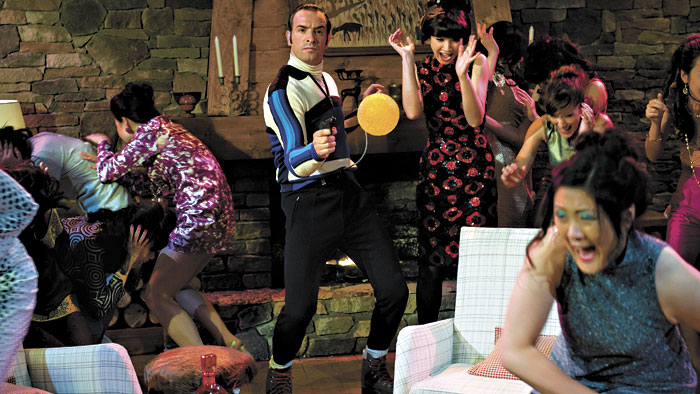
Considered as a film alone, this sequel to the delightful French 2006 retro-spy romp now wears its premise rather thin. But add the closing-night gala party at the nearby Pan Pacific Hotel… well, it’s just barely a pick. Agent OSS 117 (Jean Dujardin) is back, but he’s stumbled forward from the early Cold War espionage period (James Bond) to the late ’60s (perilously close to Austin Powers). Dispatched to Brazil to retrieve some damning microfilm from Nazis, our blithely arrogant dimwit hero encounters hippies, Jews (including a sexy Mossad agent played by Louise Monot), Chinese assassins, and loud-mouthed CIA bullies. And, yes, Hubert manages to offend them all with his oblivious, De Gaullist notions of patriarchal French superiority. But we got that joke the first time. After a ski-lodge dance party intro, Hubert’s antics—and all the split-screen Thomas Crown Affair montages—become progressively less hilarious, allowing you to study the perfect period costumes and background decor. Hubert’s lapels are wider, ladies’ skirts are shorter, men’s hair is longer, and strange new polyester fabrics now come in burnt oranges, bright mustards, and startling mauves. Much to his chagrin, the world is changing around Hubert. Still, he clings to the old ways. When the Mossad hottie lists his many imperfections—”You’re old, full of yourself, borderline racist…”—he hears only one criticism, and sounds genuinely hurt by it: “A tacky dresser?” (NR) BRIAN MILLER
See seattleweekly.com/siff for more new reviews, news, and interviews.