Black Gold
ArtsWest, 4711 California Ave. S.W., 938-0339, www.artswest.org. 7:30 p.m. Wed.–Sat., 3 p.m. Sun. Ends Nov. 15.
The folks at Arts West are talkin’ about a revolution, and it sounds like anything but a whisper. Black Gold is a satirical polemic about a blue-collar black man in Detroit who buys an oil rig on eBay and discovers a major oil reserve in his backyard. But once you accept the premise, the show’s denouement becomes all but inevitable. Without providing any spoilers, let’s just say that those with power will do anything to keep it, while those at the bottom of the social ladder will claw, sabotage, and even suffocate one another in order to move up a notch or two.
In this rambunctious production, the cast, crew, and even a few audience members get pulled into the action as the narrative darts from one locale to the next and tumbles out through nearly a hundred characters, all ably portrayed by a scrappy band of street players. The script, winner of the Smith Prize for best new play of 2007, is an angry and messy affair thrumming with anxious energy and seeking to incite in much the same way as Spike Lee does at his insurrectionist best.
Despite the fact that no character gets more than a minute or two onstage at a time, Black Gold has a strong narrative backbone, and it’s impossible to become lost or bored as director Christopher Zinovitch keeps the action moving from one end of the set of urban decay to another half a world away. And while all the performers wend their way through multiple roles, each of them has an anchoring character who moves the plot along toward its inexorable conclusion.
Without ever mentioning the name of the current Oval Office occupant, James Lyle evokes George W. Bush at his most hapless in trying to get his government’s hooks into this new source of domestic oil. Nancy Colos-Nakano is the congresswoman bent on using the oil as a tool of empowerment for the people of her district, and Alex Garnett and Aaron Washington play a pair of actors on opposing sides of the Arab-Israeli conflict who are trying to use their art to help both sides find common ground. Beth Cooper is in turn a television reporter, a worried Jewish aunt, and a street fighter. At the center of the fury is Bob Williams, who plays Curtis Walker, the auto mechanic turned oil magnate.
Daniel Schuy’s set resembles Sesame Street after a smart-bomb attack, Janette Singley-Wray’s costumes are serviceable and appropriately grungy, and there are live and recorded multimedia bits that keep the show as immediate and edgy as a breaking CNN news report.
Let’s admit straightaway that Black Gold is not an evenhanded debate on our national jones for foreign oil—it’s a manifesto. There are multiple angles, but a single point of view: No matter what, the rich will get richer and the poor will get poorer. That’s not much of a comedy, but as one of the characters points out, it does ring of the absurd. So much the better. There’s much food for thought here, and when we’ve just crawled collectively out of the rabbit hole that was the 2008 election cycle, it’s easy to understand how class warfare is still the most dependable and polarizing game in town. KEVIN PHINNEY
Pacific Northwest Ballet: New Works
McCaw Hall, Seattle Center, 441-2424, www.pnb.org. $25–$155. 7:30 p.m. Thurs., Nov. 13–Sat., Nov. 15, 1 p.m. Sun., Nov. 16.
On PNB’s continuum of “newness,” there are examples here of “new last year,” “new to us,” and “absolutely new.” The fact that some of the oldest work looked the newest just makes the timeline more complex.
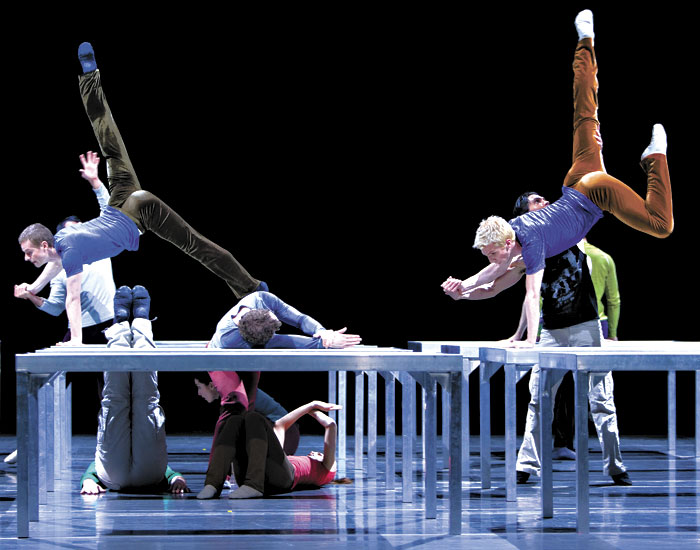
When William Forsythe’s One Flat Thing, reproduced premiered at PNB in 2000, it left audiences baffled. Thom Willems’ industrial-noise score was too loud, the athletic movement was too harsh, the array of tables that filled the stage was too distracting, and the sum of all these elements was too confusing. The volume is turned down this time, but the work is still exhilarating. From the opening moments, when the dancers drag 20 tables onto the stage with their metallic vibrations echoed by the sound score, we know we’re looking at a risky world, and as the performers slam into the floor and skid along the tabletops, we’re holding our collective breath for their safety. Forsythe has said he was fascinated by the South Pole expeditions of Ernest Shackleton and Robert F. Scott while he was making One Flat Thing, and wanted the tables to mirror something of that harsh environment—they should be “slippery, translucent, and dangerous.” A tricky kind of stage for a new kind of dancing.
By contrast, Mark Morris’s A Garden (2001) is a party en plein air, combining the fleetness of ballet allegro with the weighted momentum of modern dance. Set to a Richard Strauss score (a transcription of keyboard works by baroque composer Francois Couperin), the movement has the same gentle busyness, with some of Morris’ quirks as well. Dancers let their arms flop at their sides while their feet pick out complex patterns. The whole group takes one small hop upstage after assembling precisely in a complex array.
Kiyon Gaines, a longtime member of PNB, has the advantage of working with colleagues he knows well here, developing much of the movement on fellow corps de ballet dancer Lindsi Dec. He repays her devotion with a virtuoso role that combines casual elegance in the upper body with fiendish articulation in the legs. M-Pulse takes one of its main movement themes from its title, as lashing arms and legs propel longer dance phrases. There’s strength in the movement phrasing—we clearly see the cause-and-effect sequences through the body—but weakness in the structure of the work as a whole, as section follows section. The score, by Juilliard grad Cristina Spinei, reinforces the ongoing momentum of the movement but doesn’t help provide overall shape.
Benjamin Millepied, a dancer with New York City Ballet, has made an extremely stylish work with 3 Movements, set to Steve Reich’s Three Movements for Orchestra. His cast, with men wearing slacks and skinny ties and women in short, flirty skirts, feels like a group of real characters as they meet, part, and jostle each other. It was, at times, like work by Jerome Robbins—his sailors on shore leave in Fancy Free or his teenage rowdies in West Side Story—brought forward to contemporary times. Millepied isn’t telling stories so much as giving us little glimpses of people and their relationships, but they are as evocative as they are brief. SANDRA KURTZ
So Many Words
Theater Schmeater, 1500 Summit Ave., 324-5801, www.schmeater.org. $15–$18. 8 p.m. Thurs.–Sat. (except Thanksgiving). Ends Dec. 6.
As it turns out, there’s a reason that drama teachers harp on “suspension of disbelief” from day one in middle school: It’s important.
Take, for example, the new production of So Many Words. The participants bring everything one could possibly expect to their staging of this lecture on love—the acting is crisp, Doug Staley’s direction is perspicacious and economical, and there’s nary a fault to be found in the set design or lighting. But they’ve all been hamstrung by Roger Rueff’s lugubrious script, which soars with lofty ruminations on all kinds of love and how an artist assumes responsibility for the ideas he puts into the world—all of which has not a damned thing to do with three-dimensional real life.
The play unfolds around a tug-of-war between author Stanley and the women vying for his attention. There’s his long-suffering assistant, Beth (Karen Jo Fairbrook) who sees to her employer’s every logistical contingency; Katherine (Teri Lazzara), Stanley’s shopaholic wife and the person least impressed by his acclaimed literary flights of moral grandiosity, and Pamela (Angela DiMarco), the gorgeous acolyte intent on seducing her idol even if it means steamrolling Beth and Katherine to get her way.
As the show opens, Stanley has arrived in Washington, D.C., to accept another in a long line of writing awards, but Pamela, who has shared a plane ride with him, beats him to the hotel and must confront first Beth, then Katherine, who each try to pry this hussy out of their suite. Pamela, for all her brilliance and beauty, is an incredibly selfish and myopic homewrecker who believes her actions are well-sanctioned by Stanley’s frequent and fervent defense of amorality.
This script is broken from the start, though. In an age of celebrity stalkers (to say nothing of mallet-wielding madwomen like Kathy Bates’ character in Misery), it’s impossible to believe that Pamela would last more than three minutes without hotel security tossing her out.
Adding to the confusion are oblique references to Stanley and Katherine’s 6-year-old, who was inexplicably beaten to death. Stanley’s acceptance of this horror has made their murdered child his muse and “the engine” that gives his work its moral authority. What happened to the boy remains a mystery, though, so it’s yet another example of the playwright demanding largesse so that he can move his characters around the set as pontificating pawns.
Very few of these criticisms apply to a cast I’d be happy to see under different circumstances. DiMarco in particular has a commanding presence and is utterly entrancingas the woman who’s come to rock Stanley’s world in exchange for opening her eyes to a universe without morality or consequence. At the center of the storm is Paul Custodio as the sad-sack Stanley. He’s doing his best with the material provided, but there’s a totally off-putting variety of personality traits coursing through Stanley’s mind. No belief in good or evil: Check. No sense of decency or restraint even when his wife knows there’s a strange woman in the hotel waiting to bed him: Double-check. Then there’s his bizarre explanation of why he commands the moral high ground to justify his hurtful behavior. His revelation then turns out to be the house of cards upon which this show is so feebly built.
To the cast and director, plaudits for a noble attempt. But even a theater novice knows you cannot move an audience with characters who don’t resemble flesh-and-blood human beings. KEVIN PHINNEY