Is This Really the Best Defense?
Published 8:00 am Tuesday, January 29, 2008
Sean Garrant, a dark-haired thirtysomething with a string of convictions on theft and other charges in his past, is standing again before a Seattle Municipal Court judge. His crime this time: stealing a pair of pants. His sentence: spend several days serving sandwiches to homeless people at a downtown shelter. He’s just returned from his week of penance.
“What did you think about it?” asks Judge Ron Mamiya.
“I liked it a lot,” Garrant says. “I’m going to make it a weekly thing. It’s woken me up.”
“You know you don’t have to steal?” the judge asks, reminding Garrant that there’s a “resource center” in the courthouse where he can get toothpaste, shampoo, and donated clothes.
Yes, says Garrant, he knows.
The judge gets assurance from Garrant that he has housing and medical care, then pronounces the offender done with his sentence.
“Congratulations,” Mamiya says. “We’re going to give you a hand.” Everyone in the courtroom claps as Garrant walks up to the judge, shakes his hand, and receives a certificate.
The feel-good scene stands in sharp contrast to the usual adversarial atmosphere at the courthouse. Here at Community Court, repeat offenders can avoid jail for low-level crimes—such as shoplifting, panhandling, and disorderly conduct—if they agree to perform community service and enter the world of social services for drug-abuse treatment and the like. The other requirement: plead guilty.
Community Court is meant to address the “root causes” of criminal behavior. It also helps relieve chronic overcrowding at the King County Jail.
“It’s a magical thing,” says David Chapman, head of the Associated Counsel for the Accused (ACA), who worked with Seattle City Attorney Tom Carr to launch the program three years ago. ACA is one of two public defense agencies serving Municipal Court, where misdemeanors are heard.
The other agency working Municipal Court has a different take. Lisa Daugaard, deputy director of the Defender Association (TDA), sees this new “collaborative” model as an abandonment of one of the most basic principles of American jurisprudence: the conflict between prosecutors and defense attorneys. She doesn’t like the idea of defenders automatically acquiescing to a guilty plea, even in the name of “helping” their clients. “You shouldn’t have to plead guilty to get help,” she says.
It’s not an idle philosophical debate. In the view of Daugaard and other observers, TDA’s refusal to “go along and get along” with the city’s plans, including Community Court, has caused it to be squeezed out of the courthouse by the Nickels administration. When the city took control of muni court’s public defense system from King County three years ago, TDA—which had previously been assigned a third of the misdemeanor defense business—was reduced to getting a fraction of that. Last fall, when a panel appointed by the mayor made recommendations for renewing the contracts, TDA was slated to be cut out entirely, according to documents recently obtained by Seattle Weekly. The panel recommended replacing TDA with an agency founded by Nickels’ father. However, the panel’s recommendation was shelved after the City Council began to raise questions about the mayor’s handling of the contract, and the mayor agreed to a new round of bidding. The City Council also succeeded in changing the makeup of the review panel so that its members would be chosen from a list submitted by the King County Bar, not just by the mayor.
Still, that may not be enough to keep TDA at the courthouse. And in the view of some TDA allies and other court observers, marginalizing the agency has undermined public defense.
“I think [the city] took a competent system and trashed it,” says Seattle University law professor John Strait. He points, as evidence, to a recent city auditor’s report that showed fewer cases going to trial. Traditionally, the overwhelming majority of criminal cases end with a plea. But the “jury trial rate” at muni court has fallen further under the city’s new system. For every 100 cases, only 0.98 went to trial in 2006, versus 1.35 in 2004. That’s a 27 percent decline.
Janet Ainsworth, also a law professor at Seattle University, and a former TDA board member, calls the shift “the canary in the coal mine. That’s a signal that the system isn’t working.” Even defendants who don’t want to fight the charges against them are negatively affected by a slip in the trial rate, says TDA’s executive director, Floris Mikkelsen, because good plea deals are hard to get if prosecutors don’t believe that a trial is a real possibility.
The audit explicitly raises the question of whether the drop is linked to ACA’s tendency to take fewer cases to the jury. ACA’s Chapman responds that if clients are deciding to plead, “it’s because they’ve made an informed choice. It’s not because we’re scared.”
The audit also determined that Chapman’s attorneys were juggling 10 percent more cases than they were supposed to in 2005. It anonymously quoted officials saying that “some ACA attorneys appear overwhelmed and unprepared.” While Chapman defends his attorneys, he concedes that some have handled as many as 50 cases a month. (The average, based on a standard imposed by the City Council, should be about 32.) When it won the city’s primary contract and began handling nearly all the misdemeanor work, “we couldn’t hire fast enough,” he explains.
On a recent day, Daugaard (pronounced DOO-gard) stands as a guest lecturer in front of a Seattle University Law School class on professional responsibility. A youthful 41-year-old, with chin-length brown hair pulled off to one side by a bobby pin, she’s dressed as if for a trial in a black skirt and red top. Sitting in concentric semicircles, the students have, to a person, propped-up laptops in front of them, which they tap at (despite Daugaard’s urging to just listen instead) as she introduces her first topic: defending clients whom she knows are guilty.
“I’m always puzzled that this is perceived as an ethical issue,” she says, “but I know from talking to normal human beings that it is.”
She makes her case: “Most people who commit crimes are never going to be convicted of them because they will never be reported. If they get reported, they will never be taken seriously. The quintessential example of this is drug crimes. In Seattle and King County, most of the people who commit what is, in fact, felony delivery of narcotics will never come to the attention of the police. For reasons that are either justifiable or not justifiable, either about race or not about race, Seattle police manage not to find white people who deliver drugs. So if I defend one of the people who is arrested and prosecuted, and the end result is that they don’t get convicted because of something I’m able to do, we just returned to the status quo.”
This is vintage Daugaard, who leads a Racial Disparity Project at TDA that is challenging the Seattle Police Department’s drug policies in King County Superior Court. TDA’s long-running litigation asks charges to be dismissed against a group of defendants based on what the agency contends is SPD’s selective enforcement.
Social justice themes have dominated Daugaard’s career. Intellectually gifted, the Seattle native enrolled in the University of Washington at the age of 12 and then went on to Yale Law School. She was so known for leftist activism there that one Yalie nicknamed her “Lisa Do-Good,” as mentioned in Brandt Goldstein’s 2005 book about Guantánamo detainees called Storming the Court: How a Band of Law Students Fought the President—and Won.
When she graduated from Yale, she says, she wanted to litigate “important cases,” but “four years in New York revolutionized my thinking about that.” Working for the Coalition for the Homeless and then the Urban Justice Center during then-Mayor Rudolph Giuliani’s “broken windows” policy, which cracked down on low-level crime, Daugaard says she learned that simple misdemeanor cases are, in fact, vitally important because of their impact on poor people’s lives. In her office—on the wall of which hangs a poster of a policeman in full rig-out, under the heading “Giuliani’s idea of a social worker”—Daugaard tells of seeing homeless-but-working clients unable to keep their jobs or pick up their kids from school because they were arrested for sleeping in public places.
Eleven years ago, she brought her newfound regard for misdemeanor cases back to Seattle, where as a rookie TDA attorney she was assigned to Municipal Court. Eventually, she became the agency’s Municipal Court supervisor, then its deputy and one of its most visible figures. One of her signature campaigns was against former City Attorney Mark Sidran’s car-impound ordinance, which had police officers confiscate the cars of drivers whose licenses were suspended. Daugaard was a vocal opponent, arguing that the law disproportionately affected the poor and minorities. The City Council eventually repealed the law in 2004.
“She’s smart, tenacious—and absolutely an ideologue and a true believer,” says Sidran, now chairman of the Washington Utilities and Transportation Commission. In her mind, he says, “the criminal justice system is fundamentally racist and classist and unfair.”
She can be a fierce opponent in court, battering prosecutors with an array of motions that challenge their evidence, their policies, and even the way the whole criminal justice system works. When a popular African-American DJ, Toby “DV One” Campbell, was charged last year with assaulting a police officer as another questioned his daughter after a football game, Daugaard didn’t just argue he was innocent of the crime. She attempted to indict the entire jury system, saying Campbell couldn’t possibly get a jury of his peers because felons are excluded from serving, and a disproportionate number of them are African Americans. The judge rejected her motion to either constitute the jury differently or dismiss the case. Campbell was found guilty but ordered to do community service rather than jail time by the judge, who said the DJ was acting as an overprotective father.
Daugaard reflects a crusading spirit that has always existed at TDA. Assistant U.S. Attorney Douglas Whalley recalls that when he was a city prosecutor in the ’80s, he found TDA “much more aggressive” than ACA. He does not view this favorably. ACA was “polite,” “easier to work with,” and “cared more about the client than the cause,” he says, and consequently “got good or better results.”
“We had a relationship with them, so we listened to them,” he says. He recalls ACA founder Irving Paul coming in to meet with prosecutors, with his trademark flannel shirt, string tie, wild hair, and Harvard law degree. Paul would say: “This guy deserves a break because of his mental condition or his physical condition,” Whalley recalls. “And we would do it. TDA had nobody like that.” Instead, he says, TDA was more likely to accept that a client would be found guilty at trial, and take a constitutional issue up on appeal. “I sometimes felt like clients were swept along.”
City Attorney Carr says that in assigning the bulk of the muni court business to ACA, the city “chose the better public defender.” He faults TDA for “taking cases to trial on principle. I can’t tell you how many times an attorney has come to me and said, ‘This case is going to trial [even though] the time offered [by prosecutors in a plea deal] is less than what the guy has already served.'”
“Sure,” retorts TDA’s Mikkelsen, a blunt-spoken former misdemeanor supervisor who took over as director last January. She says clients may not want a conviction on their record, which might cause them to be deported or constitute a parole violation on another charge that would send them back to jail. “[Carr] doesn’t know that?” she asks.
Pushing TDA to the margins of muni court has had a negative impact, according to Jeffrey Veitch, a former city prosecutor who is now a defense attorney. He wrote a letter of recommendation for TDA to the city during the last bidding process because, he says, “it just seemed like nobody was doing battle with the city.” For example, he says that up until recently, judges were increasingly imposing pretrial conditions in DUI cases that he felt were unconstitutional. While still presumed innocent, a person might, for example, be forced to go to Alcoholics Anonymous every day. A Washington State Court of Appeals ruling this spring restricted that practice, but Veitch says he thought the challenge should have occurred in Municipal Court, and would have, had TDA been more in the game.
“I really felt that TDA brought a different level of passion and tenacity,” adds Michele Slotemaker, another former city prosecutor, now an investigator for the state Commission on Judicial Conduct. She says if she were accused of a crime and wanted to fight it, she’d pick TDA to represent her, whereas, “If I really, really knew I’d better plead, I might pick an ACA attorney. They would always look for the good deal, the reasonable way out.”
Chapman indeed seems like a reasonable guy. He has a wide smile, glasses, and a gray beard and mustache. A graduate of the University of Puget Sound Law School, he started his career in the Pierce County prosecutor’s office. One day, he told his boss that he wanted to be a defense attorney. Rather than representing an abstract State, he says, “I needed to have clients I could touch.” His boss suggested Chapman call his uncle—Irving Paul.
As he’s telling the story in a hallway of ACA’s offices, the man who first interviewed Chapman at the agency saunters by. He’s a lanky 30-year veteran of ACA named Byron Ward. Asked why he chose to hire Chapman, Ward thinks for a moment, then replies that the “big question” was always, “Can you get along with people?” It seemed Chapman could.
Perhaps because he’s been one himself, Chapman believes prosecutors “have a heart, just like you and I do.” That fit in with ACA’s predilection for trying to find a meeting of the minds with prosecutors. ACA, Chapman says, has always put a lot of work into “mitigation packages,” the reports that tell of clients’ life stories and often attempt to look at the root causes of illicit behavior. “We would take them to prosecutors and say, ‘Do you really want to convict this person? We’ll get him connected to services.'” Chapman says ACA was an early believer in hiring social workers so it could do so.
From there, it was a natural leap to work on collaborative courts, first helping to design the city’s Mental Health Court, an eight-year-old body that channels mentally ill defendants into treatment rather than jail, and then helping to set up Community Court. Chapman himself, along with Carr, staffed the court for its inaugural three months.
“They personally made it happen,” says Catherine Cornwall, a senior policy analyst for Seattle’s Office of Policy & Management (OPM), which administers the public defense contracts in Municipal Court.
Despite Community Court’s “collaborative” tag, “the prosecutor gets to make all the decisions,” says Deborah Lurie, who staffed Community Court for ACA until recently. Although there’s a sentencing grid, prosecutors decide, for instance, whether or not defendants are eligible for the program.
Still, she says the benefit of the court is its recognition that “there are better ways of doing things than putting people in jail.”
In a small meeting room off the lobby of ACA’s offices is a framed Albert Schweitzer quotation: “Truth has no special time of its own.” Idealism can be found at ACA, just as at TDA. “I grew up thinking that many laws were an assault on the poor,” says young ACA attorney Gordon Hill, wearing a black trench coat and grabbing a smoke one day before heading to court. His artist mother, who sends him paintings with which he decorates his office, fed him on stories of injustice. As an adult, he taught English for a while at a community college, assigning his students readings by Martin Luther King and Malcolm X, before deciding to go to law school and “fight the fight.”
After a while, he says, “ideology fades away,” but he still professes a certain feistiness that has echoes of Daugaard. “It’s not about defending the innocent,” he says, “it’s about making the government do its job.”
Still, ACA has not been as active in challenging policy as has TDA. “You find your strengths,” Chapman says. “Also, you have to remember that our core mission is to represent the client, a client.”
Speaking in a City Hall conference room, Cornwall and Regina LaBelle, the mayor’s legal counsel, trace the idea of redesigning the public defense system back to a financial discovery. Cornwall says she was digging into the amount the city pays for public defense services a few years back when she learned that the three agencies working in Municipal Court were charging Seattle a much higher rate than they were charging King County for their work in District Court.
Whether the agencies were doing so intentionally or not is a matter of dispute, but unearthing the financial discrepancy seemed to unleash a feeling of ill will toward the defense agencies. “The old system provided little accountability, which resulted in the agencies overcharging the city for millions of dollars in overhead costs,” wrote OPM staffer Bob Scales in a 2005 memo to LaBelle. Under what Scales dubbed an “entitlement system,” in which the three defender agencies provided services “year after year without question,” the city also paid the county’s Office of Public Defense $300,000 a year to administer the contracts.
As city staffers took a closer look at the public defense system, Cornwall says, they began to ask: “Does it really make sense to have three agencies?” Adds LaBelle, “It would be as if we had three different prosecuting attorneys, all with different philosophies.”
So the city opted for a new approach: Instead of dividing the work equally among three agencies, as the county had done, Seattle would ask the defenders to bid for the work. One agency would be selected as “the primary” defender and handle the vast majority of cases. A “secondary” defender would take only cases in which the primary had a conflict of interest (for instance, the agency had represented a co-defendant or victim in the past).
Announcing its decision publicly, the city said that the new system would not only save money, it would allow for more efficiency and give public defense a stronger voice.
Numerous people from all quarters of the legal world told the city it was making a mistake. The agencies themselves argued that it would weaken the voice of public defense, not strengthen it—a position Chapman still holds even though his agency came out on top. “Do I wish I had strength in numbers?” he asks. “Yes.”
The agencies acknowledged that the city would save money by contracting with them directly rather than paying King County a fee to do so. The city says it saves about a million dollars a year, both by eliminating the fee to the county and by readjusting its rates to the agencies (paying less, for instance, toward the agencies’ overhead costs). But the agencies and others who objected—including the King County Bar, Municipal Court judges, private defense attorneys, and law professors—contended that it was dangerous to otherwise tamper with a system that was known as one of the best in the country. “We were used as a model,” says professor Strait at SU, who notes that Seattle established a public defense system three years before the U.S. Supreme Court’s 1972 decision requiring one in misdemeanor courts.
In several letters to the mayor, the Municipal Court’s then presiding judge, Fred Bonner, said that the plan for the secondary agency to have just two or three attorneys (in the end the city went with two) “will be insufficient for them to function effectively and meet the court’s needs” and “may inhibit the quality of defense services.”
Daugaard says: “Everyone who actually does this work, or who knows much about it, spoke in a uniform voice to say, ‘Don’t lightly change something you don’t understand.'” Given that the mayor did it anyway, Daugaard says, “You have to ask yourself why.”
Seattle City Council member Nick Licata, who opposed the changes, says he can’t tell whether the mayor’s insistence stemmed from “having the accountants run the show” or his characteristic insistence on “firm control. The mayor prefers a tightly run ship with all hands on board— and they’re his hands.”
Nickels declined a request to be interviewed, leaving Cornwall and LaBelle to speak on the matter. It’s unclear how active he personally was in redesigning the system. But if his staff took the lead role, he certainly backed them up. He sent letter after letter defending the decision to the many people who complained.
Because the city was so stubborn in the face of widespread opposition, and because TDA ended up as the big loser in the defense shake-up, Licata says, “there was a level of suspicion out there that maybe something else was going on.” Namely that the city wanted to get TDA out of the way because it is not, as he says, “a play-along-get-along type of body.” TDA harbors such suspicions. “I believe there is a lack of enthusiasm for the work we have done,” Daugaard says, choosing her words carefully.
Licata adds that he has a hard time believing that the city “would cross the line” in such a respect. Daugaard doesn’t have any hard evidence that it did.
However, a 2003 memo from Cornwall and other OPM colleagues to senior mayoral staff, released to the Weekly through a public records request, suggests that someone wasn’t playing along with the city to its satisfaction. “Working through the jail issues has highlighted some of the problems in the current contract structure with the defense agencies,” it read. The first two problems cited: “the need to work with three different agencies to get buy-off on system changes” and “the city has very little control over the direction of the three agencies.”
Cornwall says she doesn’t recall what “jail issues” the memo was referencing, other than the continuing need to reduce the number of Municipal Court defendants in the overcrowded King County Jail. But Daugaard says that the city and defense agencies were then in deep discussions around the city’s plan to transfer some inmates to the Yakima County Jail. She says TDA was the most vocal in challenging the city’s plan, arguing that it took inmates too far away from their families and attorneys and that the Yakima jail had inadequate programs for them. The agency especially objected to bringing pretrial detainees there, and fought the city when it sent TDA’s client Alexander Hooks to Yakima in 2005. The policy question was left unresolved when the city dismissed charges against Hooks.
Cornwall and LaBelle deny that the city was carrying out any political grudges. “TDA is a very zealous advocate,” LaBelle says. “We don’t get personal about it.” They say the selection of primary and secondary defenders, both times around, followed the guidance of separate review panels. In 2004, the mayor appointed three of his own staff to the six-member panel—including Scales, author of the memo about the defense agencies purportedly ripping the city off. For the bidding last fall, there was a five-member panel, two of whose members were Nickels staffers (Scales and LaBelle).
The review panels graded the bids in a variety of categories, including experience, financial management, costs, and proposed delivery of services. According to handwritten notes members made on scoring documents in both 2004 and 2007, TDA’s antagonistic style figured prominently in the panel’s decision making. Many noted TDA’s disdain for collaborative courts. “Did not like their philosophy for specialty court,” one panel member wrote in ’04, adding, “Still viewed with suspicion and seemed to take the most adversarial approach.” Panel members lauded ACA, on the other hand, for its collaborative and “client-centered” work.
Those scoring documents, obtained by the Weekly, show that last year’s Nickels-convened panel again recommended ACA as the main public defender. It gave TDA the ax, on the other hand, recommending that the secondary contract go to the Society of Counsel Representing Accused Persons. SCRAP, an agency founded by Nickels’ father, had previously stayed out of the muni court arena to focus on juvenile defendants.
LaBelle acknowledges another critical issue in judging each agency. “Since the city was putting all its eggs into one basket, financial health was very important,” she says. “Some agencies were stronger than others.” In 2004, TDA had reserves of between $450,000 and $620,000, whereas ACA had $2.2 million in the bank, according to a chart prepared by the city.
“We have been in the business for 40 years,” Daugaard retorts. “We have never missed a payroll, never missed a payment. It is absurd to contend that we have a financial stability issue. We have a political stability issue.”
When the bidding was over, ACA ended up with the lion’s share of the work and now has more than 20 attorneys working in Municipal Court. TDA, meanwhile, has just two.
The challenge faced by two lawyers who have to appear in eight courtrooms on three floors—sometimes in more than one at the same time—led Judge Mamiya, the presiding judge at Municipal Court, to complain to the mayor last summer. “It is not possible for two agency attorneys to cover all courtrooms and still give each client the time and effort necessary to ensure effective representation,” he wrote.
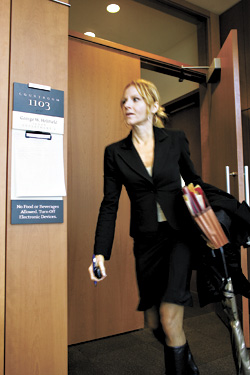
On a recent day, TDA’s Municipal Court supervisor, Theresa Allman, faces just this challenge as she walks into the light-filled courthouse, checking her case files as she goes. It’s a day reserved for pretrial hearings, when she will either work out pleas with prosecutors or set dates for trials. She has two courtrooms to be in at 9 a.m. and two to be in at 10. “Thankfully this morning, they’re just on the 10th and 11th floors,” she says as she scrambles up the stairs.
She’s just checked in with the wife of a currently incarcerated construction worker facing a domestic violence charge. Allman takes in the wife’s declaration of his innocence, then tells her to hang tight while she takes care of some other cases. On the 11th floor, she meets a nervous young Issaquah man, who has donned a tie and slicked down his hair, to deal with charges stemming from an incident at the Fremont nightclub ToST in which he allegedly pulled the doorman to the ground and pounded the windows with a bar stool. As a condition of his release from jail following his arrest, he’s been reporting daily to the courthouse, spending two-and-a-half hours away from his job at a Preston manufacturing company.
Allman peers into the small conference room outside an 11th-floor courtroom where a prosecutor normally is stationed to negotiate deals with defense attorneys. But the room is empty. “I’m stalled here,” Allman sighs. In a few minutes the prosecutor comes, and she works out a deal whereby the Issaquah man will have his charge dismissed if he completes anger management treatment and undergoes evaluation for alcoholism.
She goes back downstairs to greet an agitated middle-aged woman accused of slapping her teenage daughter, tells her to wait, then heads down to the jail in the courthouse basement to talk with the domestic violence defendant and another client accused of assault. Then, in order to meet with a prosecutor on the latter case, she joins a queue of defense attorneys waiting outside another 11th-floor conference room. “See, I’m stalled again,” she says.
When she finally she gets to talk to the prosecutor about the jailed assault defendant, she rejects the plea offer and walks toward the adjacent courtroom to appear before the judge with her client, whom a bailiff is bringing up from the jail. Then she remembers that she has also told a bailiff in a courtroom downstairs to bring up the domestic violence defendant. She whizzes into the nearby courtroom to tell the first bailiff to hold off, then sprints downstairs to arrive before the domestic violence defendant is called up before the judge. “If they call him up and you’re not there, you’re in big trouble,” she says.
Still left waiting is the client accused of hitting her daughter. Allman eventually grabs a few minutes with her to talk on a hallway bench. They have to decide whether or not to plead, and Allman needs to get up to speed on the case so that she can make her client’s case with the prosecutor. But there isn’t enough time before the court’s lunch break. Allman tells her client they will have to reschedule it for another day.
Such continuances annoy judges, who want efficiency, and present a hardship for clients, many of whom are paid by the hour and will miss more work to come back to court, Allman says. She also maintains that “it affects their level of anxiety when attorneys have too much going on and they see you juggling eight cases and running up and down steps all day.”
She says she doesn’t think she’s ended up doing an injustice to any particular client’s case, but it’s a struggle. “Back before the change, at least I felt like I had my head above water most days.” When the county ran the system, TDA had enough attorneys to assign one to each courtroom.
New contracts are supposed to address this problem. They will assign seven attorneys to the secondary defender and even bring in a third agency. It might ease the workload for all. But it may not save TDA, which still could end up banished from Municipal Court when the new contract winners are announced this spring.
Meanwhile, ACA director Chapman plans to resign after the next bidding process is through. He cites family reasons but also says the politics “left a bad taste in my mouth.”