Forget about interstate expansions, light rail, and bike lanes–what’s really at stake in next month’s tri-county vote to spend $47 billion on regional transportation projects is the future of one notoriously dilapidated little local span, the South Park Bridge.
King County, the reluctant owner of the 76-year-old structure, has drawn a line in the sand: It’s time for the drawbridge to close and come down. And the only way to guarantee a replacement is a yes vote on the roads-and-transit package, which includes $110 million to build a new bridge.
“The bridge will close in 2010 whether the Regional Transportation Investment District passes or not,” says King County Council member Dow Constantine, who represents the district that includes South Park (if RTID passes, the county has requested the money for estimated construction years 2010, 2011, and 2012). “The bridge has reached the end of its useful life. It’s rated just about as bad as any structure could be.”
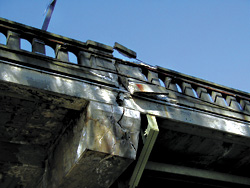
In fact, the South Park Bridge makes the rickety Alaskan Way Viaduct look stable. It has a “sufficiency rating” of 4 out of 100, compared to the viaduct’s most recent rating of 9. (Sufficiency ratings prioritize bridges for federal funding based on their condition.) A 4 is “pretty extreme,” says George Comstock, bridge information manager at the Washington State Department of Transportation’s Bridge Preservation Office. Comstock says the South Park Bridge is one of the state’s 10 lowest-rated bridges, a number of which have already closed, and adds that the treacherous rating is likely due to cracks in the bridge’s substructure, which includes the crossbeams and piers that hold it up. According to a 2005 inspection by WSDOT’s Bridge Preservation Dive Team, “All substructure units exhibited concrete deterioration, spalling, delaminations, leaching, cracks, and abrasion. In some areas the concrete is soft and easily removed with a hammer….Previously noted exposed reinforcing has corroded and provides no structural strength.”
Constantine calls the roads-and-transit package the last chance to get funding to replace the bridge. “We don’t have that kind of money in our roads fund. It’s for small bridges, repaving, and widening. I don’t think that the cities of Seattle or Tukwila would be interested in stepping up—and we haven’t seen any great interest on the part of the state,” he says. “So we have this one chance to raise the funding that’s needed. After that I don’t see a whole lot of options.”
South Park Marina owner Guy Crow’s family has worked in the shadow of the bridge for more than six decades. Crow, who also owns the buildings that house the County Line, Rick’s Master Marine, and the South Park Tire Factory, calls the turreted span “an icon round here.” He says he’s crossed it every day for the past 37 years and didn’t use to think too much about its dire condition—that is, until after the fatal Minneapolis bridge collapse this summer. “Now I’ve been stopped on it a few times and I’m going, ‘Hmmm,'” he says. “It made me think twice.”
As evidence of the county’s Band-Aid approach to maintaining the bridge, Crow, who lives in Mercer Island, keeps a souvenir, a baseball-sized glob of crusty yellow foam, on a triangular shelf in his small two-room office on the marina’s banks. Crow says he watched as engineers pumped this strange substance into the side of the bridge after the 2001 Nisqually earthquake. He saw the foam expand and force a sunken section of the bridge deck up while leaving the street littered with these space-age globules.
Timothy Lane, a county supervising engineer and project manager for the bridge, says the 2001 Nisqually earthquake caused major damage, particularly to some of the piers, which have tilted, making it difficult to realign the teeth on the drawbridge after it’s been opened. “It’s a big, heavy teeter-totter,” he says.
But Lane notes that problems with the bridge’s piers shifting first cropped up after a 7.1 magnitude earthquake in 1949, and adds that in 1984, the bridge’s guides seized up while rocking backward, causing it to be frozen half-open for days. (Unlike newer drawbridges that open from a fixed position, the South Park Bridge actually tilts backward like a giant rocking chair.) “It’s had quite a history of operational difficulties,” he says.
Despite the fact that the county has the funds to complete the design for a new bridge, Lane concurs that there is no Plan B should voters reject RTID. “Closing the bridge in 2010—that’s still the plan,” he says. “Because of the condition and the seismic activity, it’s a liability for King County to operate.”
The bridge fix is the primary reason the city has for years refused to annex an awkward-shaped unincorporated area along the Duwamish popularly referred to as “the sliver by the river.”
Crow says it’s been clear for decades that nobody wants the bridge. “It’s a big liability for everyone,” he says. “The bridge represents more to this community than it looks like. It’s the reason the boundaries are so weird down here. The city of Seattle doesn’t want anything to do with it.”
Seattle City Council member Jan Drago rejects Crow’s notion that the city has treated the bridge like a hot potato. “The county does own it, and they refuse year after year to finance the rebuilding of it. It’s a problem,” she says.
Drago, who chairs the City Council’s Transportation Committee, says the only reason RTID includes the South Park Bridge is because extra funds were freed up when the viaduct was removed from the package. She says that by working to include the bridge in its list of priority projects, Seattle’s already done more than its part.
“We’ve done them a big favor,” Drago says, adding that all this talk about closing the bridge in two years amounts to a game of chicken. “It’s hard to say what the county will do or whether they’re just posturing—I don’t know. We’re not in any better position to repair it than they are. We’ve got a 20-year backlog. One of our top priorities is the Magnolia Bridge. That’s also about $100 million, and a much higher priority.”
The decision on whether or not to close the bridge is ultimately the county’s decision, says Casey Hanewall, chief of staff at the Seattle Department of Transportation. Still, he says, it provides a critical connection for White Center and other South Seattle neighborhoods, and is especially vital to freight mobility. (The county estimates that the bridge carries about 20,000 vehicles a day, 3,000 of which are trucks moving goods.)
Closing the South Park Bridge would “affect the entire Duwamish Peninsula,” agrees Chris Arkills, a legislative aide to Constantine. “If all the cars that come down [state Route] 509 had to switch over to the First Avenue drawbridge, we’d have a whopper of a traffic problem.”
Dave Gering, executive director of the Manufacturing Industrial Council, says loss of the bridge would be an enormous blow to this blue-collar community. “It’s the role of that bridge to connect the South Park industrial community with the rest of Seattle, and conversely the role of the bridge to connect the rest of Seattle to South Park,” he says. “I don’t think King County would ever dream of doing this if this was a bridge in the Montlake area.”
State Rep. Zack Hudgins, D-Tukwila, who represents South Park in Olympia, is a regular at Monday night karaoke at the County Line, which is part of the sliver by the river at the foot of the bridge. He says not a week goes by that the patrons at the restaurant and lounge don’t corner him and ask what he’s going to do about it. “I think about that bridge constantly. I think about it whenever I’m there,” he says. “You can’t help it. It’s part of the neighborhood.”
If RTID fails, Hudgins says, everyone will have to “roll up their sleeves” and figure out how to get the bridge fixed. But he’s not promising any sort of bailout at the state level. “Everything’s a possibility,” he says, “but raising gas taxes is unlikely.”
Similarly, Seattle’s Hanewall says the city would “work closely” with King County to replace the bridge should voters reject the RTID package in November, but he also stops short of saying they’d pony up. “We’re hoping RTID passes so this all becomes a moot point,” he says.
For his part, Crow says tearing down the bridge without a replacement would make South Park a ghost town. “The bridge is a complete necessity,” he says. “This place would be deserted without it.”