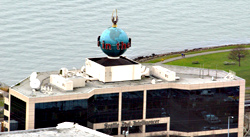

Ask around Seattle, and Gary Pruitt probably ranks somewhere around Mayor Greg Nickels’ barber in name recognition. But Pruitt, whose Sacramento-based McClatchy Co. engineered the $4.5 billion buyout this week of another California media giant, Knight Ridder, is suddenly the city’s and the state’s newest media baron. McClatchy’s holdings now include Washington’s largest chain of daily newspapers—Tacoma’s News Tribune, the Tri-City Herald in Kennewick, The Olympian in the state capital, and the Bellingham Herald—as well as 49.5 percent of the voting stock in the Seattle Times Co., whose properties include The Seattle Times, the Yakima Herald-Republic, and the Walla Walla Union-Bulletin.
That makes Pruitt, a 48-year-old First Amendment attorney who is McClatchy’s chief executive, a bigger media mogul in Washington than Frank Blethen, the Times publisher and patriarch of the Blethen family, which has controlled 50.5 percent of the Times Co. since 1929. The difference, of course, is that single percentage point of Times Co. voting stock that the Blethens own and which McClatchy will not, giving the Blethens complete control of the company.
The Knight Ridder–Blethen alliance has been famously uneasy. Executives from San Jose–based Knight Ridder sat through years of Times Co. board meetings, grinding their teeth while Frank Blethen told them how much of the company’s profit the Blethens would give them in annual dividends—never more than $4 million a year, according to court records. When the Californians complained, the Blethens voted them down. “It was,” recalls a member of the Ridder clan, who sat on the Times board through the 1990s, “an incredibly frustrating experience.”
Now it is Pruitt’s turn. Or maybe not.
Despite McClatchy’s assurances to media analysts Monday, March 13, that it sees no legal problems with owning the Tacoma News Tribune and a minority stake in the Times, some antitrust experts believe the arrangement could raise issues. The News Tribune competes head-to-head with the Times and its joint-operating agreement (JOA) partner, the Seattle Post-Intelligencer, in Seattle’s south suburbs, and the fact of McClatchy executives shuttling the 30 miles between the Times Co. boardroom in Seattle and the News Tribune in Tacoma, especially with the Times holding antitrust immunity under the JOA with the P-I, is likely to draw the attention of the U.S. Justice Department’s antitrust division.
Jack Kirkwood, an antitrust specialist at Seattle University’s law school, points out that in supermarket mergers it is common for federal regulators to force divestiture of overlapping stores. “The ability of McClatchy, which owns the TNT, to also hold several seats on the Times board could raise significant competitive issues with the government,” Kirkwood says. One likely affected party, Peter Horvitz, owner of the King County Journal, which serves the east and south suburbs, says he’s waiting to see how federal antitrust officials sort out the arrangement before deciding whether to formally complain.
McClatchy’s shareholders might also have something to say about how long to keep their new Times holding. Herman Ridder bought his 49.5 percent of the Times for $1.5 million in 1929, assuming Blethen’s financially inept grandfather, C.B. Blethen, would eventually be forced to sell him the rest. That didn’t happen, but the investment was small, and Knight Ridder held on to its stake, hoping someday to buy out the Blethens.
McClatchy won’t say how much it paid for Knight Ridder’s stake in the Times Co. But last November, when Knight Ridder’s major shareholders forced the company onto the sales block, its financial adviser, Morgan Stanley, calculated the fair market value of Knight Ridder’s Times Co. holding at $300 million. (In addition to the three dailies in this state, the Times Co. owns three dailies in Maine—the Portland Press Herald and Maine Sunday Telegram, the Kennebec Journal in Augusta, and the Morning Sentinel in Waterville.) When you are bidding on a package deal like Knight Ridder, newspaper brokers say, conventional wisdom usually dictates that you take the fair market value of an asset like the 49.5 percent share in the Times Co. and offer half. Under that scenario, McClatchy would have paid about $150 million for its new Times stake.
At the current dividend rate, McClatchy would have done better putting cash into Washington Mutual CDs. McClatchy’s shareholders, who reacted negatively to the Knight Ridder deal, are likely to lose patience fast if Pruitt can’t convince the Blethens to loosen their grip on the Times Co.’s dividend.
How much market can there be for a newspaper company locked in a death struggle with P-I owner Hearst, a company 10 times its size?
Still, who would want to buy a minority stake in the Times Co.? How much market can there be for a newspaper company locked in a death struggle with P-I owner Hearst, a company 10 times its size? Who wants to partner with a Seattle Times Co. that is run by a family whose autocratic style doesn’t leave room for minority shareholders? When the Blethens decided to buy the three newspapers in their ancestral home state of Maine—adding more than $200 million in debt to the corporate balance sheet in the late 1990s—Knight Ridder executives on the Times board say they were told about the purchase after it had been arranged.
“I can’t imagine we would have done anything other than go crazy, or go to court, if we had known in advance about a proposal to buy those papers because Frank’s great-grandfather used to live in Maine,” says a former Knight Ridder member of the Times Co. board.
Of course, one potential buyer would be the Blethens themselves. Frank Blethen wasn’t talking this week, but in an interview in December with the trade journal Editor & Publisher, Blethen said he was following the Knight Ridder sale with “interested curiosity” and might make an offer for Knight Ridder’s share of the Times Co. if the price was right.
One thing McClatchy’s new Seattle presence is not likely to affect is the JOA battle between Hearst and the Times. The Times Co. wants to end the arrangement, saying it is no longer profitable after 24 years. It commenced a formal process to do so in 2003, but Hearst sued in King County Superior Court to block the move. Under the arrangement, the Times handles the business end of things—owns the printing presses in Bothell, for example—while a P-I news staff provides content. This is supposed to make it economical to have two dailies, but P-I circulation has rapidly declined since the Times joined it in the morning in 2000, switching from afternoon publication. Knight Ridder has stayed out of that fight. And McClatchy, with the Tacoma News Tribune competing against both sides of the JOA dispute, is likely to stay out of it, too. “I don’t think it will make any difference whatsoever,” a Hearst official said of the McClatchy deal this week.
Still, the silence since last September, when both sides in the JOA agreed to stop hurling broadsides at each other in court, might be getting to the news staffs of Seattle’s two dailies. The Times has theorized in its own pages recently that perhaps Hearst and the Blethens are negotiating a back-channel solution to end the three-year litigation—or at least something positive must be up. The P-I, somewhat wistfully, has floated its own theory that maybe Hearst will end up as the Times minority owner, somehow resolving the JOA mess. The most recent rumor: Hearst will close the P-I, convert it to a Web-based news operation, and give the Times sole control of the dead-tree news market.
Titillating though such theories may be, there isn’t any substance to them, say several people involved in the struggle. Hearst has no plans to buy the Times minority stake or turn the P-I digital, an attorney involved in the fight says. “There is zip chance this thing is going away,” he adds, referring to the protracted litigation.
A more credible reason for the holdup in the lawsuit, insiders say, is that both sides are maneuvering to cherry-pick which Times loss claims to litigate next. To end the JOA and shut down the P-I, Times Co. attorneys must show losses for three consecutive years. So far, Seattle’s largest daily says it lost money under a JOA formula from 2000 through 2004, and it is likely to add 2005 to the pile soon.
Last July, the state Supreme Court unanimously validated Times loss claims for 2000 and 2001. But Hearst challenged those losses mainly on technical grounds involving interpretation of the JOA contract. Litigating 2002 could be trickier. Hearst says the Times went overboard on newsgathering that year, deliberately spending itself into the red. Times officials admit they spent heavily in 2002 but say it was to make up for staff and reader losses during a 49-day strike against the paper in 2000 and 2001.
So far, courts haven’t been tasked with determining how much spending is too much for a newspaper to do its job. Hearst attorneys say they’d like to focus the JOA’s next legal round on 2002, which would give them a chance to run the issue up and down the court system for the next few years. Times Co. lawyers would prefer to sidestep 2002’s pitfalls and are mulling whether to file a whole new three-year loss claim covering 2003–2005—one that Hearst would have trouble challenging.
So far, neither McClatchy nor the Seattle Times Co. are saying much about any of these complexities, old or new. But when the dust settles, Pruitt may look around and have some second thoughts about remaining in Seattle, giving McClatchy’s Seattle experience all the permanence of a Belltown hookup.
Bill Richards is a former Wall Street Journal, Washington Post, and Seattle Post-Intelligencer reporter who covered the JOA story for The Seattle Times under contract for three years.