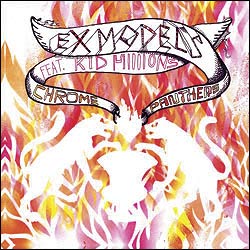
EX-MODELS FT. KID MILLIONS
Chrome Panthers
(Troubleman Unlimited)
Funnily enough, models and noise bands have a lot in common: Models fool the eye, musicians go to work on the ear, and both can be beautiful train wrecks at their most potent. Cacophony can be graceful and carefully staged or indulgent and drab. Like an anonymous pretty face, it’s ephemeral. In New York, the art punks are as ubiquitous as the beauties, and Chrome Panthers isn’t going to change that. Even at the zipless-fuck length of 27 minutes, it’s all foreplay—too much nuance and not enough action. “Chrome Panthers,” at just over a minute, allows them the gnarl of amp buzz and light tingle they’re after, as if Shahin Motia shreds her guitar with the apartment keys. The sprawl that typifies “That’s Funny I Don’t Feel Like a Shithead” and “Mutiny” never works to the band’s advantage. The former is a tribal taunt courtesy of drummer Kid Millions (Oneida) that beats itself to misery in circadian patterns. Live, that rumble makes for satisfying whiplash, but my own heart murmur has better rhythm. “Mutiny” chugs like a roller coaster to the drop point, pulsating along as Motia and bassist Zaxh yelp themselves to gleeful repose. “Buy American” mimics a piercing slide whistle with guitar pedals; the resistance to turning it off is practically a matter of audience participation. Yeesh. KATE SILVER
Ex-Models play the Funhouse with Dropsonic and Black Horse at 4 p.m. Sun., Nov. 6, $6; and at Gallery 1412 at 8 p.m. Sun., Nov. 6. $5–$15.
BROKEN SOCIAL SCENE
Broken Social Scene
(Arts & Crafts)
A year before Arcade Fire’s Funeral, Toronto band Broken Social Scene’s You Forgot It in People was the life-affirming indie-rock record passed from friend to weary friend, and the band’s live shows were a notoriously inspired accompaniment. BSS have always been musically incestuous, with participation from members of Do Make Say Think, Stars, Metric, and the inimit-able Leslie Feist; now six new members join for their third album. If BSS’s previous work was the analysis of an experiment in polyamory—simmering with excitement, nostalgia, and a little bitterness—Broken Social Scene is the curtain pushed back on a group of lovers as they invite us into the process. Instruments affectionately compete for attention; unintelligible voices pile up giddily. Characters whisper and moan and sing when moved, slink away for alone time, and return with a rhyme, rap (courtesy of K-OS on the jammed-out “Windsurfing Nation”), or hook (the exhilarating single “7/4”). Nothing is repeated for long; songs like opener “Our Faces Break the Coast in Half” are so thick with sound, they seem to contain an infinite number of possible others. There’s an awkwardness that was absent on YFIIP, which was so instantly likable it was obscene. Here, BSS don’t apologize for keeping their audience at arm’s length—an adventurousness that gets them exactly what they need. RACHEL SHIMP
Broken Social Scene play the Showbox with Feist and the Most Serene Republic at 8 p.m. Sat., Nov. 12. $15 adv./$18. All ages.
THE CLIENTELE
Strange Geometry
(Merge)
The Clientele have a pleasurably elusive relationship with time and its passage. Their songs seem to take place in an eternal recent past existing somewhere at dusk—maybe two months ago, maybe 40 years. Apart from Alasdair MacLean’s comfortingly predictable reliance on the lyrical details of dying daylight, their most conspicuous anchor to the past is their becalmed ’60s sound, and even though Strange Geometry shaves away some of the retro murk of reverb and filtered vox, a galaxy of reference points remain (Love, Velvets, Zombies). In light of this, it’s a relief that the album’s most affecting and naked expression of nostalgia (“Losing Haringey”) involves a man unexpectedly recapturing the feel of 1982 rather than 1967—it suggests ’60s-ness tapped for its ability to evoke a general sense of distance and displacement, not the good feelings you harbor toward all your favorite songs from bygone eras. (Except when the guitars half-quote the Crystals’ “Then He Kissed Me” on the first song, which is actually kind of lovable.) Likewise, the narrators of nearly every other song walk blasted around the streets and sidewalks of London, dizzy with sorrow, lost in crowds, and lured into other moments of city life where the ancient and modern seem to co-exist. MICHAEL DADDINO
The Clientele play Chop Suey with Radar Brothers and Annie Hayden at 8 p.m. Tues., Nov. 15. $10 adv.
VARIOUS ARTISTS
Children of Nuggets
(Rhino)
How do you measure success? According to Nigel Cross, former editor of the fanzines Bucket-full of Brains and hartbeat!, it’s not by record sales or “lines of A&R men with fat checkbooks queuing round the block at gigs.” A 7-inch single, some press—even the smallest achievements can find their way into a larger legacy. Just ask guitarist Lenny Kaye, who blew the dust off a host of British Invasion–era also-rans when he compiled the double-LP Nuggets for Elektra in 1972. The title of the compilation—reissued by Rhino as part of a 1998 box set, followed by the Euro-centric Nuggets II in 2001—became a genre unto itself, one that would inspire a generation of bands on the new four-disc box set Children of Nuggets, which includes extensive liner notes from Cross. Just as the definition of a “nugget” is rather nebulous, the producers of Children of Nuggets don’t quite define their artists by a singular sound. Instead, consider the context: Between 1975 and 1990, fanzines were the pony express of the underground, a way for most bands with some single on a tiny label to gain exposure. Robert Jelinek of Sweden’s the Creeps sounds just as anguished as the Sonics’ Gerry Rosalie, patron saint of garage-rock squalor, did 20 years earlier.
Jelinek’s not the only one. Plenty of vocalists pay homage to Rosalie’s mojo (Lyres, the Mummies, Hoodoo Gurus). Others inhale the psychedelic sap of Syd Barrett (Julian Cope, the Soft Boys) or revel in the Byrds’ pre-countrified folk rock—the Rickenbacker rockers receive more lip service on Children of Nuggets than any band on the original compilation. The California-based “Paisley Underground” (the Three O’Clock, the Rain Parade, Dream Syndicate, the Bangs—later the Bangles) is one of many regional splinters collected here, along with unvarnished pop released on Dunedin, New Zealand’s Flying Nun label (the Chills) and Southern-fried power-pop bands like North Carolina’s dB’s and Spongetones. The latter wear the naïveté of the Dave Clark Five in natty riffs and elementary rhyme: “I love Maryanne/She understands.”
Most of the collected bands play with the amateurish charm and limited scope of their forefathers, who freely copped the Beatles and the Stones. But they have the resources (read: record collections) to blueprint a richer sound, despite the often crappy production (the liner notes urge us to hear the songs past their oft-dated presentation), with room for curios like the Electric Prunes and the Creation. The Vipers’ “Cheated and Lied” contains as many lyrics as it does chords. The Smithereens’ “Strangers When We Meet” cross-references the Shirelles and the Ramones. Children of Nuggets‘ cobble of influences are a testament to the what-goes-around-comes-around nature of music. Yesterday’s Creeps are today’s Hives, who, come Grandchildren of Nuggets, might see their own legacy boxed and annotated. KATE SILVER
HUSKY RESCUE
Country Falls
(Minty Fresh)
At this Helsinki group’s first and only U.S. show at Austin, Texas’ South by Southwest this year, one band member was sighted wearing a unicorn-emblazoned T-shirt, while another’s advertised A Clockwork Orange‘s Korova Milk Bar, a stylistic contrast one reviewer tried to reconcile with the band’s soft-spoken, Moon Safari subtlety. Marko Nyberg, the ringleader behind Country Falls‘ understated electronic folk—recorded with 20 or so of his closest friends in Finland—and the live five-piece’s aesthetic, would probably be glad to hear it. You hardly need to read that he preferred Lars Von Trier films and visual art to music while crafting Country Falls‘ 12 vignettes: The lap-steel yawning from “Sweet Little Kitten” throughout the album, prog-rock flourishes on “New Light of Tomorrow,” and Lost Highway swoon of “City Lights” set distinct scenes in which the headphone-clad listener is star. Twenty-year-old ingenue Reeta-Leena Korhola narrates “City Lights” and appears in its lucid-dream video (one of three included on a bonus DVD); ditto for the disco-filtered ’60s pop of “Summertime Cowboy.” Along with Emma Salokoski on “Rainbow Flows”—which could soundtrack Saint Etienne’s Sarah Cracknell boarding a plane for the south of France—the women’s voices transport with an ease their male counterparts’ lack. Though lyrics aren’t the primary focus here, the guys’ charming Scandinavian accents—particularly on the single “Sleep Tight Tiger”—are the only thing saving them from unbearable twee-dom. But that’s when you’re paying attention—not driving, making love, or otherwise enacting your fantasies to Husky Rescue’s suspended stills, as Nyberg has clearly intended. RACHEL SHIMP