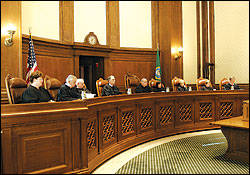
Here’s the box score on gay marriage: Two justices are in favor, one is opposed, four are undecided, and the inclinations of two cannot be determined. After oral arguments in the landmark gay marriage case before the nine justices of the state Supreme Court March 8, it sounds like Justices Bobbe Bridge and Susan Owens would vote to legalize same-sex marriage, Justice Jim Johnson would be opposed, and Justices Gerry Alexander, Charles Johnson, Barbara Madsen, and Richard Sanders haven’t made up their minds. Two justices, Mary Fairhurst and Tom Chambers, were too quiet to give us any real sense of their views.
The cases before the justices, Andersen et al. v. King County and Castle v. State of Washington, have been consolidated after separate Superior Court decisions that found Washington’s 1998 Defense of Marriage Act (DOMA) unconstitutional. Nineteen gay and lesbian couples are the plaintiffs in the combined case challenging DOMA’s definition of marriage as being between a man and a woman. Outside Olympia’s Temple of Justice, thousands of religious conservatives faced off with hundreds of supporters of the freedom to marry, highlighting the importance of the case to Washington and the nation.
Arguments in the case ranged across the breadth of issues offered in documents filed earlier by both sides (see “Supreme Courtship,” March 2): whether the state constitution provides greater protection of equal rights than the federal Constitution; whether the state’s Equal Rights Amendment precludes a ban of gay marriage; whether marriage is a fundamental right; whether gays and lesbians are a class of people, like African Americans, who have been so discriminated against over time that sanctions affecting them must be subjected to stricter legal scrutiny; and whether the state has any rational reason for outlawing gay marriage.
Attorneys on both sides noted that the justices were well prepared, and, indeed, the court zinged both sides with difficult and probing questions. But there were exceptions.
Justice Jim Johnson, who is in his first term, emerged as the darling of conservatives on gay marriage. “He seemed like he wished he could have been counsel for the government,” says Jenny Pizer, senior counsel of Lambda Legal, a gay-rights group representing some of the plaintiffs. “It’s not the usual judicial role.” Johnson repeatedly challenged the plaintiffs’ attorneys and served up softballs to the defense. At one point, Johnson vociferously argued that the state had a very good rational reason for outlawing gay marriage: Social science shows that children do best in a home with a mother and a father. Never mind that the science in question compares single-parent households to two-parent families, not gay parents to straight ones.
On the other side of the spectrum, Justice Bridge, who formerly lobbied for the Northwest Women’s Law Center, which represents some of the plaintiffs, pressed the state repeatedly on a variety of legal grounds but asked very little of the plaintiffs’ attorneys. Justice Owens opened her questioning with a heartfelt anecdote that got to the crux of the state’s argument that DOMA is simply about creating an institution to support procreation. Owens recalled marrying three heterosexual couples, none of whom could biologically reproduce because of advanced age, at the house of a lesbian couple. She noted that while none of the four couples could have children, only one couple could not be married. “What’s rational about treating them differently?” she demanded. Says Lisa Stone, Northwest Women’s Law Center’s executive director: “Justices Bridge and Owens asked difficult and penetrating questions of the opponents and didn’t seem persuaded by their answers.”
One area of questioning surprised both sides. Chief Justice Alexander and Associate Chief Justice Charles Johnson asked repeatedly that if a ban on gay marriage is unconstitutional, when did it become so? Asked Alexander, “If there is no rational basis to limit marriage to between a man and a woman, has that always been irrational?” Attorneys from both sides of the case felt they had difficulty understanding and answering this line of questioning. Some predicted it would not prove to be important. Assistant King County prosecuting attorney Darren Carnell, one of three attorneys who argued in defense of DOMA, says temporal issues were key to the U.S. Supreme Court overturning interracial marriage laws and sodomy laws, however. Says Carnell, “Those decisions both talked about those laws as antiquated. How do you measure that?” Charles Johnson’s and Alexander’s concern with timing might indicate a belief that society has not changed enough to accept a new right—the freedom to marry someone of the same gender.
Justice Sanders, the court’s colorful libertarian, and Justice Madsen, whose feminism compelled her to run for the court, gave no quarter to either side. Both thoroughly grilled all the attorneys on a variety of questions, and neither seemed satisfied with any argument offered.
Attorneys for both sides agree on a few things. This will not be a quick decision. Says Senior Assistant Attorney General William Collins, who argued for the state: “It will take them a while because it’s such a complicated case.” Among the attorneys involved whom Seattle Weekly interviewed, their earliest prediction for a decision was June, the latest October. But the justices can take as long as they like. Neither will it likely be a unanimous decision. Says Collins, “I would only be surprised if I won it 9-0 or I lost it 9-0.” Both sides expect a dissenting opinion and perhaps even a separate concurring one, which would indicate a difference of opinion as to why the law should be struck down or affirmed.
Immediately after the arguments last week, the justices retired to their chambers and debated. If it went according to tradition, a straw poll of opinion was taken, and the justice who had five or more votes supporting his or her position got assigned the task of writing a draft decision to be circulated among all nine justices. “I’m sure it was a lively conference after that argument,” says Collins, and whatever the Supreme Court’s decision, “They will be really careful to get it exactly right. They know how important this is.”