
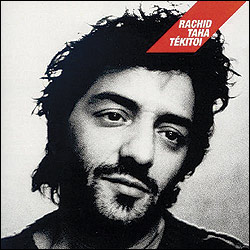
RACHID TAHA
Tékitoi
(Wrasse)
Rachid Taha is the best rock star alive. An Algerian who records in France and London and Cairo, Taha’s music is Godzilla-big: Arabic music is his touchstone, and because he loves us, he throws in new wave and funk and punk and pop and techno and every other genre in the world. “Lli Fat Mat!” (which means “What Is in the Past Is Dead and Gone!”) starts like Algerian raï, but the metallic guitar riff (courtesy of Gong guru Steve Hillage) gives it a tougher edge than you’re going to hear playing in the background at the Falafel Hut. New genres seem to emerge with each new song: “H’asbu-Hum” has a second-line shuffle and some slithery bass, and “Nah’seb” is disco dub thrash with a mandolute and some stomping drums. Throughout, Taha makes it work by sounding absolutely committed to every single song. His vocal performance on “Safi,” a condemnation of totalitarianism (and maybe Americanism, too), is epic in great ways, a mutter to a scream and back again. He gets smooth on the sexy boil of “Shuf.” And with “Rock el Casbah,” rocking the Clash song hard in Arabic and English, Taha steps right up to a legacy that might rightly be his. MATT CIBULA
VARIOUS ARTISTS
Gilles Peterson in Brazil
(Ether)
Brazil is an inexhaustible treasure trove of sound. The music of the sprawling nation’s indigenous peoples alone could keep an intrepid listener enthralled for life. Same goes for the country’s rich regional folk tradition, the incendiary proto-samba that fuels the sacred fires of candomblé (Brazil’s Vodoun equivalent), or its concert music and jazz. But musica popular brasileira is the most bottomless pit of all. Even with the benevolent likes of David Byrne and the elves behind Universal’s Pure Brazil series doing their best to stuff our earholes, anyone who isn’t keeping up on a constant basis is pretty much fucked for life on the intake tip. Not that the impossibility of keeping (or catching) up daunts Gilles Peterson in the least. A working DJ and international tastemaker outshone in recent memory only by the late John Peel, BBC mainstay Peterson was born with a golden ear, record dust in his veins, and a lifelong mission to explore and elucidate the connections between various types of music worldwide, or “connecting the dots,” as he calls it. Given his manifest predilection for digging through far-flung record bins, it’s hardly surprising that the two-CD Gilles Peterson in Brazil offers no dearth of revelations for most listeners stateside. Disc one, subtitled “Classico,” abounds with jazz-inflected, funky ’60s and ’70s pop, even dipping a toe into psychedelia on Jaime E Nair’s “Sob O Mar,” a wistful mini-epic enhanced by the samba rhythms that drive many of the disc’s 12 songs. Versatile as peanut butter, bossa nova’s older, more rhythmically sophisticated cousin also dominates “Da Hora”—the set’s contemporary disc—adroitly wed to broken beat on Marcos Valle’s “Parabéns,” house music on Spiritual South’s “Green Gold,” and jazz-funk on Bruno E’s buoyant “Dado.” ROD SMITH
JOHN LEGEND
Get Lifted
(Getting Out Our Dreams/Columbia)
“We’re just ordinary people,” Philadelphia-based soul man John Legend sings on his major-label debut, “We don’t know which way to go.” I know what you’re thinking: Please, no more middlebrow pandering from another well-intentioned neo-soul artiste who can’t get past his obsession with just-folks authenticity long enough to bust out a meaningful groove, let alone a meaningful statement about relationships. Yet despite Legend’s high- profile connections—as a session guy, he’s contributed to records by Alicia Keys, Janet Jackson, and Lauryn Hill, and Get Lifted is the first release on the new Columbia imprint headed by Kanye West, who appears on several of the disc’s tracks—there’s a kind of likable Everycrooner quality to Legend’s music that buoys sentiment like that. Like West, he’s figured out how to give normalcy some sparkle; the tracks here revolve around live instruments but don’t necessarily feel labored over in the way lots of neo-soul does. On “Let’s Get Lifted,” a smooth electric-guitar line glides over a standard-issue hip-hop beat and Legend’s creamy reggae keyboards; in “Alright,” a big-bottomed horn line anchors a groove that sounds en route from tha chuuuch to da palace. Neither brandishes its charms with undue zeal. Legend is funny, too, which is always a relief: “Maybe, baby, Puffy or Jay-Z would all be better for you,” he reasons in “Used to Love U,” without attaching a moral judgment to the idea, “‘Cause all I could do is love you.” Sometimes that’s enough. MIKAEL WOOD
HEM
Eveningland
(Rounder)
These are the things Hem’s Eveningland makes me think about: Pottery Barn, Starbucks, knit scarves, National Public Radio, Paste magazine, soy milk. Wait, come back! The album is actually quite lovely. Singer Sally Ellyson has the kind of thin, clear voice you only hear on street corners and at open-mike nights. On their second album, her Brooklyn band plays weepy folk-pop that sounds like the Cowboy Junkies without any hint of danger (“Firethief”) or Roxette’s “It Must Have Been Love” as a family prayer session in a smoky bar (“Strays”). A drowsy cover of Johnny Cash and June Carter’s “Jackson” is pure melancholy, while the hypnotically lurching beat of “Dance With Me” is anything but danceable. The Slovak Radio Orchestra provides swooning strings and fluttering woodwinds, making songs like “Receiver” and “A-Hunting We Will Go” perfect for gliding across ballroom floors in your glass slippers. According to a recent New York Times feature, those orchestral touches mean that Hem is spearheading a revival of the much-despised Countrypolitan sound (i.e., George Jones after he “sold out”), but Eveningland just doesn’t seem melodramatic enough to warrant such a comparison. Its rhythms are always restrained, its emotions always muted. Even when Ellyson sings, “We left him bleeding on the valley floor/I felt so dirty I could hardly stand it,” on “Carry Me Home,” she’s so calm she could be ordering a latte—from a coffee shop playing Hem’s music in the background. AMY PHILLIPS
Hem play Tractor Tavern with David Mead and Dawn Landes at 9 p.m. Fri., Jan. 26. $15.
SHARON JONES AND THE DAP-KINGS
Naturally
(Daptone)
As throwbacks go, Sharon Jones and the Dap-Kings are disturbingly completist, replete with a sound that stops a couple years short of Hot Buttered Soul, muffled production that sounds like it’s coming from the speakers of a Plymouth Gran Fury, and packaging that denotes “Stereo Compatibility” (whew) and arbitrary Sides One and Two. (Do not pay attention to that. You will damage your CD player.) The existence of such a retro-minded funk band is more inevitable than novel in this era of rare groove 7-inch fetishism, and the liner notes of Naturally claim it’s all because (yawn) Today’s Music Ain’t Got the Same Soul. Still, I’ll gladly take that from Jones a hundred times over Bob Seger once: Born in James Brown’s Augusta, Ga., and apparently frustrated over the delay of said event, she’s channeled years of gospel and disco-rooted experience into a mastery of classicist styles—sultry slow-dance ballads (“You’re Gonna Get It”), funk-diva burners (“How Do You Let a Good Man Down?”), and take-no-shit frustrated-love soul (the gorgeous Lee Fields duet “Stranded in Your Love”)—that would’ve gone over perfectly on the JB-run People Records at the turn of the ’70s. The Dap-Kings are tourniquet tight, as though their fanatical devotion to re-creating history demands a reverent mastery of the craft: The horn section lives and dies on their determination to successfully live up to Fred Wesley and Maceo Parker, the guitars chicken-scratch masterfully, and the rhythm section—buoyed by a limber conga/traps combo and a rubbery bass that gives Bootsy an Army cut and a sharp suit—produce the best old-school breaks you don’t have to buy on eBay. NATE PATRIN
COACHWHIPS
Peanut Butter and Jelly Live at the Ginger Minge
(Narnack)
This was recorded neither live nor at the Ginger Minge, though you’d be forgiven for thinking so upon first listen. A subsequent spin of any of the Coachwhips’ previous records—like last year’s excellent Bangers vs. Fuckers or 2003’s Get Yer Body Next to Mine—proves they’re just as explosive and, well, lo-fidelity on record as they are live (take “PB&J,” where the song ends to reveal a train loudly sounding its horn as it passes the, um, studio). But the Coachwhips just want to fuel your all-night beer party into the small hours; if they can’t, maybe it’s time to retire your drinking shoes. On a recent trip through Seattle, they covertly set up in the back of the Funhouse as the previous band finished its set. Seconds after the buzz left the amps backing the normal stage area, the Coachwhips launched into their acerbic set list in the bar’s back corner. With nary a moment to purchase another beer to spill all over the place, the crowd devolved into a swarming pit of sweaty bedlam. After releasing three full-lengths in the last two years, the Coachwhips are thankfully trying some new approaches. John Dwyer’s yelps still sound like they’re coming from a megaphone in the next room (think Bob Log III with a backing band), but songs like “I Made a Bomb” and “Human Skin,” the latter of which pretty much sounds like they let a haywire bumper car into their practice space, show unprecedented expansion for a band intent on punching songs into the ground before they knew what happened. Granted, the phrase “more sonic variety” isn’t saying much when it comes to this band, but the progression from the static one-two repetition of Get Yer Body and Bangers to the simple-chord sludge march comprising “Your Party Will Be a Success” will do just fine. GRANT BRISSEY