Are We There Yet?
Opens Fri., Jan. 21, at Meridian and others
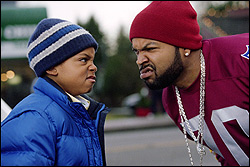
Beginning the film with a talking bobble-head doll of Satchel Paige on the dashboard of Ice Cube’s pimped-out SUV is the first of many reasons why this annoying carload should’ve been run off the road. When Nick (Cube), owner of a sports collectible store and self-proclaimed child loather, falls for a divorced “breeder” with two brats, he realizes that in order to get to Suzanne (the lovely Nia Long), he first has to charm her children. His opportunity comes when he offers to escort the kids from Portland, Ore., to a New Year’s bash that their mother is throwing in Vancouver, B.C. As soon as the road trip begins in Cube’s new Navigator, the 11-year-old diva and her asthmatic 8-year-old brother are ruining his leather interior with body fluids, spraying juice on the ceiling, and listening to Clay Aiken records. The slapstick continues with Cube chasing a moving train on a galloping horse, fighting various forest mammals, and causing the explosive demise of his beloved Navigator.
In the end, of course, the importance of family is recognized, and our hero realizes how everything else pales in comparison—even if the kids are the spawn of Satan. Cube has enough talent and charisma to star in far meatier flicks, while Long’s performance consists of high squeaky laughs, tender thank-yous, and heartwarming tears that endlessly fill her eyes. My eyes remaining quite dry, I’m convinced Cube should’ve ditched the children on the side of the road at the first sign of bladder-control issues, then run off with the illustrious Nichelle Nichols, who plays the kids’ pervy nanny. (PG) HEATHER LOGUE
The Assassination of Richard Nixon
Opens Fri., Jan. 21, at Meridian and Metro
A blip on the harried cultural radar of 1974—when Watergate, hemorrhaging ‘Nam fallout, European upheavals, and endless Cold War negotiations clogged the media pipeline—the sad tale of Samuel Byck was all but subsumed. A jobless high-school dropout, failed family man, and all-around discombobulated misfit, he attempted, ludicrously, to hijack an airliner in order to fly it into the White House and eliminate the source of his and the nation’s festering problems.
Perhaps it’s inevitable that Byck—his name jiggered as Bicke for Niels Mueller’s moody, pretentious, but potent debut—would be remembered now, after the similar 9/11 plot. Mueller’s film can never quite get into the addled head of Bicke (Sean Penn), but its telescope stare is relentless. The central gauntlet of this superfreak’s life is a sales job at a Pittsburgh office-supply store captained by a steak-and-whiskey bull-goose pitchman (Jack Thompson). The arduous ass-end of Bicke’s life gives Mueller plenty of chances to savage the ethos of salesmanship as few homegrown movies, outside of Mamet, have dared to do. Thompson’s bearish bully sums it up nicely, lauding a televised Nixon for lying through his five-o’clock shadow and selling the citizenry not once but twice on an end to involvement in Vietnam.
Penn sweats, whines, wails, and implodes like the immaculate character- research-lab pro he is; insofar as Mueller’s film works, it functions as a creepy, nearly nauseating portrait of American loserdom. It’s another theme rarely articulated in the Bush years, and Penn walks the talk, fuming at social disrespect and gazing dead-eyed at a quotidian he cannot understand or participate in. He’s virtually a lost icon of corporate-capitalism victimhood, particularly when attempting to deal with his estranged wife (Naomi Watts, cold to the touch) and fine-without-him kids.
Narrated with Bicke’s worshipful letters to Leonard Bernstein, Assassination is more than a little inconclusive, and Bicke’s final Waterloo on board a passenger jet with a briefcase full of gasoline remains as mysterious an act of outrageous self-destruction as when the film began. But the singe of helpless, clueless nobodiness lingers, as it used to in the movies of the Nixon years. (R) MICHAEL ATKINSON
Assault on Precinct 13
Opens Fri., Jan. 21, at Meridian and others
It used to be that folks looked down their noses at B-pictures, only to discover (often thanks to French critics) that they’d seen genius unawares. Classic example: the work of Howard Hawks. John Carpenter proved he was a B-director destined for A-ness in 1976 by updating an old Hawks formula—sheriff with a ragtag crew guards a bad guy in a jail under siege—in his Assault on Precinct 13. Nowadays, we put A-list effort into remakes of such B-classics; they’re what we have instead of Aeschylus.
It’s director Jean-Francois Richet who tries to reopen our eyes to that formula in his new Assault on Precinct 13, this time concerning a decrepit Detroit police station snowed in on New Year’s Eve 2004, with an archcriminal (Laurence Fishburne) locked up alongside some petty criminals, guarded by cop Ethan Hawke and a skeleton crew whose bones rattle with fear that they’re about to become skeletons. It’s about two-thirds of a fine film, and though it winds down a bit when it can’t quite figure out how to resolve itself and still keep the tension taut, it’s a satisfying B-picture packed with some talent.
Hawke’s age-shrunken head equips him to play bitter disillusionment; he’s starting to look like Ezra Pound. Instead of having a Howard Hawks–ian drunk for a partner, he has his own pill habit, the result of guilt over getting his original cop team killed. His demons, though, are just a pasted-on contrivance, as are: Fishburne’s allegedly impressive malevolence; Maria Bello’s irritatingly flirty neurosis as Hawke’s shrink, accidentally trapped in the cop-shop siege; John Leguizamo’s junkie paranoia as a criminal who, led by Fishburne, pitches in to defend the station; old-school cop Brian Dennehy’s crabbiness; and Sopranos vet Drea de Matteo’s tough-sexretary shtick. Leading the assault on them with a pack of faceless troops, Gabriel Byrne just looks glum.
Still—the station blows up real good, the camera knows how to move, and the film passes the ultimate B-movie test: Afterward, my fingernails were shorter. TIM APPELO
Dolls
Runs Fri., Jan. 21–Thurs., Jan. 27, at Northwest Film Forum
There are a few truly breathtaking images in Takeshi “Beat” Kitano’s Dolls, a slow-moving allegorical picture that rewards the patient viewer with a dense, literary narrative style. (Indeed, it’s adapted from three tales by the 17th-century writer Monzaemon Chikamatsu.) In its initial story, Matsumoto (Hidetoshi Nishijima) chooses money over love. He agrees to marry the daughter of a successful businessman on his parents’ orders, thereby abandoning his true love, Sawako (Miho Kanno). The heartbroken girl attempts suicide but survives, albeit as a brain-damaged amnesiac. Hearing the news, Matsumoto jilts his would-be bride and races to free Sawako from the hospital. Their ensuing adventures are both moving (Matsumoto must act as a parent toward his childlike former lover) and devastating (he tethers her to his car at night so she won’t flee, then wakes to find her tugging, in vain, at the end of her literal rope). Kanno does most of her acting wordlessly, yet the sympathy she inspires lends real emotion to an otherwise chilly film.
Made before The Blind Swordsman: Zatoichi, Kitano’s 2002 Dolls shifts its main plot into a mythological dream world where Matsumoto and Sawako reappear as the Bound Beggars, who traverse the Japanese landscape in a stupor, connected by a thick red cord. At one point, the Beggars lurch past hundreds of varicolored pinwheels, and the image is enough to make you go slack-jawed. Not surprisingly, neither Matsumoto and Sawako nor the Beggars arrive at any kind of standard resolution. In Dolls‘ other two intertwined chapters, a retired yakuza re-encounters an old flame after three decades, and a fan tries to prove his devotion to a reclusive, disfigured pop star. The only thing clearly uniting these stories is the theme of manipulation and control, introduced in the Bunraku puppet show that opens the film. A visual feast, Dolls intriguingly binds modern Japanese life to a timeless mythology that’s too beautiful to ignore. (NR) NEAL SCHINDLER
Fear and Trembling
Runs Fri., Jan. 21–Thurs., Jan. 27, at Grand Illusion
A culture-clash comedy that takes the notion of Japanese otherness to ludicrous extremes, Alain Corneau’s Fear and Trembling follows a year in the life of Amélie (Sylvie Testud), a Japanese-born Belgian who lands a job as a translator for a Tokyo multinational. Amélie’s dream of becoming “a real Japanese” assumes masochistic overtones as she eagerly submits to demeaning chores (endless photocopying, bathroom duty) while secretly harboring a crush on her bitch-on-wheels boss, Fubuki (Kaori Tsuji). Testud speaks what sounds like fluent Japanese throughout (she won a César for her efforts). Still, one must question her level of commitment to a film that professes a deep respect for the Japanese culture and then renders its Japanese characters as a bunch of screeching ninnies. The movie’s few pleasures are tangential. Fubuki reveals she’s always wanted to be an archery champion—shades of Diana-ness that recall Connie Nielsen’s boardroom huntress in the similarly Franco-Japanese (but infinitely superior) Demonlover. Later, Amélie attempts cultural rapprochement by referencing Nagisa Oshima’s Merry Christmas, Mr. Lawrence. She knows her efforts have failed when her uncomprehending manager looks at her askance and spits, “You look nothing like David Bowie!” (NR) DAVID NG
The Green Butchers
Runs Fri., Jan. 21–Thurs., Jan. 27, at Varsity
Apprenticed to a sadistic butcher, Svend and Bjarne want to escape their employer’s taunts and open their own shop. So Svend mortgages his house, while Bjarne decides to euthanize his brain-dead twin, Eigil, in order to collect their parents’ inheritance. Thus, The Green Butchers begins promisingly as a black lampoon about victims in a small Danish town learning how to victimize. Mads Mikkelsen, as uncontrollable perspirer Svend, perfects a worried middle-distance gaze that suggests an improbably frightened Christopher Walken. His sub-Godot exchanges with laconic stoner Bjarne (Nikolaj Lie Kaas) are predictable but funny, and the two leads capably humanize an overdetermined screenplay that often fumbles with bludgeoning symbolism and rank sentimentality. An accident in the freezer results, of course, in the sale of human fillets, marinated and dubbed “Svend’s Chicky-Wickies.” Compared, though, to anthrosausage classics like The Texas Chainsaw Massacre, Motel Hell, and Delicatessen, Butchers has little appetite for the darkest questions at the heart of its conceit. The satire bites firmly only in the middle half-hour, when rapacious queues assemble, and the titular losers anxiously embrace their miserable lives’ first success. (R) BENJAMIN STRONG
William Shakespeare’s The Merchant of Venice
Opens Fri., Jan. 21, at Neptune
Gorgeously filmed in Venice, exquisitely art-directed for 16th-century authenticity, meticulously constructed for plausible psychological realism, Michael Radford’s Merchant of Venice is everything Shakespeare’s was not. The real thing is a perverse fable (or rather, confusingly, four interlocked fables), set in an otherworldly place where people behave in magically strange ways. Shylock is a mythical beast, half spluttering clown, half bloodthirsty, greed-head monster, who tries to collect the agreed-upon interest from a Christian who defaults on a loan: a pound of flesh.
Radford tries to make excuses for Shylock. He shows Christians spitting on him and notes that Jews only loaned money at interest because Christians were forbidden to (in the first great capitalist capital, somebody had to). Al Pacino makes an honest stab at humanizing Shylock’s bitterness, but it’s a losing proposition. Moderns want to read the famous “Hath not a Jew eyes?” speech as an outraged plea for tolerance, but Shylock is an anti-Semitic caricature in a pro-Christian moral tale. His rant demands un-Christian revenge, which the play exists to rebuke. True, he’s so big he busts out of his cartoonish outlines, and both he and his debtor victim, Antonio (elegantly melancholic Jeremy Irons), bear the interesting shadow of Shakespeare’s father—busted, disgraced, and ruined partly because he loaned out money at 25 percent interest. Shylock is complex; Radford and Pacino want to make him simple, depraved on accounta he’s deprived. Pacino’s raspy modern accent also has just a bit of the Tony Curtis “Yondah lies da castle of my faddah” problem—though that’s partly OK, because he’s supposed to sound grittier than his Christian moral superiors. Pacino’s voice is grit.
Aside from the fact that it makes no emotional sense, this Merchant is pretty good and glossy. Portia’s castle is stunning, and Portia more so: Lynn Collins scores both as radiant nubile and unconvincingly bearded boy judge giving Shylock his clever comeuppance. All of the many supporting actors are mutedly brilliant, except the Nerf ball Joseph Fiennes as Antonio’s bosom buddy, Bassanio.
Radford’s breakthrough hit, Il Postino, infused a sentimental romance with obscure grief by casting as the lovestruck postman an actor who was so ill he died just after the shoot. His Merchant boasts a similar haunted sweetness. But in devillainizing his villain, he betrays Shakespeare and destroys the story. (R) TIM APPELO
Notre Musique
Runs Fri., Jan. 21–Thurs., Jan. 27, at Northwest Film Forum
Whatever his past reputation and future legacy, let’s just examine Jean-Luc Godard’s latest work within its contemporary context. At 74, he’s a man still very much politically engaged with the world; one suspects that, in his Swiss home, he’s got CNN, BBC, and Al Jazeera all beaming into his satellite dish. You can’t dismiss the guy as an old fogey, and Notre Musique is a fairly vital, modern work. It’s certainly not tedious or pedantic at a mere 80 minutes; though backward-looking and obsessed with history (both cinematic and political), Godard isn’t the type to bore you with stories about how much better things used to be in the good old days.
In fact, he’s mainly intent on telling you how much crappier things were in the bad old fascist days of world war, genocide, and ethnic cleansing. In the first of Musique‘s three semisymphonic movements (labeled hell, purgatory, and paradise), Godard’s montage includes World War II, America’s near extermination of its Indians, the Holocaust, Vietnam, Bosnia, and the Palestinian-Israeli conflict. (Rwanda, 9/11, Iraq, and more recent calamities seem to be absent.) In the second section, intellectuals mutter aphorisms at a literary conference in Sarajevo; a gnomish Godard himself is among the attendees, lecturing on film grammar and smoking cigars. Though it’s hard to tell them apart, two young visitors represent different responses to history: the more optimistic Israeli journalist Judith and pessimistic Russian-Jewish Olga. In the third chapter, there’s a brief glimpse of post-historical, post-dialectical bliss for young people (albeit one gated and guarded by the American military).
Linking these three passages is Bosnia’s ancient, notoriously bombed Mostar bridge, now being rebuilt. On one side of the river, you have the past, with all its savagery and conflict; on the other, the future hope of reconciliation and harmony. The sight prompts different reactions for Olga and Judith—the latter even has visions of resplendent, costumed American Indians (who are, in fact, also attending the same Sarajevo conference), as if history can be redeemed. Godard’s triptych is both Dantean and dialectical. You don’t have to believe in his paradise, where a dead woman finally finds peace, but the symbolism is unmistakably classical. Perhaps owing to its age and perspective (like Godard’s), what Donald Rumsfeld scorned as “Old Europe” here seems closer than we Americans are to renewal. Godard’s tune may be familiar, but it’s reassuring for that very reason. (NR) BRIAN MILLER