On the morning of July 15, the sky is an open oven, humidity approaching 50 percent, and TV promises a summer monsoon will rake the Las Vegas valley. But at the Sahara Station monorail platform, Kim Pedersen, president of the national Monorail Society, is too excited to worry about fire and lightning before breakfast. His entourage, a half-dozen society members sporting cameras and monorails.org shirts and caps, chants “Monorail! Monorail! Monorail!” They pump their fists and mill about anxiously while a refrigerator-sized security guard from Wackenhut blocks the turnstiles, awaiting the stroke of 8. Competing with the society pep squad is a long line of less-organized monorail fans, including some dressed as zoo animals. Along with tourists in cutoffs and thongs, they are queued up to take an inaugural ride on the new $650 million, privately financed Las Vegas monorail. The 4.4-mile, casino-to-casino train is mostly a commuter line for craps players, sliding through the back streets of Vegas. It is also a test run for Seattle’s planned 13.7-mile, $1.6 billion Green Line.The Las Vegas system, financed by the gambling and entertainment industry and serving the Las Vegas Strip, was built by a team headed by Bombardier Transportation of Montreal, which spearheads a group hoping to win the Seattle monorail bid next month. As Seattle City Council member Peter Steinbrueck put it, after a May visit to Las Vegas, this train “gives us an idea where we want to go.” Or not go
Before the official opening, some Vegas celebs are breaking in Bombardier’s sleek, 72-seat, four-car trains (with standing room for another 150). They are painted up in gaudy promotional themes to help raise more than $50 million a year in advertising from Monster Energy drinks, Nextel, and others. The slope-nosed train promoting the Hilton’s Star Trek show warns, “Resistance Is Futile.” So was some monorail planning. Chronic software glitches during testing caused trains to arrive early and others to arrive late. Doors wouldn’t open in stations. A heavy drive shaft fell off a car and clattered on the pavement 20 feet below. The monorail opened six months late and has left Bombardier and partner Granite Construction facing $12 million in penalties for delays. It all held together, though, for last Wednesday’s star tour. Singer Gladys Knight is delighted by the reasonably swift 14-minute ride from the MGM Grand to the Sahara. Penn & Teller— the one who talks, anyway—eyes his costumed fellow entertainers and wonders about riding the rails with a guy in a rubber suit. Comedian Rita Rudner is satisfied just not to get mugged.
Though Las Vegas officials project a daily ridership of 50,000, on opening day, despite all the hoopla, just 30,000 showed, most of them presumably tourists. At $3 a pop, says Las Vegas Sun columnist Susan Snyder, “The monorail is not intended for the hired help.”
But then, this is Vegas, home to the Liberace Museum, 99-cent margaritas, and an Elvis impersonator on every corner. They have even invented a machine that takes your money and, with the exception of a cherry here and there, whirls fruitlessly. The monorail is the fusion of this weirdness, taking you sin-to-sin on a tight schedule. For Pedersen and his sky riders, the monorail is their Vegas payoff and 8 a.m. their number. “We’re going to ride it like crazy,” says Pedersen, of Fremont, Calif. “We’re excited about it because they’re eventually going to move to downtown,” extending the line to Glitter Gulch, “and eventually go the airport, and I believe it will go to the suburbs someday.”
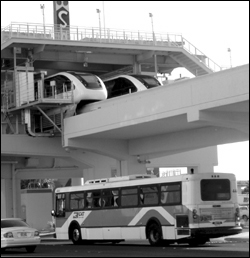
Pedersen, a serious sky-rail hobbyist who cruises the Net for monorail news, is familiar with Steinbrueck’s apparent epiphany in the desert. A once-wary supporter of the troubled Seattle Monorail Project (SMP), Steinbrueck seemed to have discovered something in Vegas even more spiritual than the Chapel of the Bells. While wincing at the Vegas monorail’s “brutalist” 30- to 40-foot support columns and overhead switching platforms, he returned to Seattle anxious to improve on those designs and get the Green Line rolling. That was great, Pedersen says of Steinbrueck’s conversion. But he doubts there’s a way to slim down the columns for Seattle. “That’s the size they have to be to hold these systems,” he says. Besides, in Vegas, where the Z-shaped rail route travels behind the casinos about a block off the Strip, the big columns and heavy guideways compete mostly with parking-garage architecture. “And I don’t think the columns are all that unattractive,” says Pedersen. “It’s a good design.”
He has a point. The beige T-, H-, and L-shaped columns and 10-foot-thick crossbeams blend into the desert background. In supersized Vegas, amid steroidal Romanesque resorts on the nearby Strip, the monorail is a scale-model train in a billionaire’s playpen. Though Steinbrueck wasn’t earlier able to take a test ride on one of the driverless trains, I climb aboard with the Monorail Society. Before opening day ends, I notch 20 rail miles and tour all seven stations, including one that now links the city’s big off-Strip convention center to the nearby hotels. The spartan stations, some with hotel access ramps, all have elevators, escalators, and automated ticketing machines. The train cars are comfortable and air-conditioned, and the line has an emergency catwalk its full length. The monorail’s quiet swoosh and automated destination announcements (interspersed with casino promos) are remindful of Seattle’s airport subway—but with a panoramic view that includes a bar featuring female mud wrestling. At the least, it beats riding a bus on eternally gridlocked, eight-lane Las Vegas Boulevard, the Strip, where transit passengers are allowed to pile in until someone in the back of the bus shouts, “I can’t breathe!” Still, the bus is $2 and monorail fares are $3 one way, $10 a day, $20 for 10 rides. The casino investors, who formed the nonprofit Las Vegas Monorail Company (LVMC) to run the line, financed it in part through $450 million in bonds. Though it claims to be a private venture, the monorail relies on the state’s bond guarantees to underwrite its financing, and as a nonprofit, LVMC doesn’t have to contribute millions in taxes. LVMC will get its return from the fare box and from predicted increased tourism along the Strip, already crowded with visitors and bustling with construction cranes. Investors are also sitting pretty if the line is expanded to downtown, since the plan is to seek mostly federal money for that leg. Taxpayers would likely be on the
hook for the airport extension, too.
Other than—surprise—the possibility the public has been misled about a major transportation project, what’s the lesson of Las Vegas? LVMC has the advantage of being privately owned and can better control its destiny. But it did so in ways not out of the reach of a tax-supported bureaucracy like the Seattle Monorail Project (SMP). Vegas built its system away from heavily used streets. It took to the side of the road rather than running trains down the middle. Almost all of the track is comprised of dual guideways. The line had an uncomplicated, workable plan from the beginning. And it used a design-build-operate-maintain bid process that, although SMP plans to do the same, could be a minus in Seattle.
SMP plans to concentrate its line on congested corridors, sometimes in the middle of them, with little expectation of easing gridlock. It will also use less-efficient and riskier one-rail tracks for almost a third of its line, and, unlike the Vegas system, the Seattle monorail will dominate downtown and neighborhood air space. With a request for proposals sometimes lacking in specifics, SMP is also leaving part of the decision making to its two bid teams—one headed by Vegas veteran Bombardier, the other by Hitachi. If it wins the bid in Seattle, financially troubled Bombardier would be on the rebound from multimillion-dollar mistakes in Vegas. If delays should crop up in Seattle—anyone believe they won’t?—how will the threat of more fines affect a company that also lost $174 million in its first quarter this year?
Then there’s that comparable cost thing. The Vegas monorail cost about $160 million a mile. SMP says it can do the job for about $110 million a mile. How can that be? The Vegas group had no Ship Canal to cross, no West Seattle Bridge to stride, no downtown skyscrapers to wend around, no hard turns to make or appreciable grades to climb. Vegas has built what it considers a streamlined system, even if its function is just a cut above the monorail at Disney World (another Bombardier system). How does Seattle build a more extensive commuter line for considerably less? “Well,” says Todd Walker, the Las Vegas monorail’s spokesperson, “I don’t know if you can strictly compare the two. Start with the stations. We’ve got seven in four miles. You’ll have comparatively fewer per mile. And our stations are very large.” Construction costs can also vary widely, he notes.
Still, Seattle will have 19 stations over 14 miles, and some will be sizable—one 10 stories tall. Another Vegas monorail official says that they’re having trouble with Bombardier’s cars—one of which last Thursday night was vibrating loudly from a rubbing sound. He’s been to Seattle, the official adds, “and I can’t imagine with all those hills and water that you’d be able to build it cheaper than on a desert floor.”
Vegas nonetheless thinks it can show Seattle and other cities the monorail way. Officials were especially happy to get an opening-day e-mail from Steinbrueck last week, saying thanks for the inspiration. “We have a great relationship with Seattle,” says spokesperson Walker. “Especially with Peter and Joel Horn,” SMP’s executive director, “who has been here, too. I think Las Vegas serves as a good example for Seattle.” Now there’s a slogan for our welcoming signs.