More than a decade after whistle-blowers began trying to expose and end a fraudulent medical billing system at the University of Washington, and just days after news reports focused on the failure of top medical-school officials to end the illegal practices, the med school last week announced plans for an “independent” internal review of the Medicare rip-offs.
University Vice President for Medical Affairs Paul Ramsey says he wants a committee to determine what lessons can be learned from the scandal—although one of those lessons is already painfully obvious: On the same day Ramsey announced his review, last Thursday, June 10, the university paid $35 million to the government to settle a civil lawsuit resulting from record-setting Medicare fraud. (The UW wire transfer to the U.S. attorney’s office was for $32,263,757; the remainder was paid to the state.) Nonetheless, the university, which also spent at least $25 million in legal fees the past five years and watched two of its doctors admit to felonies in connection with the billings, maintains the “vast majority” of questioned billings “were unintentional mistakes,” and admits no wrongdoing.
The settlement money comes from a $180 million UW medical reserve fund, created from a percentage of UW doctor fees and controlled by Ramsey. The dean’s fund, in turn, will be replenished from the budgets of the School of Medicine, Children’s Hospital, UW Medical Center, and UW Physicians—the UW’s billing group and epicenter of the billing fraud. In addition, Harborview Medical Center, the county-owned hospital for the poor and uninsured, which is run by UW, will be required to cough up as much as $15 million over five years for “faculty support.”
According to a copy of what some are calling Harborview’s UW “bailout resolution,” obtained by Seattle Weekly, “The University of Washington has notified Harborview Medical Center that in its opinion the availability of faculty physicians to practice at Harborview Medical Center, continuity of patient care, and the extent and level of uncompensated care will be adversely and substantially impacted by the economic conditions created in the near term by the payment of a substantial civil settlement to the federal government.” (Mention of the settlement was added to the resolution, a board member says, after long debate among members.)
A board member says in reality the money, which will come from Harborview’s operating budget, will go to cover UW’s Medicare scandal costs. Though the payment plan was recently approved 7-3, some Harborview board members are now saying they were not told UW Medical had the hefty $180 million reserve fund, about which they learned by reading a recent issue of Columns, the UW alumni magazine, quoting Ramsey. Harborview, whose operating budget ended with a $1.2 million deficit in 2002, according to the latest state Department of Health figures, can’t afford to pay for UW’s fraud, says one board member, who has asked that the $15 million payment be reconsidered at the board’s next meeting.
The inside story of the billing scandal, as told by UW whistle-blowers, was reported in last week’s Seattle Weekly (“Everybody Knew,” June 9). The following day, Ramsey issued an e-mail to UW staff and faculty, announcing the review committee and citing Seattle Weekly‘s story and another in The Seattle Times. On Monday, June 7, the Times revealed that Ramsey had ordered an internal probe about billing allegations in 1998, but found no wrongdoing. Whistle-blowers told Seattle Weekly, however, that the fraud was in full swing then.
In his e-mail, obtained this week through a state Open Records Act request, Ramsey wrote: “Over the past several days, both The Seattle Times and Seattle Weekly have run articles related to the federal billing investigation. Although a settlement was reached with the federal government on April 30, there continues to be a high level of media interest in this investigation. While we could respond point-by-point to each of the allegations raised in newspaper stories, I believe that this would accomplish little and would be a distraction from the important work ahead.”
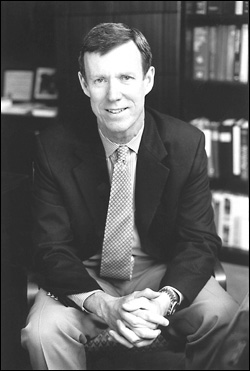
Instead, Ramsey, who presided over the med school during the billing irregularities as chair of the Department of Medicine from 1990 to 1997, and then as medical school dean since 1997, said he’d create a review board to see where UW went wrong. Dennis Okamoto, chair of the medicine board, will appoint an “independent committee to determine lessons to be learned from the investigation and identify the additional steps we must take to ensure that we do not repeat the mistakes of the past,” Ramsey said in the e-mail. The move has the support of UW President Lee Huntsman, incoming President Mark Emmert, and Gerald Grinstein, president of the UW Board of Regents, Ramsey said.
To whistle-blowers, that sounded like the internal medicine UW has been self- prescribing throughout the scandal. It “seems like another measure from UW Medicine to distract their employees and the public with more smoke and mirrors,” says Mark Erickson, the former UW Physicians employee who revealed the fraud to the feds in 1999 after failing to stop the illegal billings within the system. If the school was serious about probing the scandal, Erickson says, “they would hire an outside firm to conduct a truly independent investigation and report directly to the Legislature with their findings and recommendations.”
Says Swannee Rivers, another whistle-blower: “I still wonder why the individuals who could have brought about change earlier failed to respond. If something had been done earlier, things wouldn’t have escalated to this point.” Rivers, who worked in the UW Physicians billing office for more than a decade before writing a tell-all resignation letter in 1995, says that “the public needs to know what has occurred and continues to occur within this prominent, previously well-respected institution.”
In his e-mail, Ramsey concedes, “We made mistakes. I accept responsibility for these mistakes and for ensuring that we learn from them. We have taken many steps to improve our business practices and oversight. As a result, we are in a much better position today than we were at the start of the investigation. The UW Medicine Board established a standing Board Compliance Committee in 2001. There are compliance offices in the practice plans, UWMC, and Harborview that provide the resources to analyze and act on the types of concerns that were raised by the whistle-blower. I assure you we continue to seek ways to improve our compliance programs. . . . “