When it comes to defining genres, even people who are paid to express themselves with the written word are often at a loss. After almost a decade of declining to provide a succinct description of what alternative country is, the publishers of the bimonthly music mag No Depression have issued a compilation instead. Until now, they’ve followed the term “alt. country” with the caveat “(whatever that is),” but with No Depression: What It Sounds Like, Vol. 1 (Dualtone), they seem to have nailed it down. From the angsty, bar-stool rock of a 1995 Whiskeytown track to the harmonized, lonesome pull of a quietly insistent song by Hayseed with Emmylou Harris to the Carter Family’s original, 1930 version of “No Depression in Heaven”—the song from which the magazine took its name—What It Sounds Like won’t leave you wanting for a more solid explanation.
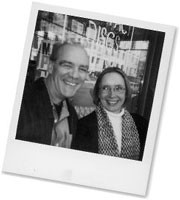
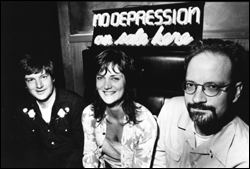
The alt-country sound is right at home in Seattle, and fittingly, the triad behind No Depression belongs, in part at least, to us, too. Co-editors Grant Alden and Peter Blackstock both wrote about music here in town before leaving for points South, at the now-defunct Rocket and the Seattle P-I, respectively, and partner Kyla Fairchild is a knowledgeable, friendly fixture in scenes all along Ballard Avenue Northwest. The three sat for the Jukebox on a recent Friday afternoon in Fairchild’s home.
Link Wray: “Big City After Dark” (released in 1990) from Missing Links, Vol. 2 (Norton)
Grant Alden: I don’t know what it is, but I’m feeling like I should; I’m waiting for a voice.
Seattle Weekly: There won’t be a voice.
Peter Blackstock: That would make it harder.
Alden: Presumptively, it ought to be Link Wray.
SW: It is.
Blackstock: Oh, that is very good. What was your reason for presuming that?
Alden: [Wray] doesn’t sing.
Blackstock: There are lots of guitar instrumentalists; how did you identify this one as Link Wray?
Alden: I’ve listened to him a fair bit—the guitar sound is pretty distinctive. I saw him in Nashville about three or four years ago with every guitar player in town up onstage with him. It was amazing.
Etta James: “Let’s Burn Down the Cornfield” (1974) from Come a Little Closer (Chess)
Alden: It’s not Etta James, is it?
SW: It is.
Blackstock: You’re two for two. So this was a good bit past At Last [1961], which was her breakthrough.
One reason that I bought At Last and that I’m somewhat more familiar with her is that an artist who I wrote a feature story on for No Depression about two or three years ago, Tift Merritt, is very much influenced by Etta James. That At Last record, I went out and got because Tift said it was one of her favorite all-time records. I don’t think [Merritt] sounds much like [James]—Tift is much more country, honky-tonk. But I can hear some of where she wants to come from vocally.
Johnny Cash: “The Time of the Preacher” (1996) from Twisted Willie: A Tribute to Willie Nelson (Justice Records)
Kyla Fairchild: Oh, I know this one.
Blackstock: I can name that tune in those first five notes that Kim Thayll played right there.
SW: This is on the [What It Sounds Like] comp, but I was interested in the brief story in the liner notes about this song.
Alden: Rolling Stone called me and said, “We want you to go into the studio and listen to Johnny Cash cut this song for this tribute record with Kim and Krist [Novoselic] and the drummer from Alice in Chains [Sean Kinney]. I said, “Yeah, throw me in the briar patch and pay my rent for two months and let’s go.” I got to hear Johnny Cash screw up lines at Bad Animals [Studios]. Kim was really confused by what they wanted from him. He was trying to give too much respect to Willie’s song, and he tried to play it straight; and he ended up sounding like Neil Young, and that’s not what he wanted to do, either, and he kind of looked at me and said, “What do they want?” I said, “They want you to be you.” So he went in and did this.
Blackstock: And this is what Grant wrote in the liner notes: If you’re looking for a way to define what we were doing when we started this magazine, which was exactly the same time this was recorded, there’s almost no better way to define it than this—you know, this combination of the hard side of alternative rock with the classic side of country.
SW: And in Seattle.
Blackstock: Yeah.
Alden: So the next day, Mark Lanegan cut his track for [the tribute comp], so I got to go back and hang around for some of that, and at the same time, Krist was running around with these old reel tapes going, “Somewhere on here is that old unreleased Nirvana track—you gotta come hear this. . . . I’ve just got to find it first.” He never did find it. He was promising this unreleased Nirvana track that had everybody excited. I think they finally did find it, and it’ll be on the box set that’s been endlessly delayed. But I think it took years.
Television Personalities: “Stop and Smell the Roses” (1984) from The Painted Word (Whaam!)
SW: This is one of my favorite songs—it makes me very sad, and I tend to think of a lot of the music I enjoy in the alt-country realm as being sad, too. I tell people that the Television Personalities are the Smiths for people who don’t like the Smiths—less drama, but a lot of the same mood.
Blackstock: Well, I guess it might be for me, because I didn’t like the Smiths. So far, I like this better than what I know of the Smiths’ stuff.
Alden: This corresponds with a time in my life where I had given up on punk rock for the first time and had started listening to country music. Randy Travis and Ricky Skaggs and that whole crowd were on the radio. This is the kind of music that drew me away from punk rock.
Blackstock: It sounds somewhat in that early ’80s new-wave vein, but I like it because I like his voice, I like the piano—it’s very melodic, which is something I respond to regardless of genre.
Fairchild: It kind of reminds me of Nick Cave a little bit.
Blackstock: The voice isn’t quite as spooky, but yeah, it sounds like that a little bit.
Alden: It’s just too well-mannered for me. I tend to run more to extremes, and I don’t doubt that the lyrics are sad, but the lyrics are the last thing in the song I hear, and I would never get past the sound to focus on the lyrics.
Fairchild: You don’t tend to like this sound, I don’t think. You don’t tend to respond to a lot of bands that are in this vein.
Alden: That’s relatively true.
Blackstock: It sounds a little bit more to me like a Modern English song—”I’ll Melt With You” or something. The first time I hear a song, I don’t generally notice the lyrics, but what I’m noticing here is a sound and a melody that would make me want to listen to it again.
SW: Kyla, do you hear lyrics right away?
Fairchild: No. No, it’s funny because I’ll find songs that I just love, and it’ll be like two years later and the lyrics will just pop into my mind subconsciously, and only then will I think about what the song is really about. In fact, there was this Graham Parker song that I just loved, and I put it on a compilation tape that I made for a friend of mine, and it turns out that the song is like a pro-life song, an antiabortion song, which is totally not where I’m coming from on that issue, and my friend was like, “I was really surprised you put that antiabortion song on there,” and I was like, “What? Are you kidding?” And I went back and listened to it, and I was kind of like, “Oh, that’s kind of weird—that sucks.” Ruined my whole compilation tape.
Nick Drake: “Things Beyond the Sun” (1972) from Pink Moon (Island)
Blackstock: This is Nick Drake, I can’t recall which record—it might be Pink Moon, which is one of my all-time favorite records. Nick Drake is definitely one of those people that you have to be in the mood to listen to, but when you’re in the mood, there’s nothing better.
Alden: Probably when you’re in the right mood to listen to it, you shouldn’t be allowed to.
Blackstock: I don’t think it’s necessarily a suicidal thing. The stereotype is that you have to be so depressed and suicidal to listen to Nick Drake, and I don’t think that, because there’s too much beauty in his music for it to be just a downer thing, I think.
SW: Were any of you able to catch EMP’s screenings of the Nick Drake documentary A Skin Too Few? It had footage of his mom playing the piano, and it was amazing to see how much he got from her. He was one of those guys where you could never pinpoint exactly where he was coming from, but in the documentary, it was clear how influenced he was by his mom.
Blackstock: Someone made a tape of this record for me about 12 years ago, before I was familiar with it, and as soon as I heard the tape, I went out and bought everything because I knew I wanted to have all this stuff. There is a side bit of trivia here: We have a section in the magazine, which is sort of a travelogue item every issue—people going someplace and writing about eating barbecue in Kansas City or going to spring training in Florida. That section is called “A Place to Be,” which is a Nick Drake song.
Alden: I don’t think I knew that’s where you stole that from.
Uncle Tupelo: “No Depression” (1990) from No Depression (Dutch East)
SW: I had to play you this, since you put the original by the Carter Family on your comp.
Blackstock: We have to reference this song all the time, too. We have to explain that our name comes from this Uncle Tupelo song from an album of the same name that [Uncle Tupelo] learned from Mike Seeger and the New Lost City Ramblers, who were covering this old Carter Family song from the 1930s, which sort of traces the history of where this song is coming from originally and how it got revived in recent years.
Alden: I think we had been publishing about two years before I actually owned any Uncle Tupelo records, though. I can remember when Anodyne [1993] came into The Rocket office. I had heard about them, and I was predisposed to like them. I played it at high volume and annoyed the office, and then gave it to a writer who adored them. I thought, “Well, they’re not very good.”
Blackstock: And a year and a half or so later . . .
Alden: Well, yeah. Oh well. We chose [this song as our name] because of where it has touched down. It comes from the origins of recorded country music in America, it runs through the folk revival, and, as far as I know, there’s no one else who has recorded it in that time. . . .
Blackstock: There might be, but we’ve never found them.
Alden: [The rerecording of the song] goes from 1960, as far as I know, to 1990. It has these huge jumps and spans a lot of time.
Billy Bragg and Wilco: “Way Over Yonder in the Minor Key” (1998) from Mermaid Avenue (Elektra)
Blackstock: Oh, this is Billy Bragg. Is it from Mermaid Avenue?
SW: Yeah, I picked this song because it has Eliza Carthy playing violin and Natalie Merchant singing, so with Wilco and everyone else, it’s a bit of an ensemble cast.
Blackstock: It’s one of the best songs on the record.
SW: I think so, too.
Alden: I just started reading the new biography of Woody [Guthrie]. I haven’t read the old one, but I’ve read his fake biography of himself [Bound for Glory], and Mermaid Avenue was such a sad place in his life—he had a child burn to death there, and a marriage which was never really quite great, but I don’t think of these songs as being sad songs. A lot of them are so childlike and completely fun.
SW: When Natalie Merchant and Billy Bragg go back and forth and at different times sing, “Ain’t nobody who can sing like me,” I love how they deliver that line.
Blackstock: There’s an interesting contrast of voices there, because Billy Bragg really isn’t much of a singer—he’s got a speaking, conversational kind of voice that he makes work for what he does—but Natalie’s very much a singer, so hearing them together is . . .
Alden: She’s a good enough singer to harmonize with him. A lot of people wouldn’t be able to harmonize with someone who has as idiosyncratic a voice as he has.
Blackstock: What’d you think of [Mermaid Avenue, Vol. 2]?
SW: I didn’t like it near as much, although I do remember at the time being grateful at least that there was a song to match “California Stars” from the first one.
Blackstock: I don’t think it was as good, but it was worth putting out since they had recorded enough for a second record. But it didn’t have the same impact as the first one.
Alden: During the Folk Alliance Conference in Nashville last year, I got to see—because Nora Guthrie’s husband sort of talked me into it—an East German political folk singer who did another record out of Woody Guthrie lyrics, only it’s sort of similar to Pere Ubu. I keep waiting for it to come out in this country so I can write about it or assign it.
Flying Burrito Brothers: “Dark End of the Street” (1969) from The Gilded Palace of Sin (A & M)
Blackstock: I should know whose version this is, but it’s certainly one of the most famous songs of our genre I’d say. It’s that crossing over of soul into country.
Fairchild: It’s the Flying Burrito Brothers, isn’t it?
SW: Yeah.
Blackstock: Is it? OK. A lot of people have done this song. I’m more familiar with James Carr’s version.
Alden: I don’t recognize this song at all.
Blackstock: It was [written by] Dan Penn and Chips Moman. I just had a funny conversation recently with [EMP’s] Jon Wurster, who had written something about Alejandro Escovedo for a friend of mine’s Web site. He said something about [how] there are probably people out there who have given Alejandro the shirt off their back. I had to go and tell him, “As a matter of fact, I have.” One night in Austin, Alejandro was playing. I was in town visiting my family, and I went to go see him in a club downtown. At that time, Ryan Adams was very briefly living in Austin, sleeping on his former manager’s couch. He was at the show, too. Between sets, Alejandro started fiddling around with the chords for “Dark End of Street,” and he asked Ryan if he wanted to come up and sing it with him in the next set. He was looking to both of us to try and figure out the words and chords and all, but I didn’t really know the song well enough to be of much help. And Alejandro just got this look on his face like, “You don’t know this song?” I was wearing my No Depression T-shirt at the time, and he said, “You don’t deserve to wear that shirt.” I decided he was right, so I took the shirt off and gave it to him.
Alden: Well, I guess I don’t deserve to wear this shirt, either.
Blackstock: You’re wearing your Rocket shirt, so it’s OK.
The New Pornographers: “Ballad of the Comeback Kid” (2003) from Electric Version (Matador)
SW: I picked a New Pornographers song that doesn’t have Neko Case on it. You guys will probably throw me out of the house for saying it, but I’ve never been a big Neko Case fan. I know she’s been in the magazine a couple times and she’s on the comp, so obviously you guys like her.
Alden: I thought this was from some weird Robyn Hitchcock thing that I didn’t have, which would be really strange.
Blackstock: I can’t see [the New Pornographers] without seeing and hearing Carl [Newman’s] old band Zumpano. I was a huge fan of them because they covered the most obscure Jimmy Webb songs you can find and I’m about the world’s biggest Jimmy Webb fan. And Carl actually rivaled me on that. This is not a direction I would have necessarily suspected that he would end up going in, but it’s been really successful for him.
SW: I like this song because it’s one of Dan Bejar’s; he’s the guy from that band Destroyer, which I used to really like.
Fairchild: Do you like Neko in the New Pornographers, but not her solo stuff?
SW: Yeah, I suppose so. I’ve just never had a connection with any of her songs. She was a really big deal when I first moved here, and I could never quite understand it.
Blackstock: I think I like her voice more than I like her songwriting. When I think of my favorite things that she’s done, it’s still . . .
Fairchild: The covers?
Blackstock: Exactly. Like [her] cover of “Bowling Green” by the Everly Brothers. But one thing I really like is that she still puts a lot of effort into doing [the New Pornographers] in addition to working on her solo career, even though you could argue that her solo career is a big enough deal that she shouldn’t be spending time doing this.
Country Teasers: “Life Is a Rehearsal” (2003) from Secret Weapon Revealed at Last (In the Red)
SW: This is kind of an oddball track. This band is originally from Scotland; now the singer is based in London and has band members all over the place. Ben Wallers, the songwriter, is really influenced by Americana and the Carter Family, and when I recently interviewed him, I was really surprised, but he said he really loves Gillian Welch and stuff like that. Generally, they’re recognized as a punk band, but he’s got a huge reverence for Tammy Wynette, and a really different way of interpreting that and recording it.
Blackstock: What I tend to find is that the people who mention certain kinds of music or influences aren’t who you would always expect it from. The people who are firmly ensconced in the alt-country camp might be more likely to talk about how they listen to blues records or indie-rock records. And conversely, a lot of times when you hear people talk about Gillian Welch or Steve Earle, [they] are actually people who are doing stuff that’s pretty far from that. But I think also they don’t want to be stereotyped. They like to play up the fact that they’re interested in other things, and also, if they’re playing that kind of music, they’re likely to be listening to other things further outside where they happen to be at.
Alden: I think musicians just like good music.