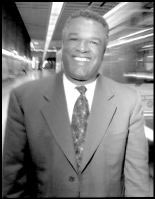
Phil Talmadge never mentions Gov. Gary Locke by name. He doesn’t need to. Everybody in the room at the King County Democrats’ winter meeting in the Seattle Hilton knows Talmadge is talking about Locke when he says, “Everywhere I go, people say the same thing—the Democratic Party has no policies and no soul. We seem tired, distracted, and aimless. What does the Democratic Party stand for?
“The same refrains stir around the state: There is no leadership. Tim Eyman is the real governor. Why should we trust you?
“Leadership and trust are connected. Trust in government is not possible unless our leaders lead. Our party will not regain its soul unless, and until, we are no longer afraid to lead.”
The Democrats give Talmadge a standing ovation after his searing indictment of the weakness of their party’s incumbent governor of the past seven years.
The coming legislative session, which begins on Monday, does not promise to increase Locke’s popularity among Democrats. Faced with a $2 billion deficit, the governor proposed a no-new-taxes biennial budget that would take away health insurance from 60,000 poor people, dismantle popular education initiatives that reduced class size and increased teacher pay, lay off 2,500 state workers, and close state parks. Meanwhile, transportation solutions are stalled after voters rejected a gas-tax increase—the campaign for which was headed by Locke.
A former legislator and a former state Supreme Court justice, Talmadge, 50, thinks this political context gives him an opening for a vigorous challenge to the incumbent in the 2004 Democratic primary. Last summer, Talmadge became the first major-party candidate to declare for governor. For his part, Locke has not decided whether to run for a third term.
The primary is 19 months away. A bit early? Not if you’ve been planning to be governor, as Talmadge’s wife recalls, since high school.
CRACKING SKULLS
Talmadge’s life story certainly reads like a governor’s r鳵m鮠In 1952, he was born in Seattle to a schoolteacher father and a Boeing-worker mother. From grade school on, Talmadge excelled academically, graduating from West Seattle High as a National Merit Scholar. He went to Yale and, after his freshman year, married his high-school sweetheart, Darlene. Thirty-two years later, they have five children, ages 15 to 31, and two grandchildren. They live in the West Seattle house Darlene grew up in, just six blocks from Talmadge’s homestead.
After graduating magna cum laude from Yale, Talmadge went to the University of Washington law school. In 1979, two years after finishing, he was elected to the state Senate as a brash, 26-year-old whiz kid and served 16 years under four governors. He chaired both the Judiciary Committee and the Health Care Committee. Allies and enemies alike acknowledge Talmadge as one of the most intellectually gifted politicians they have known.
He was no slouch when it came to passing legislation, either.
“I don’t think there was a senator who passed more legislation than Phil,” says Democrat Jerry Hughes, a former state senator from Spokane. “He was in on all the major legislation.”
IN AN INTERVIEW, Talmadge touches on a few highlights: Just a few months before his first election, the freighter Chavez hit the West Seattle drawbridge, and a new span had to be built. Talmadge co-sponsored the legislation that helped build the higher bridge we drive today. After that, his initiatives included the creation of the Puget Sound Water Quality Authority, tough drug laws, indefinite confinement for sexual predators, tort reform, AIDS testing, Seattle’s new First Avenue South bridge, campaign-finance reform, and universal health insurance (Republicans dismantled it when they regained the majority). In policy terms, he was a liberal with a law-and-order streak. Above all, Talmadge was pragmatic, eschewing ideological purity in favor of legislative accomplishment.
Politically, Talmadge was known as one tough bastard who got things done and didn’t care who he hurt in the process. In the 1980s, he terrorized people so much that someone printed up a button that read, “I’ve been Philled.” The buttons sprouted on the lapels of lawmakers and lobbyists. Those who remember that era say he was a bully and that he had a vicious edge.
State Sen. Bob McCaslin, R-Spokane, who served with Talmadge on the Judiciary Committee at the time, told the young bull to pull in his horns. Talmadge recalls McCaslin telling him, “You haven’t listened enough. You have caused these buttons to appear.” McCaslin explained to Talmadge that his aggressive, in-your-face style was getting in the way of his policy goals. Talmadge says, “I thought, ‘He’s right,’ and I backed off.”
His opponents did not notice a big personality change, however. Says Dan McDonald, a Republican former state senator from Bellevue: “You want somebody [as governor] who has ideas and who will move them forward aggressively, but that requires people to work with other folks. The jury is still out on that part of it” for Talmadge. McDonald thinks Talmadge’s personality limited his effectiveness in the Senate. “It’s hard for him to deal with lesser lights, and that’s most of us.”
Some of Talmadge’s supporters, however, say you have to crack a few skulls to get results. “His elbows can get terrifically sharp,” admits state Sen. Margarita Prentice, D-Seattle, who has endorsed Talmadge’s gubernatorial bid. “I don’t see that as a flaw. It might be refreshing to have that in a governor.”
Many other allies argue that Talmadge has mellowed as he has matured. Spokane’s Hughes says, “You have to remember how young he was. There was a harsher edge to Phil in those years. Now you have a very seasoned, gutsy, visionary leader.”
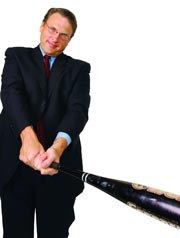
EVERYONE AGREES that Talmadge has changed dramatically in at least one way: He has lost more than 100 pounds since 1995. He is still a big man—tall and broad-shouldered as well as heavyset—but he’s lost weight gradually and kept it off by eating less, consuming healthful foods, and exercising. Son Matt Talmadge jokes, “We used to go to Dick’s all the time. Now it’s ‘Let’s go have salads.'” Getting in shape enabled Talmadge to get back into sports. He plays in an adult baseball league and competes in tournaments with Matt, whose scouting report is straightforward: “He can’t field, he can’t hit, but he can throw.” Last year, the elder Talmadge pitched 175 innings. Talmadge’s fastball has been clocked in the mid-80s, and he throws a wicked curve.
‘SOLVE THE PROBLEM’
In his final year in the state Senate, Talmadge won his first statewide election and served as a state Supreme Court justice for one six-year term. (His law practice today focuses on appeals.) On the bench, he solidified his reputation as a law-and-order advocate and also established his position as a statist—a jurist who gave great deference to the legislative branch of government. There are two academic studies that examine the court’s rulings on criminal justice during his tenure. One puts him in the “crime control bloc” of the court, and the other characterizes him as “conservative.”
Spokane’s McCaslin believes Talmadge’s law-and-order credentials will broaden his appeal around the state—always a plus for a candidate from Seattle. “He can impress people on this side [of the Cascades] with his philosophy on crime.”
While Talmadge does not hide his criminal-justice positions, they aren’t the main plank of his campaign. “The greatest problem we face in Washington state,” he says in an interview, “is the feeling that we lack leadership in government and government cannot be trusted to do the job; people are disconnected from their government.” He asks rhetorically, “What do I mean by leadership? Identify the problems. Tell people the truth no matter how hard it is. Solve the problem.
“Is leadership possible [today]? Yes it is. Look south to Oregon and [Democratic] Gov. John Kitzhaber.” Talmadge says that last year, when the Republican-controlled Oregon Legislature refused to pass a decent pharmaceutical reform bill, Kitzhaber vetoed the entire Department of Human Services’ budget, barnstormed the state demanding change, and called the legislators back to a special session, during which he got results. “That is what leaders must sometimes do,” Talmadge says.
Talmadge’s willingness to debate right-wing, tax-cut-initiative king Tim Eyman last October not only demonstrated his confrontational leadership style but earned him many points with the Democrats’ liberal base. The conventional wisdom is that in order to win the Democratic primary, you need to run to the left; then, to secure the general election, you must scamper back to the center. Talmadge, who is widely praised as an excellent political strategist, is charting a different course. His focus on leadership suggests he thinks Washington’s Democrats are so hungry for a kingpin that he can run to the center from the beginning as long as he keeps beating the strong-executive drum.
AFTER LEADERSHIP, the rest of his campaign message sounds downright Republican. On his Web site, Talmadge talks a lot about efficiency in government as “a program for Democrats. We must save monies wherever possible and make sure government programs operate as efficiently as possible.” His methods for producing efficiency include performance audits, a longtime Republican demand, repeated in recent years by none other than Tim Eyman. “We know there is a whole level of waste, fraud, and abuse” in government, says Talmadge. He believes performance audits run by state Auditor Brian Sonntag are an appropriate and effective means of combating these problems.
Talmadge also promotes “zero-based budgeting.” Today, the various departments of state government, he explains, start with their current budget amount and ask for an increase. Under zero-based budgeting, every department starts with nothing and must explain to the governor what the mission is, state how much money is needed to meet the goals, and define measures of success.
Talmadge sees the proliferation of citizen initiatives in recent years as a demonstration of a crisis in confidence in government. In response, he says, “We had better focus on what is deliverable.” That’s where performance audits and zero-based budgets come in. “Let’s force agency managers to justify each and every program, then let’s audit against [performance measures]. If they are are not [delivering], let’s dump it and try something else.”
Still awake? Talmadge is a wonk. He loves public policy and can talk about it in great detail with intense passion. In that way, he reminds one of Bill Clinton, someone just as eager as hell to realize his big-picture, New Democrat ideas by diving into the minutiae.
LONG SHOT VS. LOCKE
Talmadge doesn’t have Clinton’s touch with the common man, however. Talmadge is reserved and intellectual in manner. If he ever had a chance to debate Locke, much of the talk would likely sail over the heads of most Washingtonians.
Is that a debate we’re likely to see?
Political observers and legislators are divided on whether Locke will seek a third term as governor. There is also a split over whether Locke is vulnerable to a primary challenge from another Democrat. State legislators and the more liberal observers tend to believe that the dissatisfaction with Locke is quite deep in the Democratic Party. Political consultants don’t perceive a primary vulnerability for the incumbent.
Most observers agree that Talmadge is a long shot for the nomination, chiefly because he does not have good name recognition around the state. “If you went down the street and asked about Phil Talmadge,” says former state Rep. Val Ogen, a Democrat from Vancouver, “most people would say, ‘Who?'” Consultant Rolland Fatland says Talmadge “has about $2 million worth of name ID he’s got to buy.”
At the same time, there’s a consensus that Talmadge strategically made a wise choice when he declared his candidacy more than two years before the election. Many call it the “Patty Murray strategy.” In 1991, first-term state Sen. Murray, hardly a household name around the state, declared she was taking on U.S. Sen. Brock Adams in 1992. “There were at least 25 people ahead of Murray,” recalls Don Hopps of the Institute for Washington’s Future. Murray’s ability to win a statewide campaign against Adams was given little chance. Then Adams suddenly withdrew when The Seattle Times revealed a nasty scandal about his personal behavior. Suddenly, Murray was the front-runner. “She took the risk, and now she’s a senator,” says Hopps.
Other, better-known Democrats, like King County Executive Ron Sims and Attorney General Christine Gregoire, have signaled they will not run against Locke. That means they are stuck on the sidelines while Talmadge lines up endorsements, raises money, builds an organization, and establishes an identity.
SO FAR, HOWEVER, Talmadge has not raised much money—about $25,000. He claims that he was holding off until the 2002 election was over—not wanting to take money from the Democrats’ effort to retain the state Senate and House (they lost the Senate). “Now I feel justified in pushing ahead.” Most consultants agree that money will be very difficult for Talmadge to come by. Until the sitting governor declares his intentions, they say, money from the big interest groups that give to the Democrats—labor unions, trial lawyers, teachers, and environmentalists—will not flow to any other candidates.
Endorsements are not exactly pouring in, either. Talmadge has a steering committee of nine and a short list of endorsers. The most interesting thing about his endorsements is the number of county Democratic Party chairs: King County’s Greg Rodriguez, Kitsap County’s John Morgan, and Pierce County’s Jean Brooks, a former Talmadge staffer. That suggests Talmadge’s candidacy has more geographical reach than people give him credit for.
Talmadge will try to make up for the inherent difficulty in running against an incumbent governor of one’s own party with hustle. He is legendary for both the strength of his will and his willingness to back it up with shoe leather. Former King County Democratic Party chair Ron Forest observes, “Talmadge is everywhere across the state. He has his oar in the water, and he’s paddling like hell.”

The Tenets of Talmadge
Phil Talmadge’s platform stresses safe, nonideological issues like leadership and efficiency in government. Here are some specific ideas the candidate talks about:
Health care. Talmadge is very passionate about the state’s health care crisis but believes the political environment dictates an incremental solution. He wants to see the state use its purchasing power to drive down the costs of pharmaceuticals and insurance premiums. He admires Oregon’s approach to the Medicaid crisis—emphasizing preventive health measures (immunizations, for example) for many instead of radical intervention (heart transplants) for a few.
Tax reform. Talmadge won’t go near a state income tax. He does, however, want to eliminate the state’s Business and Occupation Tax because it taxes gross receipts, thereby unfairly penalizing start-ups and new businesses. He’s fuzzy on what would replace it.
Clean water. Talmadge sees water quality as an issue that can unite Eastern and Western Washington. Dry-siders depend on clean water for agriculture. Puget Sounders value a healthy marine environment. Talmadge wants to put water conservation and marine pollution back at the top of the governor’s agenda.
Transportation. Talmadge is critical of Sound Transit’s light-rail plan, claiming it will spend too much money to attract too few new transit riders. He favors trip-reduction programs and vanpools. While Talmadge shares a law office with Cleve Stockmeyer, a major monorail booster, and endorsed the Seattle monorail measure, he doesn’t talk about extending that system.
Reorganizing state government. Talmadge says state government is overdue for a major reorganization. He cites the number of agencies that deal with public lands as an example: the Department of Natural Resources (5 million acres of forests, farms, and underwater lands), the state Parks and Recreation Commission, and the Interagency Commission for Outdoor Recreation. “Why do we have three distinct agencies? It defies logic.” Talmadge sees reorganization as a way to trim an overgrown state bureaucracy.
George Howland Jr.