Hemingway hated semicolons, and David Mamet never met a plot twist he didn’t like. Whatever one’s opinion of the controversial playwright—dramatic powerhouse, chauvinist pig—there’s little denying his masterly way with the literary bait and switch. The Mamet formula, as instantly recognizable as Papa’s prose, spins out like an experiment in behavioralist noir: construct an elaborate, intricately nasty confidence game, plop down a handful of jaded and ethically jangled characters, and see what stirs up. Everything in Mamet is driven by this architecture of the con; it’s how he reveals psychology, motivation, and morality.
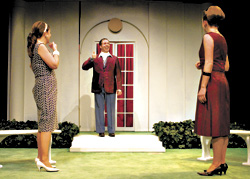
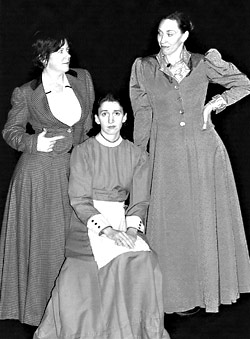
At first glance, then, Boston Marriage (through Sunday, Feb. 19; Seattle Public Theater at the Bathhouse on Greenlake, 206-524-1300, www.seattlepublictheater.org), directed by Daniel Wilson, appears to be quite a departure for the author of such head-twisting thrillers as House of Games and Glengarry Glen Ross. Two upper-class women living together in 19th-century Boston, Claire (Peggy Gannon) and Anna (Kate Myre), feel their domestic “situation” threatened by the arrival of Claire’s new love interest, a young woman whose startling family connection threatens to expose the couple and hence rob them of everything—their wealth, their home, and their fragile guise of respectability. It’s a setup right out of Henry James, to which Mamet adds his trademark terse, stinging dialogue and deliberate aura of deviousness and impending catastrophe.
It’s not long, however, before Claire and Anna are hatching a scam to allow them to retain their way of life. From here on, everything unwinds in familiar Mamet style, complete with double deals dealt at cross-purposes and ulterior motives all around. And it’s all quite fun. Wilson’s direction is strong and confident. He keeps the mood light and the pacing sharp, which rightly brings out the play’s more farcical elements. Heather Persinger is impressive as Anna’s maid, Catherine, a lower-class Scot who eventually proves herself as wily and willful as the women she serves. And Gannon and Myre are excellent as longtime lovers who know the best and worst in each other. Their familiarity, by turns easy and weary, fuels the play’s comedy as well as its intrigue.