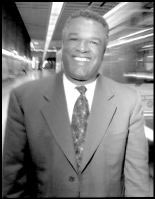

Who is the fairest of them all? Each candidate in the race for the open seat on the state Supreme Court, position 3, insists they will follow the law, not their own personal views. Jim Johnson, a folksy, passionate advocate from Olympia who narrowly won the primary, says, “I traveled the state with a simple message: The Supreme Court should be fair and impartial and protect the rights of everyone.” Mary Fairhurst, who has honed her deliberative equanimity in the attorney general’s office for the past 16 years, says, “As justices, our role is to be fair and impartial and follow the law.” Their critics insist, on the other hand, they know what sort of justices Fairhurst and Johnson will be based on their work as lawyers.
THE ADVOCATE
The rap on Johnson is that he is a right-wing, Indian-hating ideologue. “Jim Johnson is such a dangerous person,” says former state Supreme Court Justice Phil Talmadge, who was known for his strong support of the state’s position in most cases. The former justice is one voice in a loud chorus that denounces Johnson for his private practice of the past nine years that has included work for conservative groups like the Evergreen Freedom Foundation, a think tank that supports privatizing public education; Permanent Offense, Tim Eyman and his tax slashers; and the Building Industry Association of Washington, a lobbying group well-known for its hostility to environmental regulation. Previous to that, Johnson spent 20 years working for the attorney general’s office. In his first 10 years at the A.G.’s office, he specialized in fish and wildlife cases, where he earned the reputation of someone who is very hostile to Native American treaty rights. “He was Slade Gorton’s designated Indian fighter,” says Talmadge. “It wasn’t just the labor of a lawyer—it was a labor of love. It had a bad flavor to it.”
Johnson says his critics misunderstand him in many ways. People in “my client groups who think they can predict how I will rule as a judge will be wrong.” He says people constantly confuse lawyers’ views with those of their clients. “They make that mistake with me,” he says.
He feels his views on Indian treaty rights have also been misrepresented. “The Indians do have treaty rights, but they do not override everybody else’s rights.” He points out as illustrative of his views a case that he argued on behalf of 64,000 private landowners who were battling the tribes’ right to collect shellfish on their property. He was personally satisfied with the court’s decision in the case even though his clients did not win the day. “It got to be a balance between private landowners and treaty claims,” he says. The court held that the tribes did indeed have the right to gather shellfish, but not in an unrestricted manner.
Mason Morisette, a lawyer who opposed Johnson in the case, disagrees sharply. “On the question of property rights and treaty rights, he has hewed this one line: The treaties are not good law and don’t give Indians rights. He’s never prevailed.” Morisette thinks Johnson is too narrow-minded to be a good judge.
Johnson responds that some of his “critics are people who have lost cases or parts of cases to me. People accuse me of being a passionate advocate. Most good judges have been good advocates—I’ve been a better advocate than most.” Johnson points out that he has far more legal experience at the appellate level than his opponent, Fairhurst. Johnson says, “I have handled nearly 100 cases in the federal Courts of Appeal, Washington Supreme Court, and United States Supreme Court.” The thread that he sees throughout his cases is an ardent support of people’s constitutional rights—be they private-property rights, voting rights, or free-speech rights. He does plead guilty to having one bias. “If there is a vast conspiracy to enforce the state Constitution, then I’m part of it.”
‘JUDICIAL TEMPERAMENT’
Mary Fairhurst’s critics paint her as a government lackey and Bar fly. “Fairhurst has worked for the attorney general and had an unremarkable career. She was [Washington State Bar Association] president—part of the legal establishment,” says state Supreme Court Justice Richard Sanders, a libertarian. Sanders predicts, “Ninety percent of the time, [Fairhurst] will line up behind the government, whatever the government wants to do.” Sanders believes Fairhurst’s claim of neutrality is a smoke screen. “Be suspicious of people who say they don’t have any beliefs and can be impartial. Anybody who is running for state Supreme Court has a philosophy.”
Sanders blasts the myth that judges somehow set aside their own views and strictly rule on the law. What actually happens, he believes, is that judges’ personal views shape their understanding of how the law should be interpreted.
Fairhurst, who has the reputation as a very sweet-natured person, is really offended by Sanders’ observations. “It’s disheartening that he can make that accusation, because I’ve worked for the citizens of Washington for 16 years,” she says emphatically. “I am respected for being able to look at things from all sides. I can make tough decisions that go against my own personal beliefs if the Constitution demands it.” She boldly declares, “I have no agenda. I am not biased in any way on any issue.”
Fairhurst also takes umbrage with Sanders’ view that her work for the Washington State Bar makes her part of the legal establishment. “I have worked to improve the administration of justice, to enhance opportunities for minorities, to improve access to justice. My opponent has done none of those things, and Sanders did none of those things before joining” the Supreme Court. She adds, “I care about safety in the communities and that all people are treated with respect. Sanders has no evidence to show that I would be anything but true to the Constitution.”
Fairhurst says her career in the attorney general’s office has been one where she worked on a variety of complicated civil cases. It is not a career that requires a fiery advocacy but instead brings out different, more mediating qualities. “It’s not push, push, push, and I think that’s the tendency of my opponent. I have brought the thoughtful and the collaborative forward.”
She says one of her most significant cases came out of the Washington Corrections Center for Women at Purdy. The prisoners had successfully sued the state over the inadequacy of the prison’s medical, dental, and mental-health services. A federal judge ruled that the prison’s administration had to make improvements within a certain time period. Fairhurst came in to help the administration prepare its case to show those requirements had been met. In a two-week evidentiary hearing, many documents were presented to a federal magistrate to show Purdy’s compliance. The magistrate found the administration had completed its obligations. Fairhurst says the case “was an important one for me because of the efforts [the administration] had made. Also because of the amount of depositions and evidence presented. It was very important that the women were receiving the necessary services and that the Washington Corrections Center was able to come out from the shadow of federal oversight.”
Fairhurst also feels the case highlights her “judicial temperament.” It demonstrates how she can bring people together to work toward a common goal. That’s what she hopes to do on the court as well. “It’s my style to do business in a cooperative way,” she says.

SW PICK
The voters do not have an ideal choice in the race for state Supreme Court, position 3, between Mary Fairhurst and Jim Johnson. We would like to combine Johnson’s passion for constitutional rights with Fairhurst’s judicial temperament. Since we cannot, we have decided to err on the side of caution, picking Fairhurst as the safer of the two choices. Fairhurst is a very able attorney who has dedicated her life to public service in the attorney general’s office and with the Washington State Bar Association. She is widely acknowledged as someone who truly aspires to be a “steward of justice,” to have the legal community reach out and break down barriers of race, gender, and class created by both lawyers themselves and the court system in general. There is also no doubt that Fairhurst will sincerely listen to all sides of a case with an open mind and work collegially with the other justices. We hope, in addition, that once elected, Fairhurst will show more fire when it comes to protecting Washingtonians’ liberty than she does on the campaign trail. Johnson, on the other hand, exhibits all the advocacy for voting rights and individual liberty that one could ask for. His record on Native American treaties, however, really gives us serious doubts as to his ability to set aside his beliefs and rule on the law. He also seems too unsympathetic to the plight of the convicted when their punishment is excessive. We give a mild nod to Mary Fairhurst.
Seattle Weekly Editorial Board