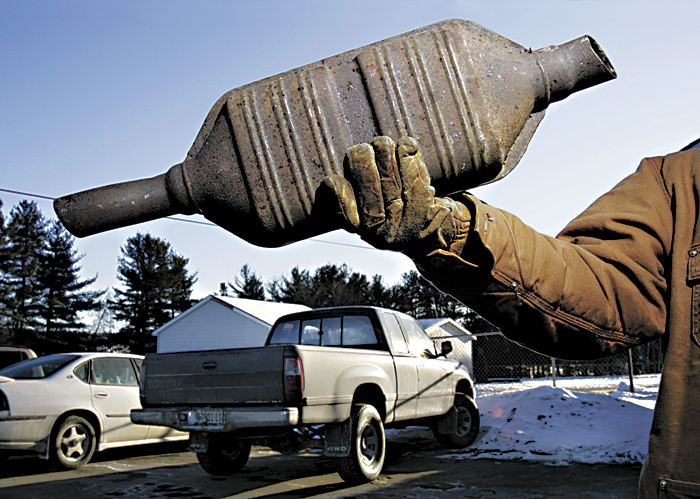
At his shop, West Seattle Midas manager Jeff Craig has a car waiting for a new catalytic converter. The last one didn’t stop working or rust off; instead, someone took a saw to the thick metal part that sits on a car’s undercarriage. It’s the second missing-catalytic-converter job to land at Craig’s shop in less than a week.
Craig’s repair jobs coincided with the appearance of theft stories on area blogs. In September, an activerain.com blog poster said his was stolen in the Northgate Mall parking lot. In November, a West Seattle Blog reader said theirs disappeared in a park-and-ride lot at Westcrest Park. And on Jan. 3, another West Seattleite reported a missing converter, inspiring yet another to look under their car to find someone had also taken theirs.
“This has been kind of something across the country for the last couple of years,” says Seattle Police Department spokesman Mark Jamieson.
The converters aren’t valuable as a part per se, but for the metal they contain. Most converters use platinum, the stuff of high-end wedding rings, to create a reaction that turns carbon monoxide into less-harmful carbon dioxide. The exhaust cleaners also contain rhodium and palladium, both used to make white-gold jewelry. Hence, converters can fetch up to $100 apiece at scrap yards.
Jamieson says he’s often asked, whenever a crime like this appears to be on the rise, if it has something to do with economic conditions. But “unless you arrest somebody and they say, ‘The reason I stole that catalytic converter is the economy is really bad and I lost half my 401-K,’ you can’t really know why they do it,” he says.
Craig says replacing a converter also requires sawing it off as thieves do, but adds that recyclers should be able to spot the stolen ones based on the overall condition of the part. “If they’re cut off and they’re still good, the insides would still be intact—and that would indicate that there’s no reason to replace them.”
West Seattle Recycling Center manager Ron Barge says rather than inspect each converter for signs of theft, he refuses to accept them unless the seller is willing to present some form of identification so he can find them later if there are questions about stolen parts. “We don’t like to buy them because they’re kind of a high-profile theft,” he adds.