
When Chris Cvetkovich announced that he would open a street-food-inspired restaurant, the buzz was palpable. He shared an early working menu with me then, in October—one that he was still tweaking. I eagerly gobbled it up, writing an excited, likely far-too-early preview for the new place that would be called Nue. Talk of Romanian mititei, Indonesian curry sandwiches, and even some modernist-technique items—like compressed fruit inspired by the ultra-fresh, beautifully cut chilled fruit found on the streets in countries like Malaysia—seemed an exciting antidote to a food writer’s occasional palate fatigue.
By the time I made the trip to the Capitol Hill restaurant a couple weeks ago, I was still hopeful, but also knew that this could get ugly. My biggest concern was that taking dishes from so many places around the world, with so many flavor profiles, could result in a cacophonous assault on the taste buds. But as I discovered, Nue has avoided this potential pitfall—in part by incorporating Asian flavors on almost half of the menu, with a focus on Vietnam, Japan, and Korea. So when Barbadian pig tails or Latvian smoked sprats are thrown into the mix, it’s more a welcome departure than a global war on the tongue.
Also helpful: the relatively small size of the plates (with perfect price points generally in the $7–$12 range). They are, however, easy for two to share generously. You’d be smart to curate your choices and ask to have them brought in an order that makes sense to you. On our first visit, almost everything (five dishes) arrived at once, which is hardly ideal. The second time around we called the shots, and the experience was far better.
Nue’s small interior holds three communal tables and a few seats at a back bar, and the cratelike shelves that make up the main wall—garnished with papier-mache dragons, cans of Thai fruits and other exotic foodstuffs, bottles of cheap foreign beers, and tattered Lonely Planet guides—give off an Asian food-stall vibe. A large painted mural of a pig and a goat drinking together, labeled respectively as “hungry” and “horny,” are whimsical and kind of out of left field, yet feel at home among the rest of the pitch-perfect kitsch.
However, there’s nothing kitschy about the food, prepared by Glynn Ward, who worked at The Willows Inn and Joe Swain, formerly of Glacier Brewhouse in Alaska. The big flavors found here are spot-on, and their balance, as well as the textures, are actually quite complex, in the way that the best street food can be. A bite of the chunky Japanese yakitori chicken thigh—grilled, bone-in (no street-style skewer)—encompasses the sweet teriyaki-style sauce, the “kewpie” mayo (a creamy Japanese mayo made with rice vinegar instead of distilled vinegar), the thin strips of nori, and the julienned pickled ginger, and is one of the most beguiling I’ve had in a very long time. (It’s also my 7-year-old daughter’s favorite dish.) South African bunny chow comes served atop lightly toasted slices of Pullman bread that hold up under the heaping mound of shredded chicken breast cooked with Indian masala, lime, and cilantro. The meat yields an almost stew-like affect that in some wondrous way manages to taste like both curry and barbecue. Ripping at the bread with your fingers and using it to “spoon” up the meat certainly screams messy, on-the-fly street food.
The grilled jerk pig tails, unfortunately, were almost all fat. The waitress (who happens to be the owner’s wife) told us that fat content varies wildly from pig to pig. I believe her, but there needs to be a check in place to make sure that they’re not serving ones as inedible as ours. Spicy Korean jumbo chicken wings really were gigantic; they ask for the largest possible, apparently. More important, though, they’re glazed with garlic, ginger, sesame, scallion, and a spicy gojujang (a Korean fermented soybean, red chili, and rice sauce) that brings delightful heat and requires wet-wipes to clean your hands after eating, as well they should. I can’t decide if these or the tasty ones at Tray Kitchen are superior. I’ll keep eating both until I reach a verdict, which could take, you know, forever.
We cooled it all down with a composed Vietnamese spinach & herb salad, which, while not resembling street food, reminded me of those papaya/peanut/fish sauce salads in a cup you get on the street in Vietnam and Thailand. There isn’t any papaya, but the leaves are dressed with shiso, basil, peanuts, nuoc cham dressing, candied shrimp, sawtooth (similar to cilantro), and rau ram (Vietnamese coriander). It isn’t spicy, but the intersection of all of those ingredients, surprisingly, works—the pungent tempered with the subtle. It’s a haiku of a dish, straightforward yet mysterious.
Speaking of all those herbs and sauces, it’s commendable how Nue really takes the time to source authentic, harder-to-find ingredients. It makes reading the menu challenging, but the staff is more than happy to answer any questions.
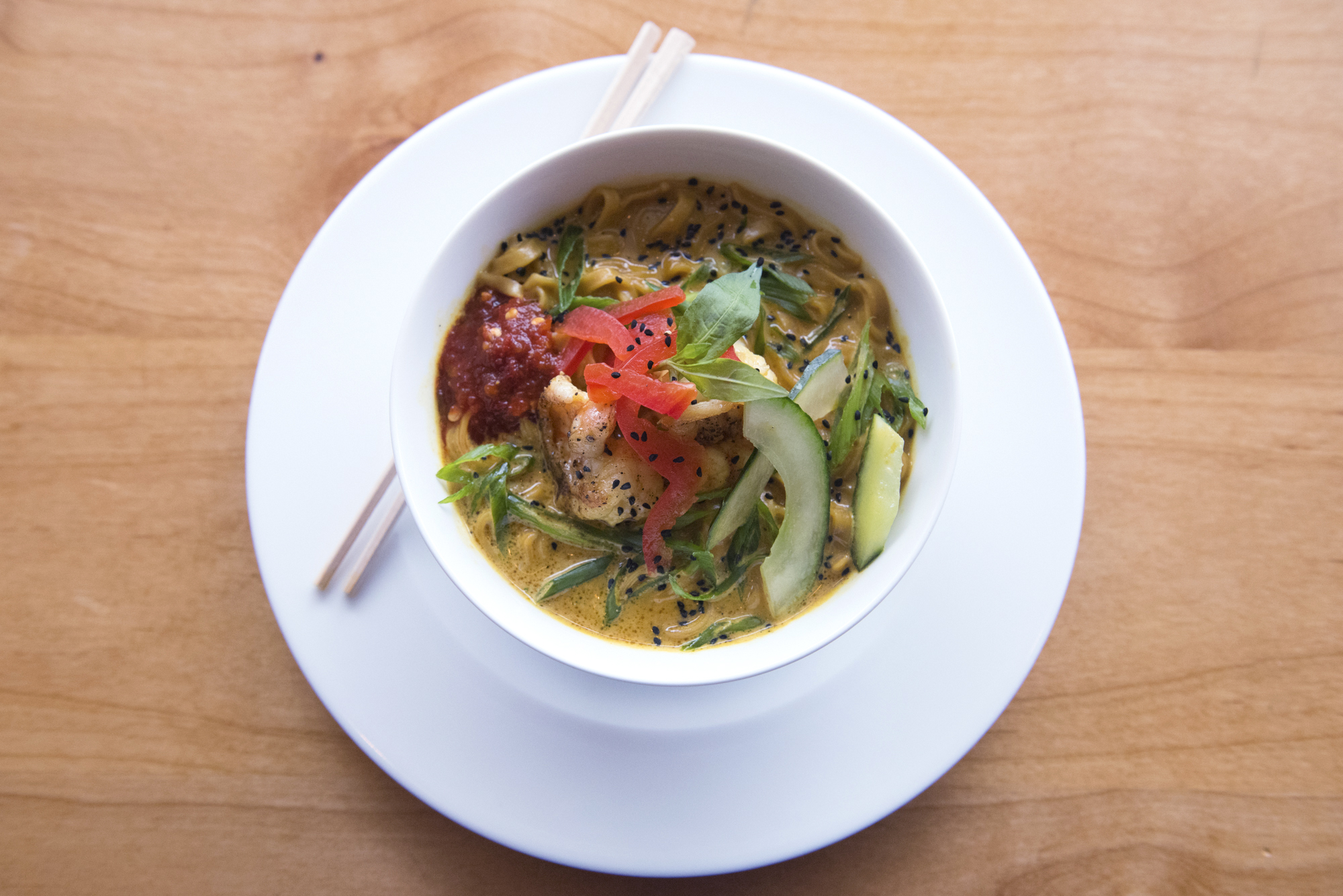
A prawn laksa, a spicy noodle soup found mostly in Malaysia, is given a southern Indian spin via a thicker peanut and coconut curry treatment, but the galangal (think ginger and eucalyptus), sambal (a vinegary chili-based sauce with notes of fish and shrimp paste), and duan kesom (Vietnamese mint) keep it true to its origins.
Romanian mititei was fine if not memorable, the grilled pork sausages enlivened by two dipping sauces: a horseradish mustard and ajvar, made from smoky eggplant and red peppers. Most impressive on this plate were the pickles, which achieve a cooling, milder bite than your average pickle while managing not to taste like an underbrined cucumber. I’d buy these by the jar. Likewise, the Indian spinach pakora were entirely reputable, though not what I’d seek here. However, their ability to keep the chickpea filling moist deserves mention.
After two visits, I have yet to explore Trinidad (goat curry), Latvia (sprats), the Caribbean (the cubano sandwich) or Hungary (paprikash), though of course I have every intention to. I’ve also tried Nue’s single dessert item—liquid-nitrogen ice cream, a nod to their love of Modernist cuisine—only once, but found the infusion of shiso honey rather lackluster. Had it not been dinner, I would have gone for the Vietnamese-coffee version. (They plan to change up flavors regularly.)
Finally, while I’ve grown weary of imbibing and describing six-ingredient craft cocktails, Nue surprised me with a drink menu worth mentioning. On a whim, I ordered the “Little Diddy ’bout Jack and Siam” (cue cheesy laugh track), curious about a cocktail described as “chilled Chardonnay, jackfruit, Thai chili, basil.” I’m a fan of jackfruit’s earthy, soapy, ever-so-slightly-sweet, pineapple-gone-bad flavor. It’s definitely what you’d call an acquired taste, but it’s not in fact related to the stinky durian that it resembles. In this preparation, several chunks of the meaty fruit, soaked in alcohol for hours, float in a slightly sweet chardonnay and get a spicy blast from the chili pepper and an herbal note from the basil.
I fell in love with this inimitable drink. I had two, and talked about it to whomever would listen the following week. Throughout the day before my second visit, I spent more than a few minutes fantasizing about it. Then, crushingly, they told me they were out. I think I gasped. The server explained that they hadn’t soaked the jackfruit in time, which I’ll chalk up to new opening kinks rather than laziness. Apparently, other customers also asked for it that night, which I hope bodes well for this unusual but bewitching cocktail.
With or without it, Nue, with its shabby charm and killer food, is going to be just fine—as long as they continue to surprise us with their unique takes on favorite street fare and execute them as well as they have to date. Street food is in danger of becoming a cliche, it’s true, but this exciting new restaurant reminds us why it’s so utterly addictive.
nsprinkle@seattleweekly.com
NUE 1519 14th Ave., 257-0312, nueseattle.com. Noon–10 p.m. Tues.–Wed.; noon–11 p.m. Thurs.–Sat.; 11 a.m.–9 p.m. Sun.

Top: Nue’s cozy, eclectic interior. Bottom left: chicken yakitori. Bottom right: prawn laksa.