Here’s one of the recession paradoxes in Seattle, routinely called America’s most literate city. Library usage is up. Amazon, one of the nation’s largest booksellers, is booming. Its electronic reader product Kindle is a hit. We’re home to two of the best and biggest bookstores in the U.S.: Elliott Bay Book Co. and University Book Store.Yet at precisely the same time that layoffs are afflicting the region, when consumer spending is down, and the economy is mired in a recession, used book stores are failing? It doesn’t make any sense. Paying a buck for a dog-eared Penguin edition of Jane Eyre is an entertainment bargain. It used to be that used book stores sprouted like mushrooms at every major Metro stop in the city. They were the distressed building owner’s best friend: If you couldn’t rent a vacant storefront space to, say, the Gap, a used book store could move in its entire inventory, plus cat, and start attracting customers. Secondhand retailers may not pay top-dollar rents, but they keep shoppers on the sidewalk, which helps raise all boats. That’s why a recent press release (after the jump) raises worrisome questions about the economics of reading in Seattle…Capitol Hill’s Horizon Books, located on 15th Ave. E. between Prospect and Harrison, has announced it’ll close its doors on March 15 following a progressive sale (right down to the shelving). In a press release, owner Don Glover said:”This marks the closing of Seattle’s oldest used bookstore – operating in the same location, under the same ownership, since July 1971. It’s been a slow, difficult decision, but a necessary one given the economics of the situation. We’ve enjoyed being a part of the neighborhood and Seattle’s cultural fabric. After the closure of the 15th Ave. store, Horizon Books will operate on the internet, in addition to maintaining a browsing space at 1423 10th. Ave. (between Pike and Union), a space shared with Recollection Books.”It’s significant that Horizon is going to the Web, when the Web (whether it’s eBay or Amazon, which sells used books) is what has shaken the traditional used book trade. Professional “book pickers” now raid the best estate sales, library sales, and new arrivals at Goodwill, truck their wares to a mini-storage locker, and undersell local retailers like Horizon Books, Twice Sold Tales, Magus Books, and Arundel Books, and Bookworm Exchange. All you need to be in the business are a computer, a Web site, and the willingness to wrap, schlep, and ship a lot of books at the post office. (We should also note that Elliott Bay sells some used books, and University Book Store offers used textbooks.)It’s even more efficient to deal in volume from a large warehouse, which is why Amazon’s 2004 entry into the used book market caused such an industry shakeup; and, from its new merchandise divisions, it gets the benefit of the company’s huge computer power and shipping clout. Amazon doesn’t break out used books as a portion of overall sales, but Publishers Weekly says Amazon is now the largest used book seller in the nation. PW also reports that while industry used-book sales are growing, most of that growth is over the Web, not via bricks-and-mortar stores. Meanwhile, used book sellers–whether mom-and-pops or lone-wolves working out of their basements–can use Amazon like eBay: as a cyber storefront for their titles. (For a small fee, of course.)This is essentially what killed downtown’s vast, century-old Shorey’s Books in the late ’90s. The main holdout in the used book biz is Half Price Books, a Texas-based retail chain with dozens of stores nationwide. Its Cap Hill and Roosevelt locations benefit from bulk buying power and a Web search function that places Amazon prominently on its home page.Over in the Uptown neighborhood, Twice Sold Tales’ owner Jamie Lutton says, “I do see a drop in sales. I had to cut my Queen Anne store in half.” Twice Sold also has locations in the U-District and on Cap Hill. “I grumble, sometimes loudly,” says Lutton. But, she adds, “Our Internet sales are pretty good. We’re just gonna continue to ramp down [at the retail level] and continue to sell online.” She also points to Seattle’s many literate, book-filled households, the affluent boomers selling and emptying their large houses to move into retirement condos. Somebody’s got to sell that inventory, much of it hardcover and in the original dust jacket.Whether the recession is hurting or helping used book stores, says Lutton, that effect is nowhere near so large as the entry of Amazon and Half Price Books into her field. “I’d say business was cut in half,” she recalls. How many of Seattle’s used bookstores have closed since then? “Where do you want me to start?” She rattles off a half-dozen neighborhood favorites like the Couth Buzzard and Batty Books. Among these friendly competitors, Horizon Books now included, you either adapt to the Internet or die.Meanwhile, opposite the Uptown Twice Sold store, the used CD business is doing quite nicely at Easy Street Records, as our Brian J. Barr has reported. With everyone moving their shelf-clogging music collections to iPod and computer, you could call the sales boomlet a relative bright spot in our recession. Or, to look at if differently, the recession may be driving people to liquidate their CDs and bookshelves (then the shelves themselves) because they need the cash. Not to purchase more books or music, but to buy food or pay the rent.Has Lutton yet seen an upsurge in such motivated book sellers in her stores? “Ask me again in six months,” she says.
More Stories From This Author


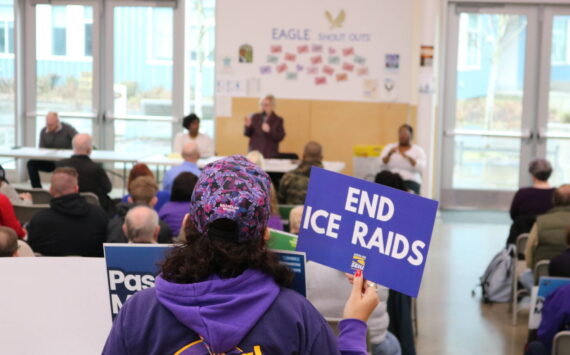
King County blocks construction of ICE detention centers
The King County Council approved an emergency one-year moratorium on March 3 that immediately blocks acceptance of permits for new…
By Staff reports • March 4, 2026 2:48 pm

Rivian and Lucid could see direct-to-consumer car sales in WA
Legislation allowing luxury electric vehicle makers Rivian and Lucid to join rival Tesla in selling directly to Washington customers is…
By Jerry Cornfield, Washington State Standard • March 2, 2026 6:12 pm
Renton man sentenced for 2023 Seattle homicide
The 61-year-old man received a nearly 31-year sentence.
By
Joshua Solorzano • March 2, 2026 4:30 pm