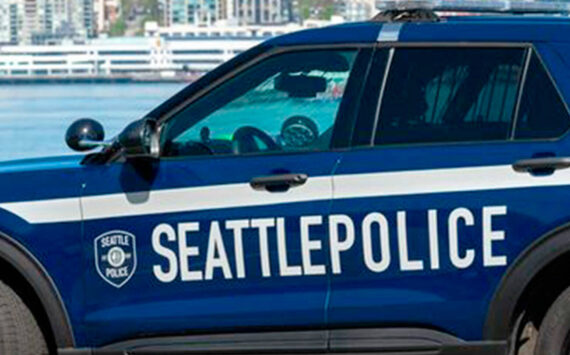
THE POLICE call it a tragedy but have yet to explain why it was necessary last week to shoot Aaron “Smokey” Roberts, 37, who was unarmed. Roberts, an African American, was stopped for “driving erratically” by white Seattle police officers Greg Neubert and Craig Price late Thursday night at 23rd and Union, according to the police. Roberts, a convicted felon with an outstanding warrant, then tried to flee, the police say, dragging Officer Neubert, who had reached in through the car’s window, along the street. The police account continues with Officer Price opening the passenger door, jumping in, struggling with the driver, and firing one shot that killed Roberts.
Among the questions raised by people protesting the shooting:
*If Roberts was trying to get away, why did he supposedly grab Neubert’s arm and drag the officer with him? (Police also suggest Neubert was somehow caught on the car after he reached in through the window.)
*With Roberts occupied—possibly driving with one hand and holding Neubert with the other—did Price try to club the driver or grab the key instead of shooting him after jumping in through the passenger door?
*Rather than shooting Roberts in his right side (and presumably putting the officer he was trying to help in the line of fire), could Price have shot Roberts in the leg, at a trajectory less likely to be lethal?
*Why did it take a half hour after he was mortally wounded for Roberts to arrive at Harborview Medical Center a mile away, where he was pronounced dead 10 minutes later?
*Did the police pull Roberts over, in a city where racial profiling is common, because he was a black man driving a big white Cadillac?
Only a day before Roberts was killed, a community delegation met with top City Hall officials to discuss, among other things, police relations in the Central District. According to a member of the delegation, five officers were identified as problem cops, allegedly well known in the Central District for harassment. Among the five were the two officers involved in Roberts’ death.
Police presumably have the answers or are getting them from their main witnesses, the two officers. Though the department quickly releases information on murders and other crimes by citizens, it withholds details of police shootings for internal review and then publicly presents them months later at a coroner’s inquest.
The incident may have unfolded exactly as police have hazily outlined it, and the officers’ actions may have been justified. “We all must resist the temptation to reach any conclusions until we have the full story,” says Mayor Paul Schell’s chief of staff, Maud Daudon. But as the cops and City Hall know from history, a black community already angry and suspicious about police tactics is understandably further agitated by shaded statements and stonewalling.
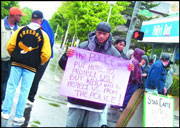
BLACK CENTRAL DISTRICT resident Kevin Graham has strong feelings about the white cops in his neighborhood. Like Roberts’ family and other community members, he thinks the shooting was a case of murder by a department that unfairly targets and harasses African Americans. The morning after the incident, Graham was up early sketching and photocopying a batch of “Wanted . . . Crooked Cops” fliers, then distributed them to passersby at the death scene outside Midtown Center. Police and media had not yet released the identities of the two officers. But Graham already had the cops’ names on his fliers.
“Oh, we know them,” said Graham as other blacks joined him in a street corner protest Friday (watched over by police in riot gear—without name tags). “I put in an internal investigation [complaint] on officer Neubert for when he planted some drugs on me,” Graham said. “I have not been contacted or anything. If they would have addressed that issue, he would have been on suspension and this could have been avoided. Already, this officer shot somebody at McDonald’s on Third and Pine in 1995.”
“Yeah, that was when Joe Palmer was shot,” said Graham’s friend, a tall young man and musician who uses the name Nut Case. (Palmer, a drug dealer, had pulled out a realistic gun-shaped lighter and was critically wounded by the officer.) “Neubert, he’s been threatening to kill people for months, whenever he pulls you over.”
“You talking about Neubert, man?” said a short black man, L. White, in the crowd. “The other day he pulls us over and says ‘Where’s the dope?’ We say, ‘There’s nothing here.’ He says, ‘You can tell me.’ Then he gets us all out. He says about me, ‘He looks like the rapist who beats his mom on Cherry [Street]. He beats his mom on Cherry,’ that’s what he said. He put everyone back in the car, they can go. I had to walk home in the rain. Just harassment.”
Roberts himself had at least one earlier run-in with Neubert, on the force since 1992. In that case last year, Roberts, a drug user who was divorced and had children, was arrested by Neubert for allegedly robbing an ex-girlfriend, Cassandra Bruce (she later recanted). He pleaded guilty to a firearms violation. Police have not said if Neubert and Roberts recognized each other Thursday night (the Cadillac is registered in the name of Roberts’ mother). Court records show Roberts was imprisoned for a year before his transition to the downtown Seattle work-release program at the Reynolds Hotel, which he walked away from in January. He has been arrested for or convicted of theft, eluding police, and assault. In court records in 2000, the police referred to him as “high risk . . . armed and dangerous.”
Friends and family call him a decent man who had a drug problem. “Whatever he did,” says ex-wife Carolene Roberts, “he didn’t deserve to be shot down in the middle of the street.”
Police officials say Neubert—who was hospitalized overnight—and Price—on the force two and a half years—are good officers and like all cops have enemies and misinformed detractors. The department says both officers feared for their lives and Price was justified in shooting Roberts. The cops have little reason to believe they’ll be proved wrong. In 33 police-related shootings since the early 1980s, coroner’s inquest juries found every killing justified. That includes shooting a black man with a toy squirt gun, killing a black man as he was surrendering, and shooting another black man in his home as he held a TV remote. Five of the last eight police shootings in Seattle involved black victims.
“I know all cops aren’t bad,” said a young black woman standing at the Roberts death scene last week. “But why do I think they all lie to us?”