A COUPLE OF hell-raisers who hope to shake up the status quo came by the Weekly‘s office this week. Both Curt Firestone and Grant Cogswell are running against incumbents for Seattle City Council. Can either of them win?
THE TWINKLING FIREBRAND
Firestone is a firebrand who refuses to burn out. For the last 15 years, this 60-year-old’s gray beard, rumbling baritone, and twinkling eyes have been familiar to anyone involved in progressive electoral politics in Seattle. Two years ago, he challenged powerful council incumbent Margaret Pageler. Calling in his many chits from years of electoral work, he raised a respectable amount of money—$60,000—and put together a fine list of endorsers, including many elected officials. He wound up with 32 percent of the vote, a perfectly respectable showing.
The transition from activist to candidate was not smooth, however. Firestone lost his sense of humor on the trail; he talked too much, despite not being knowledgeable enough about city politics; he didn’t know his opponent’s record well enough to debate her effectively; and his platform had too much boilerplate lefty rhetoric—like his call to make Seattle a city that disobeyed federal immigration laws.
This time around, he’s taking on Jan Drago, a council workhorse best known for establishing dog runs in city parks. Firestone has long preached that progressive candidates have to run in order to gain experience to be effective on the campaign trail. So far, he is his own best example: His performance against Drago in our editorial board debate was a big improvement over two years ago. He has softened the rhetoric without becoming mushy, and his answers are shorter and more to the point. He still, however, needs to work at being a more likable candidate and present positive reasons to support him, rather than solely criticizing Drago.
It seems highly unlikely than he can win, however. Drago has raised $80,000, to Firestone’s $14,000, without breaking a sweat. After eight years on council, her knowledge of city government is encyclopedic, and she can trot out her law-and-order rap, her friend-of-the-homeless rap, or her business-ally rap as the need arises.
Firestone is aware that he’s running for the future. As he puts it, he made a $60,000 investment two years ago and needs to keep running to protect that investment. He is looking forward to another election, when he can pounce on a really vulnerable incumbent, which Drago is not, or an open seat. The question that he ultimately faces is whether Seattle wants a firebrand activist government, or whether the city is content with the sluggish liberal limousine it’s had for 20 years.
MONORAIL MANIAC
Grant Cogswell’s candidacy blazes with the passion of a true believer. Cogswell is trying to pull a Judy Nicastro: Two years ago, the unknown Nicastro appeared from nowhere to win a City Council seat.
Cogswell’s candidacy resembles Nicastro’s in many ways. They both have an in-your-face style, although Cogswell lacks Nicastro’s charm and sense of humor. Cogswell also appears to share Nicastro’s good political instincts: He challenged the constitutionality of a ban on criticizing opponents in the city’s voters’ pamphlet, getting some nice free publicity to boot. Also like Nicastro, Cogswell is running on a single issue, although his raison d’괲e is the monorail, not renters’ rights.
Cogswell was one of the original monorail backers. He has always been utopian in his beliefs about the ability of the monorail to solve the city’s transportation crisis. He wholeheartedly believes the monorail is our silver bullet, that it is cheap, nonpolluting, fast, easy to build, and will “get a majority of people in this region onto transit.” The real-world track record of monorails is not so glorious, but it could certainly be an important part of an overall transportation plan.
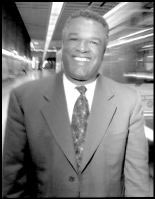
Unlike Nicastro, however, Cogswell is not running for an open seat; instead, he is opposing the City Council’s transportation czar, incumbent Richard McIver. McIver’s record on the monorail is terrible: He barely lifted a finger to help it and went out of his way to hurt it on occasion. Cogswell is hammering on that point repeatedly—luckily for McIver, one tires of hearing about it after a while.
Cogswell has an uphill battle in a number of areas: money (McIver $66,000, Cogswell $5,300); McIver is not only the council’s only black member, he’s the only racial minority period; McIver, who was roughed up by police during WTO, has championed and passed mild police reforms, as well as spoken out effectively against racial profiling and for racial justice; and McIver’s moderate style and power broker politics seem closer to Seattle’s voters than Cogswell’s grassroots fervor. We’ll see if Seattle’s monorail mania rolls right off the track and actually attaches itself to Cogswell.
We will also see if, in the long term, Firestone, Cogswell, and other activists like them are successful in their effort to push city government in a more populist, progressive direction.