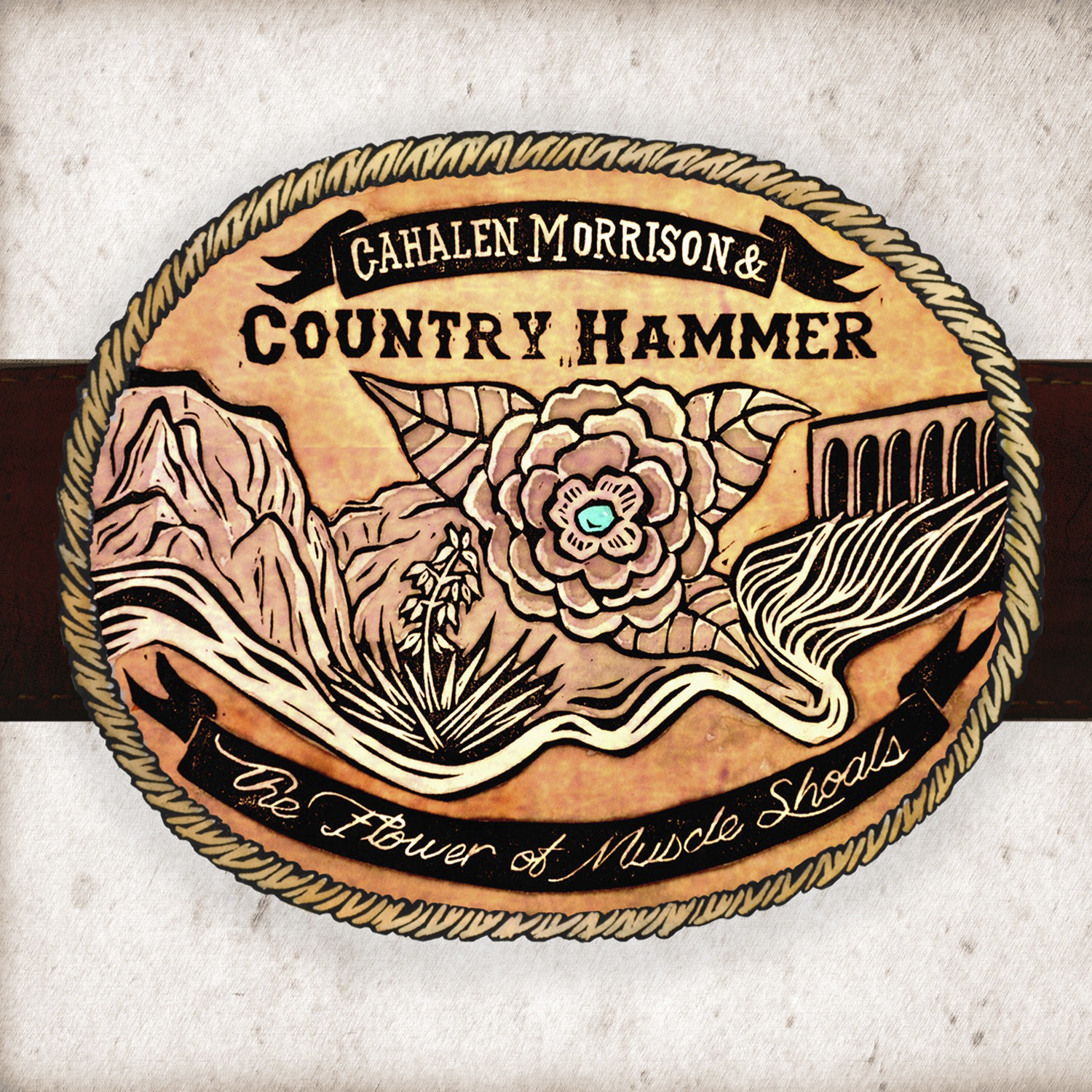
VeeShapeCahalen Morrison & Country Hammer, The Flower of Muscle Shoals (out now, Free Dirt Records, cahalen.com/country-hammer) If it sounds funny for a Pacific Northwest-based string player originally from New Mexico to name his first album after a town in Alabama, well, that’s what a little bit of love will do. Not only is this release Morrison’s first with his new band Country Hammer (you likely first heard of him from his roots duo with Eli West, with whom he still plays), it’s his first since he married, and the title track was written for his new wife, who hails from the fabled Southern town. Thankfully, Morrison’s happy heart hasn’t changed the hard-luck ethos one would expect from a band complete with pedal steel and fiddle; there’s still plenty of country noir to go around. “Sorrow Lines the Highway of Regret,” for example, is a honky-tonkin’ barroom stomper in the tradition of Ricky Skaggs or Dwight Yoakam, and the accordion-flecked “San Luis” is surprisingly upbeat for the cryptic elegy it appears to be. There’s even a subtle darkness to the title track—something about “red dirt blood she bled”—but that, Morrison says, is because he enjoys “phrasing things to sound darker and more visceral than they necessarily need to be . . . like it conveys a deeper, more mystical emotion that way.” Maybe that’s just his way of putting it to make the rest of us sad sacks feel better. Whatever the reason, alongside his dust-filled, twangy vocals and his seasoned country band—including Country Dave Harmonson on pedal steel and Ethan Lawton on drums—it’s an effect put to good use. GWENDOLYN ELLIOTT
VeeShape
VeeShapeChris Staples, American Soft (out now, Barsuk Records, chrisstaplesmusic.com) Chris Staples comes from a lineage of Seattle singer/songwriters unfairly labeled as folk. Sure, he’s playing an acoustic guitar, but that’s merely the means he uses to convey his pop sensibility. American Soft’s tracks center on Staples’ vocals and acoustic guitar, though he employs simple drums and synthesizers nearly throughout—a pattern he breaks free from on the instrumental “Wurlitzer,” which reveals his knack for experimental composition, pairing snappy rhythms with arpeggios from the namesake organ. Elsewhere, though he sings just above a warm whisper and doesn’t include any show-off moments, every song is packed with sensational hooks that stick, and you’ll be humming melodies from “Black Tornado” and “Dark Side of the Moon” long after the record ends. Yet for all this, Staples is at his best when he strips a song to its bare bones. Closer “Early Bird Tavern” could be an epic pop-rock anthem, but playing it as an acoustic ballad underscores the heavy weight of its lyrics. He even pays homage here to pop-rock legend Tom Petty with the refrain “You don’t have to live like a refugee.” It’s a true showcase of his talent for doing more with less, and mining the underlying beauty in simplicity. DUSTY HENRY
VeeShape
VeeShapeTomtem, The Farewell Party (out now, Versicolor, tomtenmusic.bandcamp.com) Like his band’s 2012 release Wednesday’s Children, Tomtem frontman Brian Noyeswatkins still holds a blazing torch for the lo-fi, psych sounds of the ’60s. But here on the band’s second full-length, with the help of studio multi-instrumentalists Lena Simon and Jake Brady, the aesthetic is pushed into the new millennium, merging Noyeswatkins’ Cockney-lite drawl (not unlike that of a young Mick Jagger) with the drone-filled reverb of artists like Cass McCombs and Papercuts, aka Jason Quever. The latter’s influence on the album is more than just coincidence; Quever recorded and produced it himself at his San Francisco home studio, and his penchant for dreamy chamber pop is unmistakable on the album’s first three tracks, “Pipe Dream Boy,” “Wayward Song,” and “Asimolar” (which could be a McCombs outtake). But things get peppier on “Thomasina,” with its perky piano intro and lush horn instrumental, recalling the music of Sondre Lerche and Sufjan Stevens—an excellent example of how The Farewell Party balances Quever’s lo-fi style with Tomten’s baroque-leaning qualities. With a liberal use of mellotron next to Noyeswatkins’ milky vocals and an unhurried approach to songwriting, it’s a distinctive and very happy marriage overall. GE