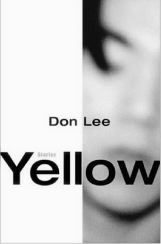
YELLOW: STORIES
by Don Lee (W.W. Norton & Co., $22.95)
FOR THE PAST 12 years, Don Lee has edited the literary journal Ploughshares, shepherding into print some of America’s most stimulating poetry and prose. In the meantime, he has published his own short fiction; a tale here, a longer novella there. Now, with Yellow, Lee collects his journeyman efforts into one volume, and the result is a gem of a book that offers an atmospheric glimpse into the Asian-American experience at the turn of the 21st century.
Like Sherwood Anderson’s Winesburg, Ohio and Gloria Naylor’s The Women of Brewster Place, the stories in Lee’s debut interconnect and overlap, establishing a universe of their own. Set in a small Northern California town called Rosarita Bay, they feature Asian Americans from all walks of life: a retired banker in pursuit of the best waves to surf; a famous woodworker in love with a woman for the wrong reasons; a pair of mixed-race orphans stranded by a father who has left them for one last run at the PGA tour.
While Lee’s characters never meet one another, the themes each story embodies—the perennial tug between culture and assimilation, the impossibility of these people finding home in a culture that designates them as aliens—reverberate through all the tales. In “Domo Arigato,” a married man wistfully recalls his first stab at love, which happened to be with a white woman. Through the scrim of years, he tries and fails to divine the reason for their breakup. “Maybe [her parents] had been right: it was easier being with your own kind, you couldn’t overcome the hatred of countries or race, any more than you could forgive someone for breaking your heart.”
These stories often invoke the shadow of race through the prism of improbable love. In “The Lone Night Cantina,” an Asian woman indulges her cowboy obsession by picking up a handsome, long-legged drifter at a bar. When the man turns out to be mourning the death of his wife, Lee’s heroine must confront the pool of sadness lurking beneath her fake blond hair and affected cowgirl twang.
UNLIKE ANDERSON’S classic, Lee’s stories never quite form a novel. Considered together, their overall affect is more cinematic and diffuse, not unlike the movies Short Cuts or Magnolia, in which large casts of characters enact the sad dramas of their lives in poignant isolation. Our darker secrets and small wars must always be fought alone, Lee suggests here.
Lee narrates these stories with an old-fashioned omniscience that allows him to evoke the complex emotional lives of his characters with unassumingly polished prose. Like Chaucer’s Canterbury Tales, a seed of the episodic novels to come, Yellow celebrates the whole human comedy, from our petty hatreds to our occasional moments of grace.
The strongest stories in this collection explore the ways being Asian in America means internalizing the prejudice one suffers. “Yellow,” the collection’s masterpiece, brings to life a man who has spent his days in a pugilistic stance, boasting about his face and body to anyone attempting to count him out. Yet when his hard-earned muscular physique fades in middle age, the sharp edge of his pessimism remains. And in the story’s dramatic finale, Lee’s protagonist suddenly sees the wall he has erected between himself and the world.
Epiphanies such as these lift Lee’s stories from the page and give the book its deceptively lyrical ballast. The Asian-American experience, as these stories reveal, has grown ever more rich and complicated, making the notion of a collective community a difficult one to imagine, let alone render. With Yellow, Lee has captured this truth beautifully, wisely, and with winning economy.