Opening ThisWeek
PBallet 422
Opens Fri., March 13 at Sundance Cinemas. Not rated. 75 minutes.
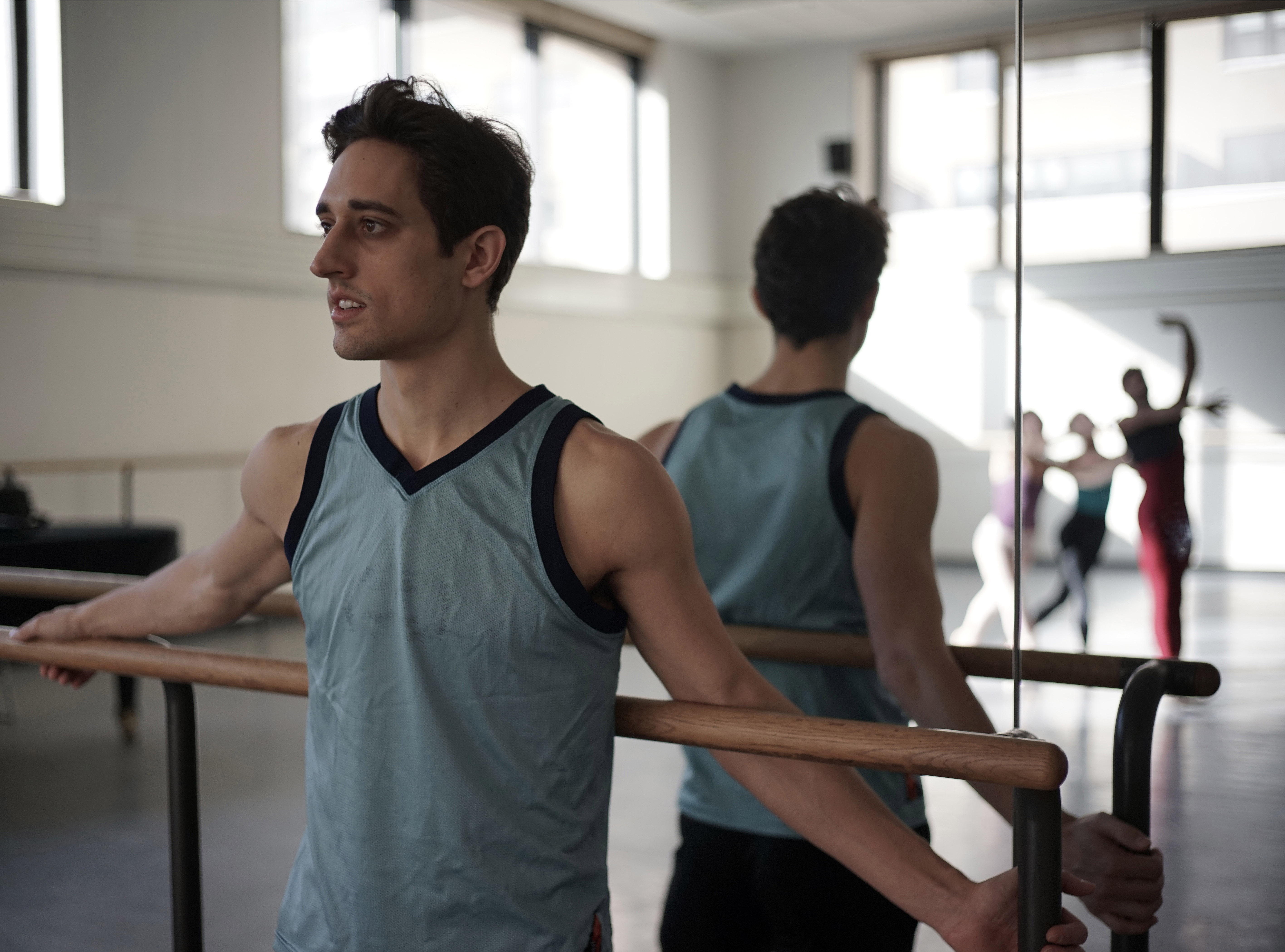
Jody Lee Lipes’ documentary isn’t so much about a dance as about the process of making one. We follow choreographer Justin Peck from rehearsals to meetings and back again, watching him as he watches his dancers, scribbles in a notebook, listens to the score, and talks with the myriad collaborators who are all a part of the project. It’s like a job-shadowing assignment. By the end of the film, we know much more about Peck’s life as an up-and-coming dancemaker than we do about the ballet we’ve seen him make.
Paz de La Jolla is Peck’s third work for New York City Ballet, but it’s the company’s 422nd new commission—hence the film’s title. More than any company working today, NYCB is organized to create and present new ballets. And as Lipes’ camera threads its way through the warren of hallways at Lincoln Center, we see the legion of artists and technicians required to run that institution. Costume and lighting designers, rehearsal assistants, musicians and conductors, physical therapists and makeup artists—all have an integral part to play, and Peck calls on them all. Between those logistical meetings we see bits and piece of the ballet as it comes together.
Lipes has made a doc in the tradition of Frederick Wiseman: Rather than utilizing interviews and explanatory narrative, we are left to sort out the various locations and situations for ourselves. This uninflected style fits Peck’s calm demeanor. He’s making a complex ballet, full of virtuosic dancing, but he seems to keep any emotional outbursts in check. As time counts down to opening night, he only gets more serious.
If anything is missing from Ballet 422, it’s an extended look at the dance itself. We see phrases in rehearsal, and the inevitable tweaking of details, but we don’t really view the ballet in a full run-through. Even during its premiere, we still watch Peck watching his dance. The camera is focused on the choreographer, dancers reflected in his glasses. Sandra Kurtz
Beloved Sisters
Runs Fri., March 13–Thurs., March 20 at Grand Illusion. Not rated. 170 minutes.
Last year brought a lot of chatter about cinema’s obligations to historical accuracy. Did Selma distort Lyndon Johnson’s role in the civil-rights struggle? Did American Sniper sanitize the Iraq War’s most lethal sharpshooter? Whatever the answers, we can conclude that the further we get from the historical period in question, the less discrepancies seem to matter. Which is why few people will fret over whether the historical characters in Beloved Sisters actually got it on as a threesome.
There’s no definitive proof that German writer Friedrich Schiller was snuggling up with his wife’s sister, but this movie certainly likes the idea. In the film, set in the late 18th century, Schiller (the callow Florian Stetter) meets future wife Charlotte (Henriette Confurius) when he is still a threadbare playwright. Charlotte has the luxury of marrying for love, because her older sister Caroline (Hannah Herzsprung) has already married for wealth, thus propping up the fortunes of Charlotte and the sisters’ shrewd mother (Claudia Messner). But both sisters are close to the writer, and his erotic attention is clearly divided. Charlotte is less formed and apparently somewhat uncomplicated, but Caroline is a complex woman and a talented writer herself. Schiller publishes her serial novel in his magazine, a story that becomes the talk of the literary world for a few months. The casting itself tips the balance in Caroline’s favor: Herzsprung, an actress of hooded eyes and smoldering demeanor, is a richer performer than the out-pointed Confurius.
With its heavy-breathing material, Beloved Sisters has possibilities, but veteran director Dominik Graf swerves recklessly between the arthouse and soap opera. The thing stretches out to 170 minutes, which makes for a lot of pretty costumes and houses but not much momentum. I ended up enjoying the movie, in part because Graf arranges the entire story around letter-writing. He’s surely cribbing from Francois Truffaut’s Two English Girls, another love-triangle period piece that featured actors addressing the camera as they narrate their passionate letters to one another. The device gives Beloved Sisters an antique quality that lifts it from the humdrum realm of the average miniseries. Robert Horton
Cinderella
Opens Fri., March 13 at Ark Lodge, Majestic Bay, varsity, and other theaters. Rated PG. 105 minutes.
At the preview for Disney’s live-action retelling of its 1950 animated favorite, I saw both young girls and grown women decked out in gowns and tiaras. The fans are ready, and, when the mood strikes me, I also can be swept up in watching two beautiful people fall in love. And beautiful they are: Game of Thrones’ Richard Madden as Prince Charming (in some very flattering tight pants) and Downton Abbey’s Lily James as the demure and free-spirited Ella, who wears butterflies in her hair because that’s just her brand of Manic Pixie Dream Girl. (Let’s also here bestow the praising-hands emoji upon James’ eyebrows, the boldness of which is unprecedented by any other Disney princess.)
The familiar plot has been gently tweaked. Prior to the fateful ball, Ella now meets Prince Charming in the forest, where he claims to be a humble apprentice working at the palace. Ella’s also been given more agency. Unlike most adaptations of the Perrault folk tale, this Ella is hardly embarrassed by her low station. She soon adopts a strong take-me-as-I-am attitude, surely designed to appeal to girls raised on Frozen. After being christened “Cinderella” by her evil stepmother (Cate Blanchett) and stepsisters, she chooses to reclaim the demeaning nickname and make it her own. Is that the best message for how to respond to bullying? Perhaps not the worst.
It’s fair to say that no one does Cinderella quite like Disney. My circle still speaks in hushed, reverent tones about Disney’s racially diverse 1997 TV adaptation of the Rodgers and Hammerstein musical Cinderella starring Brandy, with Whitney Houston as her fairy godmother. Directed by Kenneth Branagh, this bubblegum version doesn’t inspire quite the same adoration, though it features my favorite color palette: shades of sparkle. And the new Frozen short that precedes the film is alone worth your $12 ticket price. Diana M. Le
Kung Fu Elliot
Opens Fri., March 13 at SIFF Film Center. Not rated. 88 minutes.
In the geek-show school of documentary, strange pockets of humanity are uncovered so we can laugh at the foibles of people who are not us. Either you feel bad for laughing, or you reject that sort of condescending approach altogether. (Or you feel superior to other people, I guess.) Kung Fu Elliot invites audience mirth at the expense of its collection of Nova Scotia oddballs, but you might not feel so guilty about your laughter by the time the movie reaches its bizarre, late-hatching revelations. There’s some creepy stuff going on in Halifax, folks.
At first the movie comes on like the Canadian answer to American Movie, that portrait of a hopelessly incompetent indie filmmaker (a geek-show doc par excellence). Our central figure is Elliot Scott, an out-of-condition martial-arts practitioner. He lives with (or off) his girlfriend, Linda Lum, who exists in a mode of deadpan exasperation and is also a producer, photographer, and driver (“because I have a car”) for Elliot’s moviemaking exploits. He seeks to be the Jean-Claude Van Damme of Canada, though thus far his two self-made features are being sold outside video stores. The documentary tracks the progress of Blood Fight, Elliot’s newest kung fu flick. Incredibly, he actually shoots some footage in China, when his acupuncture class visits there. Elliot’s feeble martial-arts demonstration in front of an actual Shaolin monk is one of the movie’s indicators that Elliot’s bravado might not be founded in reality.
In short, Elliot starts looking less like a self-deluded dreamer and more like a sociopath. Directors Matthew Bauckman and Jaret Belliveau play the audience quite skillfully here, as the story gradually goes down a disturbing road. It’s like watching the career of Ed Wood unfold in time-lapse quickness: from gung-ho promoter to ham-handed moviemaker to sleazy purveyor of soft-core (and possibly hard-core) porn. It’s a strange game for a documentary to play, and it leaves behind a faintly sour taste; you feel especially bad for the people sucked into Elliot’s high-kicking vortex. (One Blood Fight actor, hung out to dry by Elliot and the doc filmmakers alike, seems to have sprung from the Waiting for Guffman ensemble cast.) I’m mostly sure Kung Fu Elliot is for real; if not, somebody went to a lot of trouble to create the trailers for Elliot Scott’s past DVD efforts, such as They Killed My Cat. Search that one online, and revel in the campy realm of human absurdity. Robert Horton
P’71
Opens Fri., March 13 at Guild 45th & Meridian. Rated R. 99 minutes.
For young soldier Gary (Jack O’Connell) and most of his British squad, Northern Ireland is more than another country. Dispatched there to patrol the volatile frontline between Catholic and Protestant factions is like being sent to the moon (a mission then only two years past). Is Belfast even part of the UK? Gary and his mates aren’t sure. None have passports or any education.
The Army is just a job, and we shall later learn that naive Gary used it to get out of an orphanage (where his kid brother still resides). In Belfast, the Irish are utterly alien and hostile—savages, seemingly, like Hollywood Indians. On Gary’s disastrous first patrol, at the sight of his convoy, all the women on a republican street begin slamming their trash-can lids to the pavement in warning—like tribal drums.
That warning goes unheeded. Twenty-five minutes into the picture, directed with brutal, kinetic grace by Yann Demange, Gary finds himself running for his life. No rifle, no backup, no idea where he is, behind enemy lines. IRA bullets fly around his head as he races down shoulder-width alleyways in a panic, camera pell-mell behind him, until he finds brief refuge in a backyard privy. (This is Ireland, and indoor plumbing is still a luxury in 1971.) There poor Gary sobs in fear, the smell of shit and his own blood in his nostrils; and you can’t help thinking of the similar ordeal O’Connell’s aviator endured in Unbroken.
The rest of ’71 is a pure, thrilling, suspenseful chase movie—the best thing I’ve seen thus far in the new year. And though running from monsters is a cinema standby (think of Aliens), the treacherous neighborhood politics are what makes Gary’s overnight odyssey so harrowing. Briefly protected by a Protestant militia-connected boy his brother’s age, the lad quizzes him about faith. (Here subtitles would help.) Are you Catholic or Protestant? he asks. Gary doesn’t even know; he was raised in a children’s home; his parents—if he ever knew them—are never mentioned. He’s totally disoriented, stunned from punches to the head, later concussed by a bomb. His age and innocence make him a hapless pilgrim (or potential martyr) in a place as terrifying as Fallujah today, like being caught between Shia and Sunni militias.
Demange and his screenwriter—Black Watch playwright Gregory Burke—have obviously seen the 1947 classic Odd Man Out, to which ’71 bears due comparison. But James Mason’s fugitive was there a man who knew his own sins, while O’Connell’s Gary has yet to commit any. (After his first act of violence, stunned by that moment, he reaches out to console his victim.) The politics swirling around Gary are meanwhile a moral murk: He’s double-crossed by his superiors and sheltered by his supposed adversaries. What he learns about his military—and government—is best expressed by an Irish ex-Army medic who stitches up his wounds (without anesthetic, of course): “They don’t care about you. You’re just a piece of meat to them.” By that time, Gary certainly looks it: bloodied, quivering, helpless. ’71 doesn’t pretend that better times are near (Bloody Sunday is just a year ahead), though it does finally proffer a few shreds of humanity against a future we know will be terribly bleak. Brian Miller
Wild Tales
Opens Fri., March 13 at Seven Gables. Rated R. 122 minutes.
The opening sequence of Wild Tales sets up a Twilight Zone-style series of revelations, compressed into just a few minutes. Passengers riding on a suspiciously underfilled plane begin to realize that there might be a reason for their presence there, beyond the obvious business of getting to a destination. Writer/director Damian Szifron wants to get his movie started with a bang, and he does—in fact, the rest of this anthology feature doesn’t live up to the wicked curtain-raiser. But there are enough moments of irony and ingenuity to explain why the Oscar voters made this Argentine entry one of the five nominees in the Foreign Language Film category (it lost to Ida).
Along with the airplane opening, modes of transportation figure prominently in the stories. In one, a lone driver (Leonardo Sbaraglia) has a flat tire in the middle of nowhere, which allows the slowpoke he antagonized earlier to stop by and exact revenge. In another, an explosives expert (Ricardo Darin, the star of The Secret in Their Eyes) becomes enraged by a parking ticket—rage that leads him to lose everything. But there’s a twist. A lot of these segments rely on a twist, a technique that doesn’t quite disguise how in-your-face the lessons are. The twists also can’t disguise the way some of the tales rely on illogical behavior to allow their plots to develop.
The long final episode suggests that the illogical behavior can be chalked up to a strain of magical realism. Here a wedding reception goes on far longer than it would in the real world, when the bride (Erica Rivas) melts down after learning something rotten about her groom during the party. The story goes off the rails, but also hits a crazed pitch that results in some unpredictable highs. Szifron’s targets are macho culture and the lizard-brain need for revenge, although mostly he’s into savoring the sardonic juice he can squeeze from his greedy characters. Sometimes that means sitting through 20 minutes of buildup just to get to a single amusing plot reversal, as in a segment about wealthy folks trying to cover up a family crime by buying off the people around them. Wild Tales is a showy exercise (you can see why Pedro Almodovar signed on as a producer), and Szifron has undoubtedly punched his ticket for bigger and better things. He’ll have to deliver something more than a scattering of gotchas next time. Robert Horton
E
film@seattleweekly.com

Don’t get out of the car! Sbaraglia in the “Road to Hell” episode.Sony Pictures Classics