Opening ThisWeek
Captain Phillips
Opens Fri., Oct. 11 at Guild 45th and other theaters. Rated PG-13. 132 minutes.
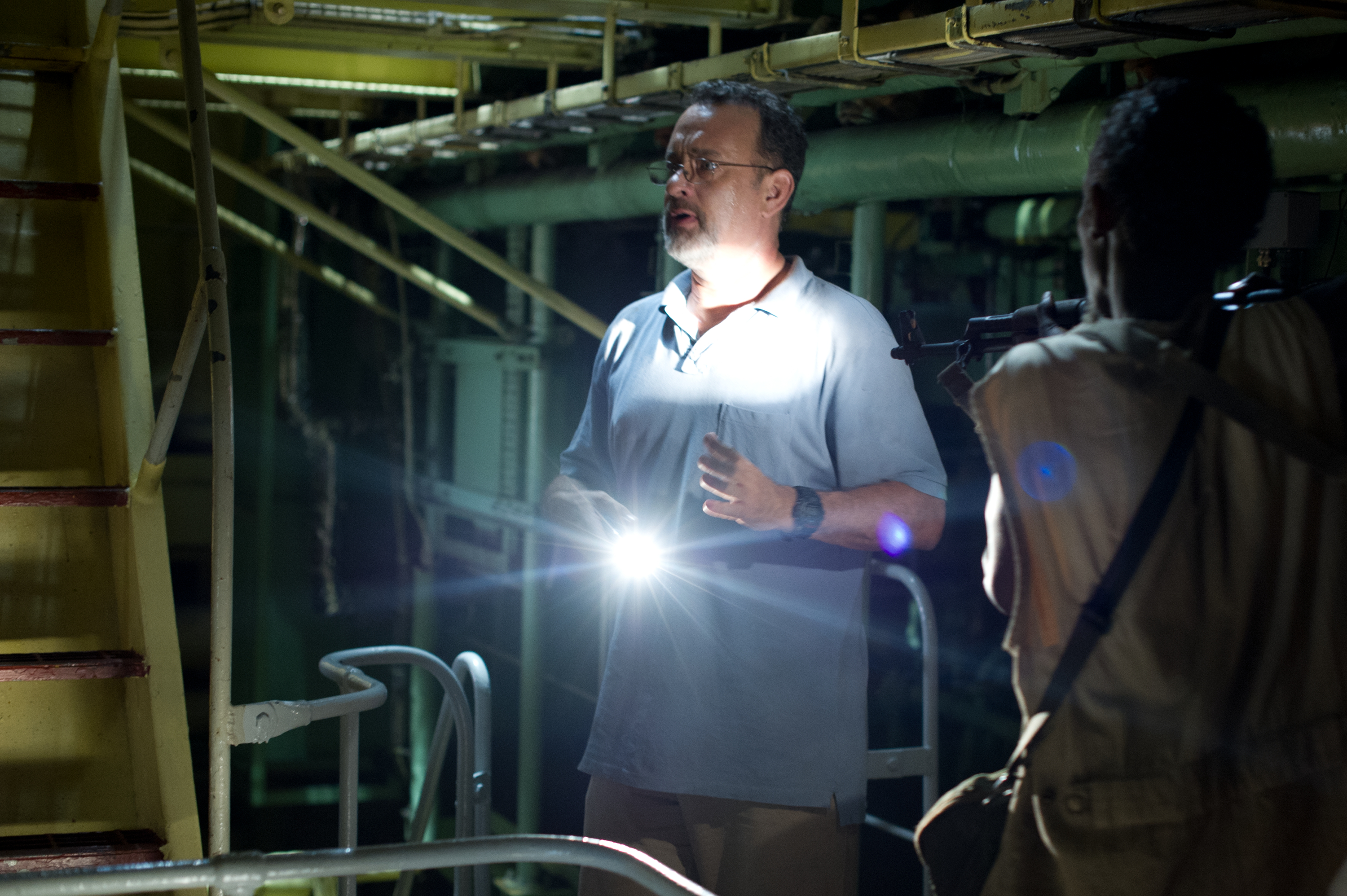
Tom Hanks has taken a lot of abuse in his screen career. He was stranded on a desert island in Cast Away, suffered AIDS in Philadelphia, marooned in space in Apollo 13. And worse, there was Bosom Buddies. Now he’s hijacked and held hostage by Somali pirates, as actually happened to Richard Phillips in 2009, upon whose book this film is based. If you read that account or the newspapers, there’s nothing surprising here, though expert director Paul Greengrass—of the Bourne movies and United 93—adds as much tension as he can, chiefly through jittery cameras, screaming pirates, and the late-film addition of lethal Navy SEALs.
But if I may jump to the end of the movie first: Greengrass and screenwriter Billy Ray do make the interesting decision not to treat that ending triumphantly. We know things will go badly for the pirates. We know the Navy will do its job with complete professionalism (those are real ships, meaning a military-approved script). But what we could not guess is that after more than two days of cool thinking, protecting his crew, calm negotiating, and even coaching his captors, Captain Phillips would finally lose his shit. The film’s most startling scenes are of his blind confusion and shock, the terror that one associates with Michael Haneke torture porn.
Weakness and fear are not what we expect of our leading men, but Hanks has never played the conventional action hero. Can you name a movie where he’s driven a car into opposing freeway traffic, walked unflinchingly away from an exploding orange fireball, or leapt through the air while firing two pistols in slo-mo? Part of his durable appeal, which almost makes him a throwback to the old studio era, is his commitment to type—a suburban decency and propriety, a respect for the unshowy norms it takes to survive in an often cruel, capricious world. He’s like Walter Mitty without the fantasies, but aware of life’s fantastic turns and twists. (“Oh, great, I fell in love with a mermaid . . . ”)
Captain Phillips is both a worrier and a realist. Driving to the Vermont airport with his wife (Catherine Keener), he frets about their kids being unprepared for the hyper-competitive globalized economy. “Big wheels are turning,” he says. “You gotta be strong to survive out there.” He should know, since his job is to shepherd container ships from one port to another. The route from Oman to Mombasa runs through dangerous waters, and his freighter is equipped with “pirate cages” and water cannons—but no actual weapons—to keep small boats off the hull. Phillips demands that his torpid crew prepare for the worst, and their drill is interrupted by the worst: Muse (Barkhad Abdi) and three fellow pirates, the youngest a teenager. (All are first-time performers cast from Minneapolis’ Somali-American community.)
Muse is the second captain of the film, insisting the ransom racket is “just business . . . taxes” for foreign nations using Somali waters; the third later arrives on a U.S. warship. All three captains understand their intermediary role. The big wheels are above them. Navy Captain Castellano (Yul Vazquez) has the White House on his neck. Muse says of the warlords who stake him, “I got bosses.” “We all got bosses,” replies the weary Phillips, who flatters Muse by treating him as an equal. If not quite cogs, they’re bit players in the global nexus of commerce and power. (Nowhere is jihad mentioned; the pirates have nothing to do with al-Shabab.) Still, their conflict is starkly asymmetrical: all our American military might versus four skinny guys with AK-47s. And here are two models of crew-and-command: the fractious Somalis versus the unified SEALs, each carrying a very different price tag. A better film on the subject was released in July, the Danish A Hijacking, but Captain Phillips reinforces the same point. Muse and Phillips are both small men ferrying large assets in the international supply chain. And if they don’t like the job, plenty of others will take their place. Brian Miller
Escape From Tomorrow
Runs Fri., Oct. 11–Thurs., Oct. 17 at Sundance Cinemas. Not rated. 90 minutes.
Turns out those kids who dread going inside Space Mountain or the scary Cinderella Castle have been right all along. Something sinister lurks inside the Magic Kingdom; scratch the surface and evil comes leaking out. That the “Happiest Place on Earth” might hide a shadow beneath the sunshine isn’t an especially bold idea, and—to its credit—the brand of creeping horror found in Escape From Tomorrow is more than a specific attack on a rather easy target.
First-time filmmaker Randy Moore shot his movie at Disney World and Epcot Center without asking permission, an act of bravado that made it instantly notorious at Sundance this year. (You’re seeing the film now because the trademark-protective Disney folk have decided to ignore it as much as possible and weather the storm.) Although this suggests an underground aesthetic, the black-and-white result is sharply composed, tightly scripted, and dense with digital effects. Abel Korzeniowski’s grand score, peppered with soundtrack nuggets from other films, is another unexpected touch. And while the movie does have fun letting the air out of certain beloved Disney balloons—did those vapidly grinning puppets in “It’s a Small World” just flash a fang-baring grimace?—the nightmare that unfolds has more to do with a general human tendency to retreat into fantasyland than with a slam on Walt Disney.
We are following Jim (Roy Abramsohn) and Emily (Elena Schuber) as they escort their two kids through a final day of fun at Disney’s two Orlando theme parks. Jim’s a beefy American Dad from the Craig T. Nelson mold, but with a distinct weakness for perving on teenage French girls and believing urban legends about the bedroom habits of Disney “princesses.” His journey eventually goes off its funhouse rails and enters a surreal realm, with a Shining-esque hint that maybe Jim was always meant to be here. Escape doesn’t entirely hold together, and its more baffling moments—did that Disney nurse just say something about “cat flu”?—suggest that it was never meant to. That Moore and his cast shot a movie under Mickey Mouse’s nose is a fun factoid, and there are some “How’d they do that?” moments, for sure. But the guerrilla-moviemaking stunt is just the beginning. What’s really exposed here isn’t Disney World, but us. Robert Horton
We Are What We Are
Opens Fri., Oct. 11 at Varsity. Rated R. 105 minutes.
Teenage vampires have had their day (Twilight ad nauseam), Carrie’s about to arrive again, and even a teenage zombie fell in love in Warm Bodies. So what new twist can be added to the canon of adolescent romance/body-horror? Iris (Ambyr Childers) suddenly finds herself second-in-command in the curious Parker family following the death of her mother. There’s also a son of about 6 and 14-year-old Rose (Julia Garner) in the upstate New York household, which any census taker would classify as rural and poor. Out in the shed, grieving patriarch Frank (Bill Sage) repairs antique watches and keeps an eye on the trap door below, whence plaintive female cries are sometimes heard. What’s he keeping down there? Why does Frank force his family to fast before their annual Sabbath dinner? And why does no one recognize the scripture he recites at his wife’s grave?
It’s the Testament of Alyce Parker, we eventually learn, an 18th-century forbear whose diary of near-starvation during colonial times has now become a very peculiar family creed. This remake of a 2010 Mexican horror movie (a fable of urban inequality) has been given a leafy Catskills treatment; the early scenes of nature and pregnant rain clouds are almost Thoreauvian in their serenity. And director Jim Mickle takes a leisurely hour before detailing the dietary facts of the Parker family. They are strict locavores, leaving the food miles to their prey.
This isn’t the kind of movie where people are cleanly killed with guns. Shovels, hammers, tire irons, and teeth are the preferred instruments of slaughter. The Parker sisters have been raised in a violent home where rebellion is inevitable. “I just wish we were like other people,” says Rose. “We aren’t,” snaps Iris, though she has eyes for a handsome town cop. Meanwhile, a local MD (Michael Parks) begins to follow the bones—unearthed by torrential rains—back to Frank.
Unlike most modern horror flicks, the shocks here come only at the end; and the movie is too slow and somber for its own good. (Frank is also a disappointingly dull Bible-thumper.) The cell phones belong to the ’90s, and Frank dresses his clan in frontier fashions. Yet their solemn anachronism becomes comic when a friendly/nosy neighbor drops by with a casserole. “It’s vegetarian lasagna!,” says a cheerful Kelly McGillis. Yes, Kelly McGillis. Needless to say, the Parkers don’t eat vegetarian. Brian Miller
E
film@seattleweekly.com