Opening ThisWeek
Beyond Outrage
Runs Fri., Jan. 17–Thurs., Jan. 23 at Grand Illusion. Rated R. 112 minutes.
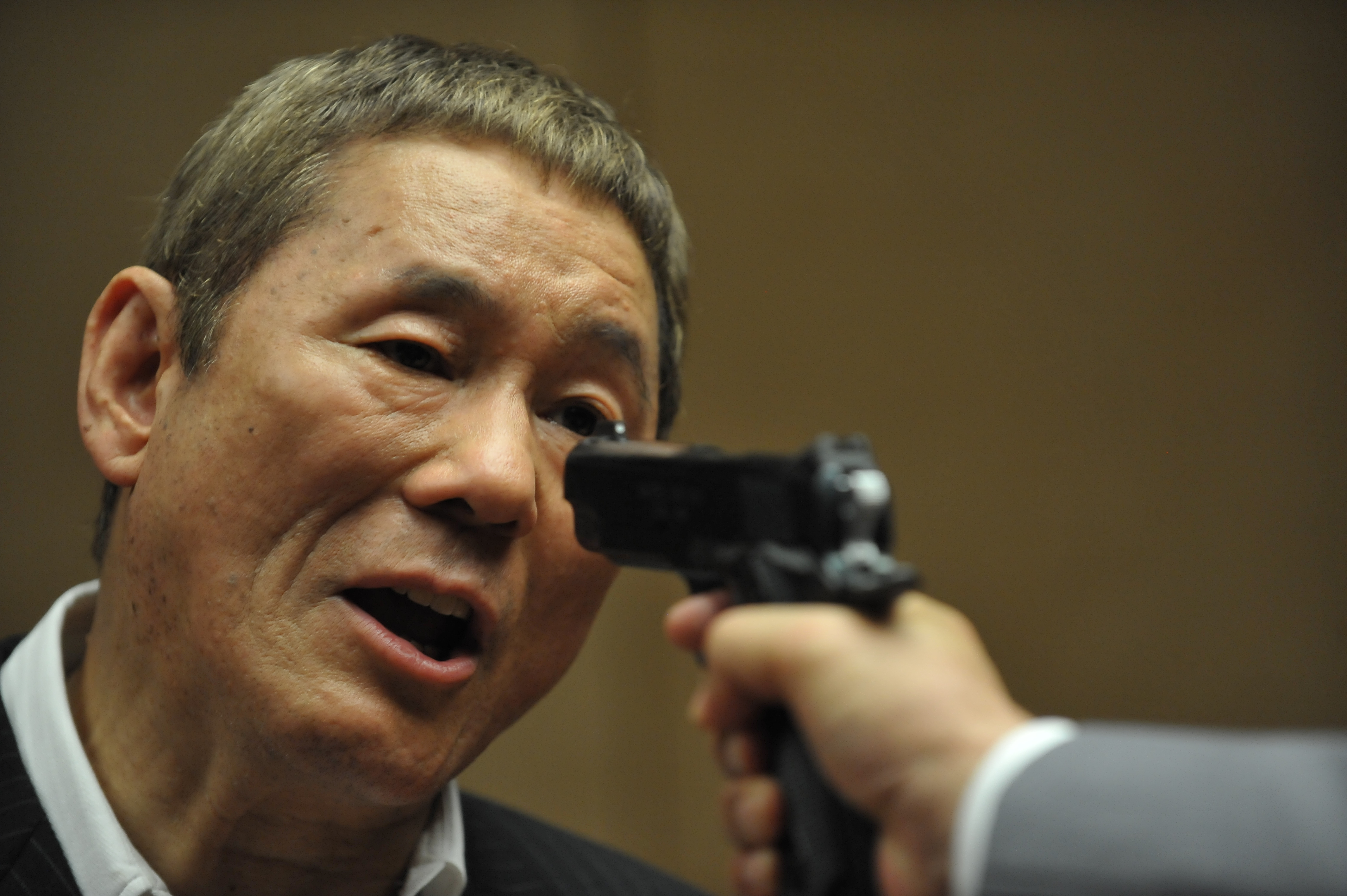
“I’m getting too old for this shit,” says an aging yakuza after being released from jail to rejoin the gang wars. That the speaker is director and star Takeshi Kitano, now 67, and that this is the long-delayed sequel to his 2011 Outrage, only underscores his point. Otomo has been at it too long. He really ought to retire from the killings, vendettas, and endlessly discussed grudges among the crime clans of Tokyo and Osaka . . . but they just keep pulling him back in.
The problem here—for Otomo, for Kitano, for us—is that we’ve all seen this movie too many times before. The old guard of Beyond Outrage insists on suits and ties and elaborate meeting protocols as they debate old feuds and plan new alliances (always with plans for future betrayal, of course). The new guard is represented by treacherous, ambitious Ishihara (Ryo Kase, back from Outrage), who demands that his elders learn how to master hedge funds and other means of modern criminality. The impudence! Next thing you know, he’ll have the yakuza using Snapchat and Skype!
Otomo, caught between the two gangs being gamed by Detective Kataoka (Fumiyo Kohinata), is a man accustomed to traditional tools: knife, gun, and power drill. (In one concession to technology, however, he finds a novel use for a baseball pitching machine.) As usual, Kitano effectively deploys his lopsided, stroke-ravaged deadpan to the proceedings, but it’s hard to tell if Otomo is just weary or outright bored. As director, Kitano stages the same revenge-planning scenes over and over again, the gangsters lit from above, so that their eyes are dead and coal-dark. The first Outrage was no classic, but a solid return to yakuza-land; this one makes it seem better in retrospect. Brian Miller
The Nut Job
Opens Fri., Jan. 17 at Pacific Place and other Theaters. Rated PG. 86 minutes.
The Nut Job is animation’s rebuke to Atlas Shrugged. Here we have an individualist, a practitioner of the Ayn Randian virtue of selfishness, who must learn to share with others and embrace the joys of collectivization. And by “others,” I mean other rodents. This subtext must’ve amused director Peter Lepeniotis and his co-writer Lorne Cameron, although they pepper the movie with enough dry-roasted jokes to dispel any sense of preaching.
The egotist is Surly (voiced by gravelly Will Arnett), a purple squirrel whose me-first behavior gets him kicked out of the park. He and his silent rat sidekick Buddy will vie with the other park animals to raid the pantry of a nearby nut shop—which is really the front for a gangster operation, and at this point further plot description becomes superfluous. All you need to know is that the park’s raccoon overlord (Liam Neeson) exhibits too much interest in power; that the “good” squirrel (Brendan Fraser) has an oversized image of his heroism (not really a problem, because everybody else shares it, too); and that sensible Andie (Katherine Heigl) thinks Surly might be redeemable. One problem with these park denizens: They tend to look alike. There’s a mole and some woodchucks and other such toothy creatures, which makes for less visual variety, than, say, the fauna of Bambi. The movie’s practically stolen by the only headlining canine in sight, a pug brilliantly voiced by Maya Rudolph—her arrival goes a long way toward sweetening a story with an unpleasant hero.
The film is fast-moving, even if its goal of catching the manic spirit of Bugs Bunny cartoons succeeds only about half the time. Its look (in 3-D, in some theaters) is just odd enough to be nicely distracting: a world of vaguely ’50s-era cars and buildings, decorated with saturated colors and one spectacular tree on fire. Nobody’s going to mistake The Nut Job for Disney, but the script is in the 10-gags-per-minute style that epitomizes current TV sitcoms, and it’s funny enough to keep an adult awake for most of its running time. Lepeniotis expanded the film from his 2005 short, Surly Squirrel, and financed it with Canadian and South Korean money. The latter is the only explanation for the end-credits appearance of a cartoon Psy, once again flogging his Korean novelty hit “Gangnam Style” so the other critters can join in. Until that dated reference, The Nut Job qualifies as a mildly pleasant surprise. Robert Horton
PThe Selfish Giant
Runs Fri., Jan. 17–Thurs., Jan. 23 at Northwest Film Forum. Not rated. 91 minutes.
The British underclass has been so extensively and thoughtfully explored by filmmakers such as Ken Loach and Mike Leigh that even a socially concerned viewer could be forgiven for feeling a little exhausted by the subject. But maybe we just needed a fresh voice.
And now we have one. Clio Barnard’s first feature, The Arbor (2010), was an experimental documentary about working-class English writer Andrea Dunbar. While shooting in Dunbar’s grim West Yorkshire hometown of Bradford, she became fascinated by the local adolescent boys who worked at “scrapping,” gathering and collecting scrap metal—sometimes legally, sometimes not. Such lads are the focus of The Selfish Giant, a drama that takes its title (if not actual story material) from an Oscar Wilde story. The two boys we follow are on their own all day, having been suspended at school for bad behavior. Arbor (Connor Chapman) can be hyperactive and destructive when he’s not on his medication; scrapping gives him a focus for his demon-like energy. His slow, docile buddy Swifty (Shaun Thomas) tags along and keeps Arbor settled down. Swifty has a similarly empathetic bond with animals, which leads the scrap-dealer (Sean Gilder) to see him as a driver for cart-racing his horse in local road races. Without money, Arbor and Swifty are without worth, so they’ll do anything to make some.
Nobody speaks the King’s English here—the subtitles are entirely necessary. Whether she’s honoring those thick accents, finding the proper pitch for the boys’ tussling friendship, or pausing for eerie shots of the town’s nuclear towers shrouded in fog, Barnard rarely sets a foot wrong. The outcome of the story is not difficult to predict, but Barnard is more interested in place and character than in surprising plot twists. There will be no miracles in store, as both boys—wonderfully acted by newcomers—are true to who they are: Arbor will find a way to overreach and screw up what they’ve got going, and Swifty will be too steadfastly loyal.
The adults are also captured with precision. We can’t know much about how they arrived at their sad places, but we can read the cycles of economic worry and deprivation in their faces. (Swifty’s mum is played by Siobhan Finneran, star of the 1987 cult film Rita, Sue and Bob Too!, penned by Andrea Dunbar.) There is almost no overt commentary in The Selfish Giant about, say, current British austerity policies or social inequality, because Barnard understands that capturing this milieu is its own indictment. The saddest indictment imaginable. Robert Horton
PThe Square
Opens Fri., Jan. 17 at Sundance Cinemas. Not rated. 108 minutes.
One of 15 docs on the Oscar shortlist (the nominations come tomorrow), Jehane Noujaim’s The Square is both timely and behind the current news cycle. And that’s not to fault the Egyptian-American filmmaker’s brave, total, immersive commitment in a fluid and sometimes dangerous situation. She spent over two years following the protests and battles at Tahrir Square, which erupted in January 2011. No one, including her, had any idea where events would lead. Her perspective is mostly ground-level, following a half-dozen charismatic revolutionaries, some of whom speak English. There’s no history of Egypt before the protests, almost no news footage or outside comment, and much raw video that we see being shaped into YouTube dispatches from a liberal media room where Noujaim is embedded, high above the square. (The view down at the swarm, especially at night, is breathtaking.)
“The battle isn’t just in the rocks and stones,” says British actor Khalid. “The battle is in the images and the stories.” You might think that Noujaim (Startup.com, Control Room), a Harvard-educated media type, would be in full agreement. But the longer The Square goes on, the more we see how rocks and stones (and tear gas and rubber bullets) really do matter—and how they shape the images and stories. (But the Koran trumps everything, including YouTube.) One of Noujaim’s cameramen, Ahmed, is a central figure in the protests, making speeches, debating skeptics, and tossing stones at the police. He’s the one closest to the Arab Street, and we can see him grow exhausted from the cycle of taking the square, being beaten back, and returning months later. The initial euphoria eventually runs into a brick wall called the Muslim Brotherhood, here represented by the warm-hearted family man Magdy.
Absent a narrator, lacking many explanatory intertitles or graphics, The Square’s granular approach makes it a very partisan doc. Noujaim is on the side of the revolutionaries—who wouldn’t be?—without ever trying to summon a thesis from all the exhilarating, power-to-the-people process of revolution. To be fair, that may be impossible. Her film is an invaluable chronicle of an historic moment, but it’s only a moment during Egypt’s very long, fraught history. From the pharaohs to the colonialists, from Sadat and Mubarak to Morsi and beyond, regime change seems to be the only constant. And, says Ahmed with a smile, “We’re waiting for the next one.” Brian Miller
E
film@seattleweekly.com