Opening Nights
PThe Best of Enemies
Taproot Theatre, 204 N. 85th St., 781-9707, taproottheatre.org. $20–$40. 7:30 p.m. Wed.–Thurs., 8 p.m. Fri., 2 & 8 p.m. Sat. Ends April 25.
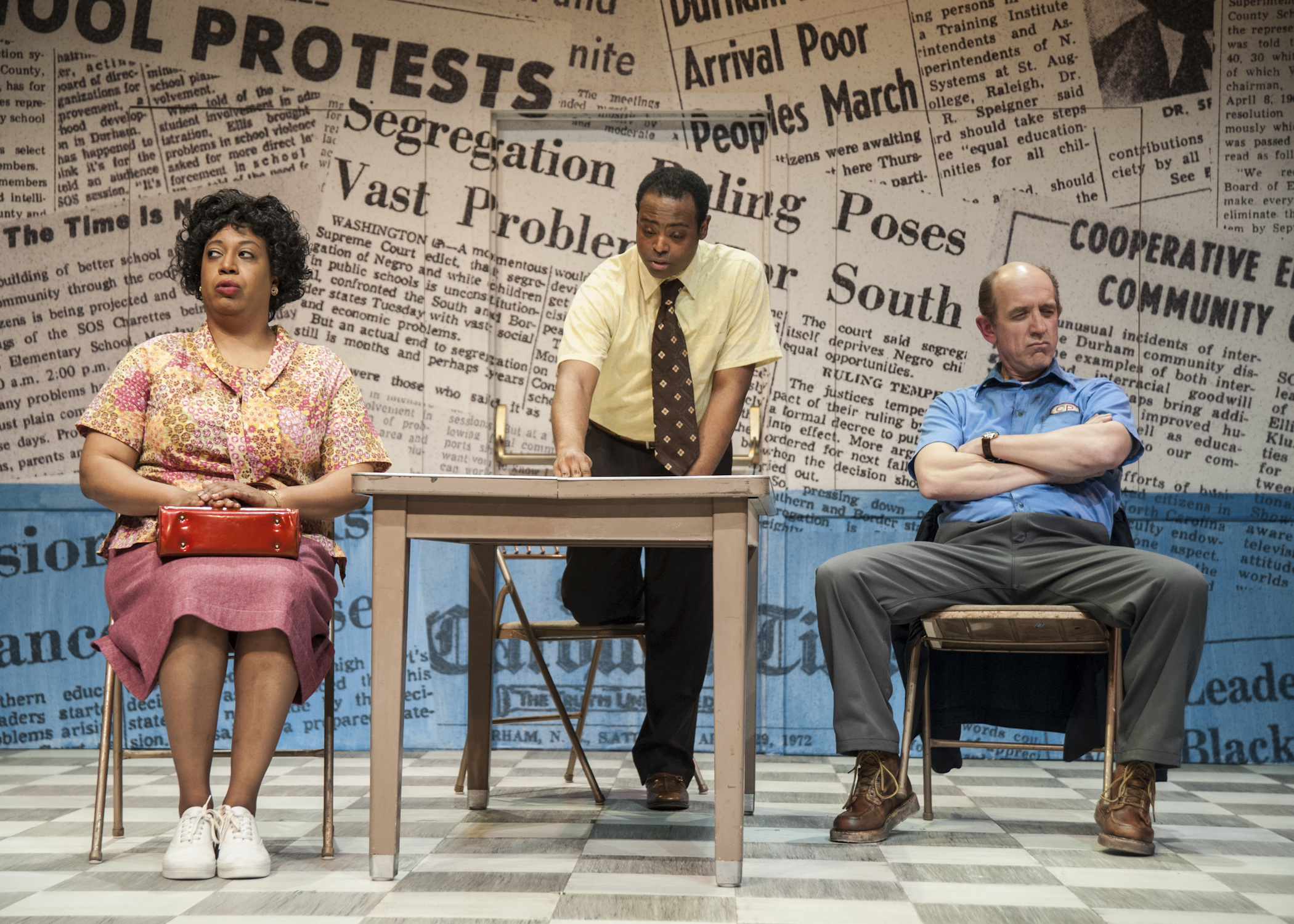
Five years ago my elderly Orange County doctor declared of his old hometown, “Detroit was fine until the Negros took control.” Aghast, I failed to muster any response. In liberal Seattle, where we are supposedly educated and enlightened, being that bigoted seems incomprehensible today. Flash back to Durham, North Carolina, in 1971, however, and racism is the norm. Segregation is a fact of life, as confronted by two locals nominated to the federally mandated school-integration committee. One is a black civil-rights activist, Ann Atwater (Faith Russell), the other a white KKK member, C.P. Ellis (Jeff Berryman). Both are poor, and both were real people featured in journalist Osha Gray Davidson’s 1996 book. (This recent dramatization is by Mark St. Germain; Scott Nolte ably directs.)
Ann and C.P. form an odd alliance indeed, though the play first has them air bulletproof biases from opposite sides. Both vomit vitriol until they nearly asphyxiate from their animosity. Enemies opens with C.P. extolling whoever executed “Martin Lucifer Coon,” giving Ann every reason to hate this ignorant redneck. Russell imbues Ann with a Medea-esque fierceness, yet eventually she somewhat softens. Otherwise there’d be no play, no dramatic resolution. Enemies thus takes its antagonists on an inevitable journey toward racial reconciliation, along the way exploring notions of poverty and education that still bedevil the South today.
The federal mediator overseeing the mismatched pair, Bill Riddick (Corey Spruill) furnishes a flawless foil for these fighting factions, most notably when spewing an equal-opportunity list of ethnic slurs in order to show the rage on both sides. Enemies is full of such venomous dialogue, though the small ensemble occasionally blunders its enunciation, so I missed some of the spiteful nuances. Still, the true story makes compelling theater, full of droll moments, disgusting diatribes, and deep transformations. There are subtle comic touches, too, as when C.P. and Ann try to get in synch while collating survey results.
Richard Lorig’s simple set consists of three chairs and a table, juxtaposed against a backdrop of old news headlines. Mark Lund’s sound and video design adds further context from this tumultuous time, well serving the drama from not-so-distant times.
How far have things changed in four decades? Watching then writing about Enemies makes me feel both sad and optimistic. Schools have been integrated in legal principle if not practice. Racism is more widely abhorred than ever. Yet the 24-hour news cycle, political punditry, and social media permit a polarization that C.P. and Ann could never have predicted in 1971. ALYSSA DYKSTERHOUSE
Lizard Boy
Seattle Repertory Theatre, 155 Mercer St. (Seattle Center), 443-2222. $17–$67. 7:30 p.m. Wed.–Sun. plus matinees; see seattlerep.org for schedule. Ends May 2.
Do a Google image search for “lizard boy” and you’ll find some startling images of a gentleman who has undergone extensive reptilian facial transformations, including tooth-sharpening, tongue-forking, and subcutaneously implanted eyebrow ridges. The plastic surgery involved is expertly done, which perhaps makes it all the more horrifying. Justin Huertas’ new musical is a similar sort of smoothly engineered but unnatural graft. One component is a sort of slice-of-life look at dating and relationships in contemporary Seattle, centered on a lonely young gay man, Trevor (Huertas), who, though scarred emotionally (recently) and physically (permanently), needs to get back on that horse while trying to jump the hurdle separating meaningful connection from superficial one-nighters. (This is not a fresh theme, covered near-exhaustively in Paul Rudnick’s Jeffrey 20 years back, but admittedly it’s one each new queer generation probably needs to re-explore for itself.)
Trevor has a unique backstory, though: As a kindergartener he was doused in the blood of a dragon that escaped from Mt. St. Helens and landed (there to be slaughtered) on his school playground. Hence the physical scars, and hence the mysterious, Harry/Voldemort-ish mental connection that draws him to damaged rock star Siren (Kirsten deLohr Helland). Here the show pivots into extravagant comic-book fantasy, including superpowers, mind control, a dragon attack, and a climactic battle.
By itself, the fantasy could have made for a fun and flamboyant camp extravaganza, no question. But the reason it so thoroughly doesn’t work when paired with the real-world relationship stuff is that it’s played with exactly the same earnestness. It really has to be seen to be believed: No one in the history of the Royal Shakespeare Company ever performed King Lear with straighter faces than director Brandon Ivie asks of Lizard Boy’s cast while delivering dialogue like “Siren, let him go!” “I’ll let him go all right—let him go DIE!” To their credit, the cast’s commitment to that earnestness is total and unflinching. (William A. Williams completes the trio as Trevor’s new friend Cary.)
That said, I’m perfectly ready to concede that the reason Lizard Boy had so little to offer me was that it never intended to. In its very first scene, Trevor sets up a Grindr profile: so not my demographic. (Which makes the Rep’s decision to commission and stage it all the more noble: How many other Easter Sunday matinee attendees had any clue what Grindr was?) And this seems to explain another puzzling juxtaposition: that what is so obviously a personal labor of love for Huertas, with journal entries and his own coming-out story as source material, comes out so stilted and unspontaneous.
This is going to sound supremely bitchy, but that doesn’t make it any less true: If you’re 14 or 15 and, well . . . haven’t seen much theater, you will enjoy Lizard Boy far more than I did. As the target audience, you won’t mind the show’s self-conscious calculatedness—from the local references to the off-putting whimsy of the instrumentation, which includes kazoo and (gaaah!) two ukuleles. Nor will you keep thinking of Rent, American Idiot, Spring Awakening (with which Huertas toured), or any number of other recent pop musicals in which people half my age assume that singing about how hard it is to be half my age is enough to build an evening-length show.
Lizard Boy drove me up the wall, but I won’t claim it doesn’t very skillfully do just what it sets out to. GAVIN BORCHERT
E
stage@seattleweekly.com