Opening Nights
PAir Twyla
McCaw Hall, 321 Mercer St. (Seattle Center), 441-2424, pnb.org. $28–$174. 7:30 p.m. Thurs.–Sat., 1 p.m. Sun. Ends Oct. 6.
Twyla Tharp has been making dances since 1965, and for all that time she’s used just about every element she could find. Her work is both intensely intellectual and deceptively casual, physically grueling and kinetically relaxed. Tharp’s trademark is this combination of genres—of movement, music, theater, and literature. Which means that her newest work, made for Pacific Northwest Ballet, mixes classical vocabulary with the Lindy Hop, Greek mythology with American stereotypes.
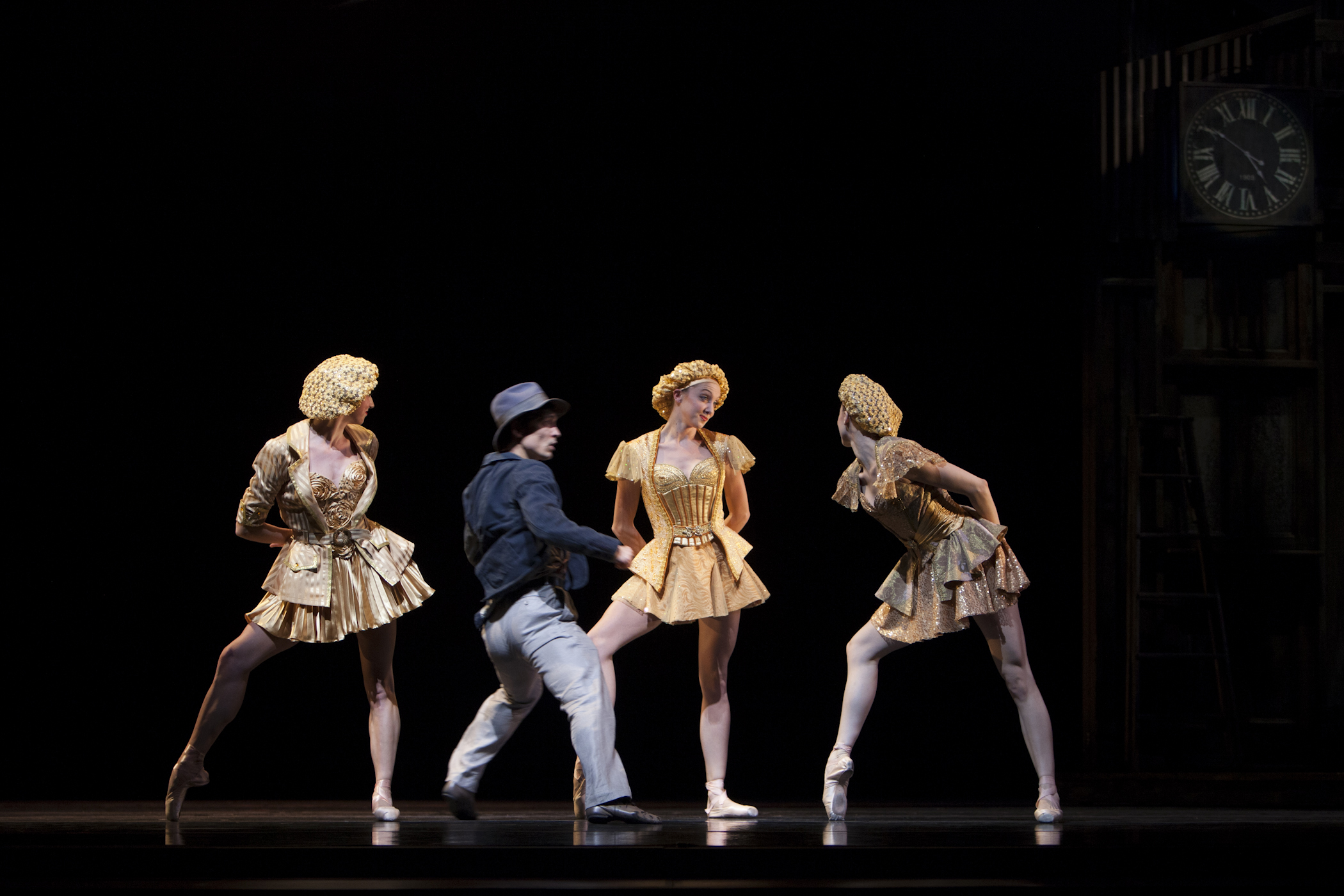
Waiting at the Station is a narrative work, but far from a traditional story ballet. We follow a solitary man as he tries to connect with his son. Yet he’s distracted by the people around him, couples flirting and squabbling, and pursued by a trio of women who may turn out to be the Fates. He’s more frustrated than anything: His son doesn’t pick up the steps he wants to teach, and he’s constantly trying to dodge the fatal trio. It’s only after he seems to die and come back to life that he puts everything right, defusing the quarreling couples and launching his son to follow in his jazzy footsteps. Only then he can catch the train he’s been waiting for, bound for the next world or the next town.
Santo Loquasto’s designs locate this work in the 1930s, and the score by renowned R&B master Allen Toussaint zeroes in on New Orleans. Tharp has always had a special affinity for jazz, and it’s been a key element in developing her signature style. The seemingly easy virtuosity that lies on top of some fiendishly difficult movement is a perfect match for Toussaint’s rhythmic play. (His appearances during the first week of the program were also an incredible bonus.)
As the father, James Moore has one of his best roles, bringing his technical skills to the service of the character. Price Suddarth plays his son, tricking us into thinking he can’t dance as well as the father, which makes his triumph extra-sweet. Carrie Imler and Laura Tisserand are the fractious women, partnered with Kiyon Gaines and Jonathan Porretta—all four of them totally immersed in every bump and shimmy.
Waiting is flanked by two prior Tharp works. Brief Fling (1990), new to PNB, makes more distinction between balletic and modern virtuosity. It’s a great showcase for the company’s range, especially the contrast between Kaori Nakamura and Leta Biasucci in different roles. Nakamura’s rock-solid classical technique makes everything look simple, while Biasucci is the tricky ringleader of a group of boisterous hooligans. In the iconic 1982 Nine Sinatra Songs, all the couples are exactly matched with Tharp’s tone. Thirty years ago, her choice of music seemed ironic, but it’s obvious now she created a classic that complements the American songbook. Sandra Kurtz
Hail Caesar: Forbidden Oasis
Teatro ZinZanni, 222 Mercer St., 802-0015, dreams.zinzanni.org. $108 and up. Runs Wed.–Sun. Ends Jan. 26.
A five-course dinner + circus and vaudeville acts + audience-participation tomfoolery + the slenderest possible wisp of narrative: The TZZ formula never varies, but never palls, either, thanks largely to the emcees who juggle it all. Here Frank Ferrante returns as the flamboyant chef Caesar, a sort of omnisexual Liberace/Chazz Palminteri mashup. The sharpness and speed of his wisecracking improv skills are impressive, as would be expected from a performer who’s earned acclaim impersonating Groucho Marx.
The slinky Dreya Weber, equally skilled as an aerialist and singer, plays a resurrected Cleopatra. Vita Radionova, star of a dazzling how-is-that-even-possible hula-hoop routine, plays an Egyptian goddess in charge of a “love spice” that everyone’s after. Wayne and Andrea Conway Doba—in showboat parlance, a “general business team,” able in comedy, song, dance, character work, whatever’s required—provide the evening’s emotional heart with a tap-dance routine to “Top Hat, White Tie and Tails,” “Cheek to Cheek,” and (what song could more reliably make an audience mist up?) “Mr. Bojangles.” Les Petits Freres and the local Duo Madrona round out the cast and contribute energetic tumbling and trapeze performances.
Despite its mainstream commercial appeal, TZZ has gratifyingly managed to retain some of the louche scruffiness—not in execution, but in attitude—of the alternative cirque/burlesque world, the Moisture Festival and the like, that’s burgeoned in Seattle in recent decades. You pay a lot more than you might for a show at Re-Bar or the Pink Door, but the whole immersive experience still seems a bargain: You’re not just buying dinner and a show, but a lavish evening-length party.
And as usual, the food never disappoints. The highlight of chef Erik D. Carlson’s menu was an immense slab of succulent halibut that I wanted to curl up and nap on. Gavin Borchert
The Matchmaker
Taproot Theatre, 204. N 85th St., 781-9707, taproottheatre.org. $15–$40. Runs Wed.–Sat. Ends Oct. 19.
Thornton Wilder’s classic farce is a tortured piece of art. A 1954 variation on an oft-retooled tale built around mistaken identities and general buffoonery, The Matchmaker has found timelessness through the playwright’s valiant attempt to reach for something more elevated than base ridicule. When a production achieves its intended balance, the play—later adapted as the Broadway musical and movie Hello, Dolly!—manages to knit themes of love, mortality, class, and the dread of loneliness into delightful and thought-provoking theater. When it doesn’t—well, you at least hope the buffoonery is good.
The great aims of the play, set in the 1880s, are embodied by widowed marriage broker Dolly Levi Gallagher (played boldly and joyfully by Pam Nolte). With a thick Irish brogue and twinkling eye, she encourages the ridiculous adventures of the tale’s naive working-class adventurers to achieve her ultimate goal: marrying her client, the tight-fisted Yonkers half-millionaire widower Horace Vandergelder (Robert Gallaher). She’s after his money, a base desire good for easy comedy, but Wilder has written her a higher purpose. “I’ve always felt money—pardon my expression—is like manure,” Dolly says during her grand soliloquy. “It’s not worth a thing unless it’s spread about, encouraging young things to grow.”
Dolly’s deeply sad but life-affirming speech is impassioned and moving, and yet it seems to come out of nowhere. Wilder peppers his hit play with expertly crafted dialogue that makes us empathize with his characters’ crushing loneliness or economic plight, but the cast generally fails to deliver on such moments; Wilder’s subtle strokes are skipped over as setups for broad laughs.
Thankfully, those laughs land consistently. Directed by Scott Nolte, this production is buoyed by the manic energy generated by its two slapstick teams: Robert Hinds and Brad Walker as Vandergelder’s bachelor employees, and Natalie Anne Moe and Asha Stichter as man-hunting hatmakers. Hinds is impossibly likable as the rube Cornelius, at his best when he’s turning a particular goonish phrase. As his counterpart Mrs. Malloy, Moe is a riot, playing her young-widow role with a bug-shit abandon that hints at a deeper inner darkness. But in a play so obvious, hints are never enough. Mark Baumgarten
Secondhand Lions
The 5th Avenue Theatre, 1308 Fifth Ave., 625-1900, 5thavenue.org. $29 and up. Runs Tues.–Sun. Ends Oct. 6.
Given its stated mission to send a new musical to Broadway every season, the 5th Avenue has scored one bull’s-eye after another. With successful launches of First Date, Memphis, and Catch Me If You Can, later subject to a few tweaks and refinements, they’ve made it look easy—until now. Though its problems aren’t insurmountable, Secondhand Lions will require a substantial rethink.
Based on a 2003 movie in which lovable old Texas codgers Robert Duvall and Michael Caine schooled young Haley Joel Osment (remember him?), this stage musical proffers a stupefyingly talented cast and two or three killer showtunes. What it doesn’t have, and desperately needs, is focus, despite such a simple plot. Walter (the pitch-perfect Johnny Rabe) is an 11-year-old nebbish sent by his philandering mother to spend what promises to be a miserable summer with uncles Garth and Hub (Broadway mainstays Gregg Edelman and Mark Jacoby). Walter discovers that his uncles are the stuff of legend—unless he’s falling for their Texas-sized tall tales. There’s a trunk of money hidden on the premises, the locals murmur. Is it the ill-gotten gains of a bank-robbing career? Or did the uncles really once have exotic adventures in the Foreign Legion? To illustrate these yarns, greatly expanded from the movie, playwright Rupert Holmes creates entire fantasy sequences featuring the swashbuckling young Garth and Hub. We see how, for example, they rescued a damsel (the voluptuous Jenny Powers) from the clutches of a dastardly sheik (Jason Danieley, who chews the scenery with Saturday-matinee-serial fervor).
Like The Wizard of Oz or The Princess Bride, Secondhand Lions is a fable, a story-within-a-story bookended by a familiar reality. It’s a promising conceit, maybe even a future classic with enough rewriting. But Holmes and director Scott Schwartz make a serious misstep in treating the show’s action-filled center—the uncles’ supposed Arabian adventures—as cornball and camp. It’s tantamount to hearing Christian Bale’s Batman reflect on his crime-fighting career, then watching Adam West’s TV Batman perform those escapades in flashback. In the second act, everything grinds to such a halt that even the present-day Texas characters call bullshit and break into the flashbacks to try to set things right.
If that weren’t bad enough, the actual lion from the movie is gone and an extraneous new human introduced, the know-it-all girl Jane (Sophia Anne Caruso). Likely intended to increase the show’s demographic appeal, this irritating character only adds to the goulash of a story. Cast excluded, this Secondhand Lions is nowhere near ready for Broadway. Eugene Lee’s main set—a makeshift barn wall that serves double duty as the backdrop for desert adventures—demands serious reconsideration. First Date composers Alan Zachary and Michael Weiner’s songs are safe and sensible, and a few boast memorable tunes you’ll want to hear again and often. But until its creators take the whole story seriously—legends included—this lion will never roar. Kevin Phinney
E
stage@seattleweekly.com