Light seems to have been composer-lyricist Adam Guettel’s main inspiration: Light dappled through trees or on water, shadows between buildings, the warmth and brilliance of noon, the gold glow of a sunset—all find analogues in the shifting tints of his orchestration, with Ted Sperling as co-arranger, for The Light in the Piazza. Guettel and Sperling chose just a small, light-textured orchestra—strings, a few winds and keyboards, no brass (instead harp, bassoon, celesta—colors you don’t usually associate with Broadway)—and use even that sparingly. Some of the most affecting moments involve just a bare instrument or two under the voice. For the climax of a love duet, he pares down even further, setting words aside; Piazza‘s young lovers sing only “Ah!” in upwardly spiraling phrases. Though Guettel divides his score into discrete numbers, and doesn’t hesitate to draw memorable tunes from various influences—here a Puccinian flight, there a dash of period color (but never a molecule of cheese)—it’s all of a piece, one delicately colored, sensitively crafted sweep from beginning to end, meshing smoothly with Craig Lucas’ taut, insightful book.
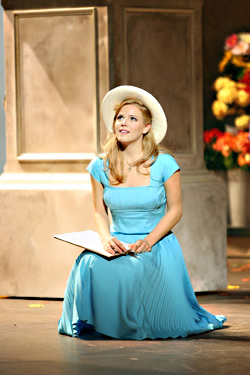
It’s 1953; Fabrizio (David Burnham) lives in Florence, Clara (Katie Rose Clarke) is visiting. Love blooms, but the story’s real center is Clara’s mother, Margaret, for whom the mismatched, startlingly sudden pairing is cause to reflect on her own faded marriage. According to convention, characters who stand between young lovers always have an arbitrary, last-minute change of heart, facilitating the happy ending; but it’s a strength of Piazza that Lucas (and Elizabeth Spencer, on whose novella he based his book) avoids this cliché, making a deeply touching dramatic arc out of Margaret’s gradual melting. Christine Andreas brings a touch of brass to this Southern matron’s gentility, looking and (accent aside) sounding more than a bit like a young Julie Andrews. Clarke, beyond being just another lovely blond ingenue, shines in the tricky role of the developmentally immature Clara. (It’s not often you see actors who can convincingly act childlike, without caricature. Why is that? They were all children once.)
Successful as the big-stage expansion of Piazza has been, I hope producers don’t forget what an effective chamber piece it can also be. The story’s intimacy and the music’s subtleties came across at the Paramount (though the blocking got a shade hyperactive; the actors had a lot of ground to cover), but really flourished, enveloped you, at the smaller Intiman. I also hope future productions continue to give Piazza the careful consideration it’s owed: understanding what makes it tick, the rare and special way it combines elements of both opera and musical, and what those elements need to shine and soar in performance.