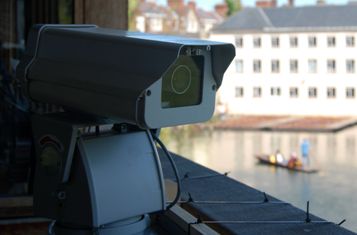
Weve got red-light cams at traffic intersections (unless Tim Eyman stops them), and some argue the police should also use video surveillance to clean up Victor Steinbrueck Park and Third and Pine. So its a good time to visit Dont You Fucking Look at Me: Surveillance in the 21st Century, which features the work of Seattles Gary Hill and Londons Manu Luksch through October 31. Also on view is (re)collector by English-born video artist James Coupe, presently a fellow and instructor at the UWs Center for Digital Arts and Experimental Media. As he explained recently by phone, he originally deployed 10 surveillance cameras in Cambridge, England, where theyre all over the place. I think the statistic is one camera for every 15 people. So its the most watched nation in the world. Pedestrians didnt notice the project until 24 hours later, by which time the digital footage had been churned through software programmed to recognize certain physical behaviors parallel to those in Michelangelo Antonionis classic 1966 perception-is-reality movie Blow-Up. Then over the following seven days captured in (re)collector, Cambridge gallery-goers could watch themselves in computer-assembled scenes that mimicked those in the film. There is a direct visual-feedback loop, Coupe explains. Once his subjects realized where the cameras were, they could go back and stage their own performanceswhich the software algorithms might or might not accept. Here in Seattle, well be seeing a four-day extract from the project on four separate video channels. Its like telling the same story hundreds of ways. There is a predetermined story being unraveled. [But] you never see it the same way twice. Coupe isnt entirely clear where the sophisticated new software comes fromit was developed in Israel, he believes. Users, whether they be artists or police, then set the softwares parameters according to what behaviors are being sought: sneaky suicide bombers, rowdy football hooligans, stealthy purse-snatchers, or perhaps just ordinary citizens acting like David Hemmings and Vanessa Redgrave. In the gallery, where we (and the story template) supply the psychology for these computer-selected behaviors, its art. Elsewhere, says Coupe, its kind of scary. 911 Media Arts Center, 402 Ninth Ave. N., 682-6552, www.911media.org. Free. Reception 610 p.m. BRIAN MILLER
Sept. 12-Oct. 31, 2008