THREE TEENAGE GIRLS befriend each other during a dull summer. They’re residents of Arizona, casualties of air-conditioning. They’re called Alice, Annabelle, and Corvus. The girls don’t have much in common except a vague restlessness; Alice is an animal-rights radical, Corvus is an orphaned dreamer with too much pain flooding her heart, Annabelle’s an aspiring prom queen and mall rat. Together they hang out in brightly lit restaurants, neglected houses, and volunteer at the nursing home called Green Palms. Annabelle’s father, a sweet man who can’t resist the fourth martini, comes to think of them as the “Three Fates.” They wander the suburban desert bearing witness—gum-cracking prophetesses of the apocalypse.
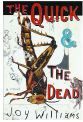
The Quick and the Dead by Joy Williams (Knopf, $25)
This is the hypnotic world of Joy Williams’ The Quick and the Dead, a novel that in many ways is the masterwork, the ultimate breakout expression, of this writer’s stealthy and unpredictable career. Here Williams has brought together elements that have obsessed her for a long time: girls, suburbia, animals, intolerable loneliness. Besides the three teen stars, The Quick and the Dead also supports a myriad of minor characters: a department store piano player with a dirty mind; a ghost called Ginger (Annabelle’s mom) who can’t stop nagging her husband; a cowboy-hatted stroke victim who believes a monkey lives in the back of his brain. These characters intersect in the merciless desert, a place where things survive despite the ravages of heat and drought. One afternoon, stranded without a ride, Alice wanders out there: “She walked quickly, sometimes breaking into a run, through the gulleys and over the rocks, past the strange growths, all living their starved, difficult lives. Everything had hooks or thorns. Everything was saw-edged and spiny-pointed. Everything was defensive and fierce and determined to live.”
The Quick and the Dead is Williams’ first novel in years; she most recently published a spooky essay in Harper’s about the animal-rights movement. Her first novel, State of Grace, appeared in the ’70s and caused a verifiable swoon among reviewers who recognized her as a Great Writer, a voice to be reckoned with. Nevertheless, much like Jayne Ann Phillips, William’s career did not follow the aggressive, ever-expanding course predicted for her. Instead she moved along the margins, publishing story collections that are now out of print, moving from one publisher to another, generally disobeying the rules of the Great Writer’s career. Occasionally she shows up teaching workshops in Arizona or Florida, and her cultish fans pay a premium just to sit near her.
WILLIAM’S PROSE BURNS with a strange and captivating music. Her sentences shimmer on the surface of the page, refusing interpretation or resolution. Throughout her career she has explored the space between language and the world, the place where words do not denote reality but instead eclipse it. Her characters never speak like ordinary people; they hold forth like amateur philosophers, aspiring muses. In The Quick and the Dead, a nursing-home attendant is given to declarations like “Birth is the cause of death” and “The set trap never tires of waiting.”
If Williams’ dialogue defies rationality, so too do her plots murmur forward like dreams, often unraveling into surrealist montages or intervals of pure poetry. Encounters lead nowhere, except into the overarching stillness. People collapse under the pressure of love. The writing itself is so beautiful, it seems to overwhelm the mechanics of the story. Here’s a passage describing the nursing home Green Palms that is so lush with rhythm and repetition it bursts the boundaries of the descriptive medium: “Beyond the draped windows waited the white ambulances with their silent sirens that never sounded on their passage to the undertaker, that moved softly down the highway, softly, when employed.”
A friend of a friend of mine, a quintessentially damaged girl, used to follow Williams around from one workshop to another. This girl, like the characters Alice and Corvus, couldn’t help seeing doom and gloom everywhere. She could talk late into the night about the terrible things that had happened to her. Her eyes were hollowed out from a series of abandonments, the kinds of things you never recover from, especially when you don’t believe in recovery. Returning from a road trip to see Williams teach, she’d talk about how she thought Williams “really liked me,” how maybe they were going to become friends. Once she even shared a gin and tonic with her, and this drink took on mythic proportions in her mind.
This hard-core Joy Williams fanatic thought she had finally discovered someone who understood the world she inhabited, a place where nightmares and violent memories formed a screen across the sky, where the abyss threatened to manifest even in the most ordinary places—supermarkets, or post offices. I don’t think her friendship with Joy ever panned out, but her stalkerlike obsession indicates the power of Williams’ vision. Her books are not things you read; rather they’re ditches you fall into. Sometimes it takes hours, days before you can dust yourself off and find your way out.