Opening ThisWeek The Hobbit: The Desolation of Smaug Opens Fri.,
Published 10:57 pm Tuesday, December 3, 2013


Opening ThisWeek
The Hobbit: The Desolation of Smaug
Opens Fri., Dec. 13 at Cinerama and other theaters. Rated PG-13. 156 minutes.
As holiday movie titles go, The Desolation of Smaug is a less-than-catchy handle for an evening’s buoyant entertainment. But only to the uninitiated. To the throbbing fan base of The Hobbit, J.R.R. Tolkien’s fun and relatively compact fantasy novel, those words portend sheer fire-breathing awesomeness.
By now you know that The Hobbit has been elongated into three hefty movies by Lord of the Rings director Peter Jackson. Smaug is the middle one, and it improves on last year’s rambling An Unexpected Journey by sticking to a clean, headlong storyline and jettisoning much of Part 1’s juvenile humor. Our hero, Bilbo Baggins (Martin Freeman), is traveling with his crowd of bumptious dwarfs, intent on finding a magical stone inside a mountain crammed with treasure. Wee wrinkle: The mountain is home to a dragon named Smaug (voiced by Benedict Cumberbatch), who likes to emerge periodically from his lair and burn down neighboring Laketown.
This is really the only plot. Wizard leader Gandalf (Ian McKellen) breaks off from the travelers for his own jaunt; elfin archer Legolas (Orlando Bloom) returns to the fray from his LOTR stint; and a new elf character named Tauriel (Evangeline Lilly) provides woman-warrior action. Jackson once again wrote the (rather overly talky) script with Fran Walsh, Phillippa Boyens, and Guillermo del Toro, and they’ve dialed back on the funhouse action just a bit—though one zany escape, involving dwarfs riding barrels down a rushing river, is a glorious blend of Chuck Jones–style cartoony gags and Steven Spielberg’s dream of a Wild Waves park.
The tightened storytelling (even at 156 minutes!) is welcome, and the movie looks cool. From the opening scene of Gandalf conspiring with the presumptive dwarf king Thorin (Richard Armitage) in a grungy pub to the wonderfully tumbledown design of Laketown, Jackson’s eye for epic locations (New Zealand–shot, natch) is right on. I saw the film in conventional 3-D, although in some theaters it’s available in the bizarre high-frame-rate version deployed in An Unexpected Journey. One serious caveat: Jackson misplaces Bilbo Baggins. In the bustle and the rapid-fire close-ups of the dwarfs (you still won’t be able to tell them apart), good old Bilbo is relegated to member-of-the-gang status—but this really is his journey, isn’t it? We miss his solid center, amid all the breathless archery and scar-faced Orcs.
There’s a final bold move by Jackson: the ending. The LOTR episodes and other such multipart franchises generally round off each chapter with some combination of resolution and “What happens next?” Smaug is pure cliffhanger, to be revolved next Christmas. The faithful are unlikely to complain. Robert Horton
Improvement Club
Runs Fri., Dec. 13–Thurs., Dec. 19 at Northwest Film Forum. Not rated. 98 minutes.
Local choreographer Dayna Hanson’s 2010 production Gloria’s Cause was an interpretive vision of the American Revolution. Now it’s the inspiration for her film, but the original show’s notions of American identity and modern art are fairly inaccessible here. In a garbled fashion, Improvement Club retells the origins of Gloria’s Cause from the ensemble’s point of view. The plot loosely hangs on Hanson’s promise to the group that the show will run in New York. Already struggling with difficult material, the avant-garde performers—also playing themselves—grapple with whether or not to carry on when the deal falls through.
Scenes unfold through snippets of rehearsals, performances, and after-parties, which are slightly interesting in a peripatetic, Linklater-esque way. But the more the film lurchingly attempts to weave a narrative out of its many layers, the more confounding it becomes. For all her talents, the multi-hyphenate Hanson exhibits few of them within her tale. She leaves the bulk of the action to her cast members, awkwardly confined to caricatures of themselves. In such a deliberately crafted vessel with so much heart, it’s a shame Hanson couldn’t find a cinematic form for the language she speaks so fluently onstage. Gwendolyn ELLIOTT
Is the Man Who Is Tall Happy?
Opens Fri., Dec. 13 at Sundance Cinemas. Not rated. 89 minutes.
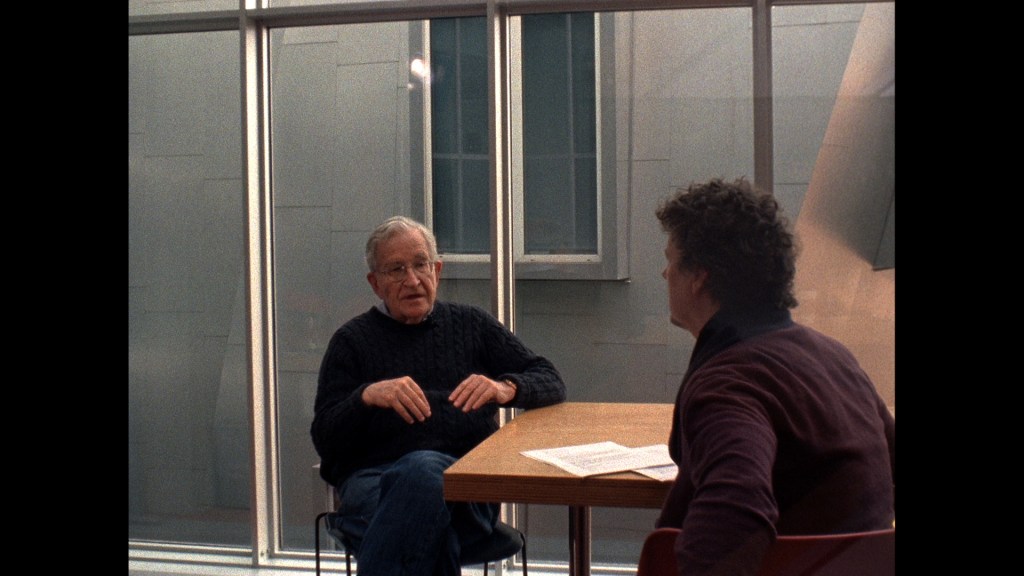
Which honor is more likely to make you the star of a movie: being voted People’s “Sexiest Man Alive” or Foreign Policy’s “Leading Global Intellectual”? For perhaps the only time in screen history, this documentary opts for the latter, choosing 2005’s top vote-getter, Noam Chomsky, as its subject.
A lot of this probably had to do with the perpetually whimsical filmmaker involved. French director Michel Gondry is also a designer, animator, inventor, and all-purpose enthusiast; he seems to be curious about just about anything that exists in the world. His resume easily accommodates the melancholy of Eternal Sunshine of the Spotless Mind, the zaniness of Be Kind Rewind, and the countless visually ingenious music videos he’s concocted over the years. His latest film consists of a conversation with Chomsky, almost entirely animated with Gondry’s line drawings and collages. Chomsky is famed as a pioneering linguist and far-left political critic; Gondry engages all that with his crayoned doo-dads and oddly haunting cut-out pictures illustrating some of Chomsky’s basic ideas.
Gondry also asks Chomsky about his childhood and his personal life. The question “What makes you happy?” seems to throw Chomsky for a while, until he lands upon examples of political heroism among oppressed people as a source of satisfaction. Chomsky suggests that his belief in questioning everything was likely rooted in childhood: “It probably started with not wanting to eat my oatmeal.” A skeptic might note that for someone who espouses the importance of doubting and questioning, Chomsky’s responses to Gondry’s questions tend to be sweeping and peremptory, cutting off their interlocutor when he offers some resistance. And that’s too bad, because one of the intriguing things about the movie is Gondry’s presence: a warm, inquisitive, thickly accented personality that seems to bring out some intriguing admissions from Chomsky. The movie could use more of that.
Just looking at this visually clever film becomes a key part of its appeal, as Gondry’s busy imagination runs a race with Chomsky’s brainiac talk. You end up not really knowing enough about either man for the film to be counted a success, but its existence leaves open one amusing possibility: Could this thing actually compete with Despicable Me 2 and Frozen in the Oscars’ best animated film category? Robert Horton
Saving Mr. Banks
Opens Fri., Dec. 13 at Pacific Place. Rated PG-13. 125 minutes.
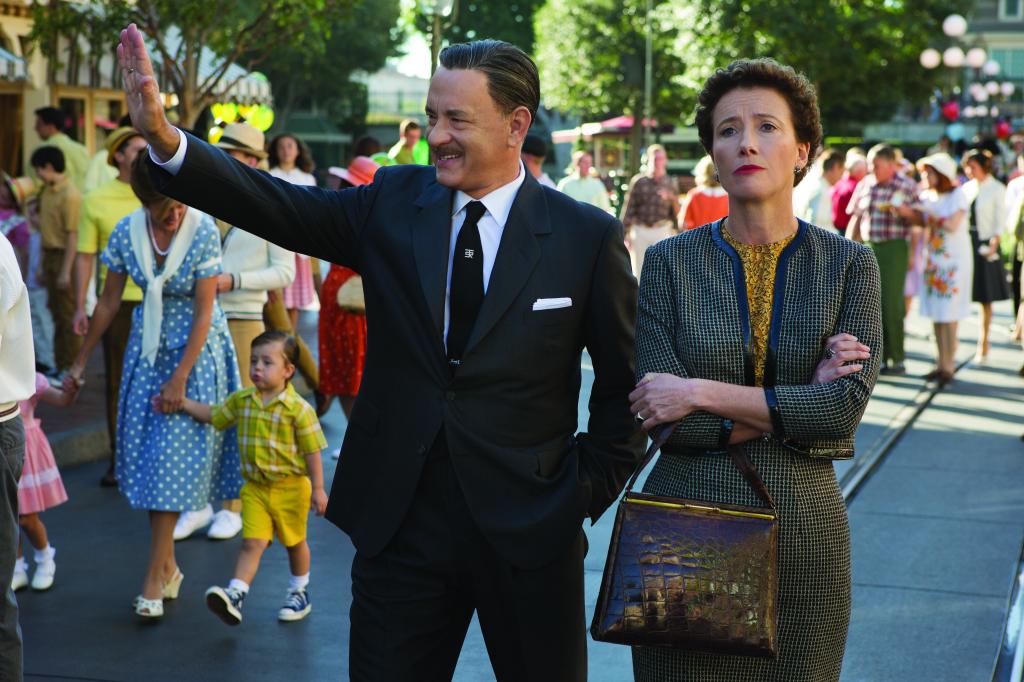
Most critics hated last year’s Hitchcock for its irreverent treatment of the iconic director (portrayed by Anthony Hopkins). How dare you tarnish this giant of world cinema!?! But consider the alternative: Here we have congenial Tom Hanks as Walt Disney, another Hollywood legend, who’s wooing prickly author P.L. Travers (Emma Thompson) to authorize his studio’s planned musical Mary Poppins. Written by Sue Smith and Kelly Marcel, the script for Saving Mr. Banks was long-coveted in development. Then Disney bought it—possibly, some whispered, to kill a project potentially unflattering to Uncle Walt and his empire.
None should’ve worried about that. Disney is depicted as a schemer and cajoler, a good-natured man with an iron will, but he wears his despotism lightly. “Call me Walt,” he keeps insisting—yet another irritant to Travers, sulkily visiting L.A. to approve the project (or not, as she continually threatens). A self-made woman who bolted Australia to refashion herself as a starchy, acerbic Englishwoman, Mrs. Travers—as she imperiously commands informal Americans call her—both needs the cash and despises her need. Her Mary Poppins books sold well during the ’30s and ’40s, but she’s blocked and broke by 1961. She turned down Disney’s offer 20 years before and is humiliated to be considering it now.
There’s enough conflict here for a good comedy of manners during the sunset of the studio system, a fish-out-of-water industry satire with a bossy spinster beginning to question her spinsterhood in hedonistic, sunny L.A. However, the script—competently directed by John Lee Hancock—is too timid to take many liberties in 1961, preferring instead to intercut the parallel story of Travers’ difficult girlhood in 1906 Australia. Little “Ginty,” so in thrall to the confabulations of her charismatic father (a charming yet vulnerable Colin Farrell), must inevitably be wounded in childhood. Just as inevitably, 50 years later, that wound must be healed—with music, laughter, and a generous heaping of Disney stardust. As Walt and company sweetened and simplified several Poppins books into one hit movie, Travers’ rocky biography has been ironed out here.
“She doesn’t sugarcoat the darkness of the world,” Travers says of her heroine, and there are glimpses of that darkness back in Australia (alcoholism, tuberculosis, marital strife, etc.). The original Mary Poppins novels were set during the Great Depression, with the alarming prospect of downward mobility for the Banks family (led by an unhappy banker, as was Travers’ father). Disney’s film pushed the story back to safer pre-WWI days, and Saving Mr. Banks similarly seems somewhat unmoored from its Mad Men, pre-Beatles era. When Travers longingly eyes the hotel bar, we wonder what she wants: booze, men, women, or simply companionship? Disney is equally sexless and square; he seems to exist only at his studio and theme park. (Coincidentally, the Coen brothers’ new Inside Llewyn Davis is also set in ’61, though the distance between the two films feels like a century.)
Hanks and Thompson bring considerable craft and goodwill to their roles, and we can laugh at their clash with the foreknowledge that Disney will prevail. (Mary Poppins was released in ’64 and won five Oscars.) Travers is on the wrong side of history and industry, so it’s mainly a question of how and when she’ll be figuratively seduced. In this very self-validating Hollywood product, the system will prevail over the genius. “We instill hope,” says Disney. Travers is too cowed to correct him: Hollywood sells hope. And happy endings. Brian Miller
E
film@seattleweekly.com