Grey Gardens ACT Theatre, 700 Union St., 292-7676, acttheatre.org. $55–$77. Runs Tues.–Sun.
Published 8:05 pm Monday, March 25, 2013



Grey Gardens
ACT Theatre, 700 Union St., 292-7676, acttheatre.org. $55–$77. Runs Tues.–Sun. Ends June 2.
Blame it on The Osbournes. Maybe it was inevitable that America’s fixation on the ugly underbelly of fame would lead to a Broadway musical. Grey Gardens is based on the eponymous 1975 documentary about Jackie O’s relatives, who then lived in a decrepit Long Island mansion of the same name. Bravo cable addicts, rejoice! Now everyone who revels in the antics of real housewives, the Kardashians, or what washes up on the Jersey shore can see what an upper-crust train wreck looks like, live onstage.
Unlike The Hills, though, this is not a contemporary tale of parvenus in sudden ascent. Grey Gardens more resembles a slo-mo retrospective of Mount St. Helens’ eruption, with lives and property crusted over after decades of neglect.
To his credit, Doug Wright’s book for the 2006 musical does what the Maysles brothers’ film could not: We get to see firsthand the lofty roost from which the Beale/Bouviers fell to earth. In the first act, Wright transports viewers from the squalid cat preserve inhabited by “Little Edie” and her mother Edith Beale (whose mother was a Bouvier, just like Jackie) back to the moment of no return, when the duo sealed their pact of mutual loathing and codependency.
It’s 1941, and Little Edie (Jessica Skerritt) is ready to break free from her eccentric and domineering mother. She’s set her sights on Joseph P. Kennedy Jr. (Matt Owen), the strapping Irish Catholic youth being groomed by his father for the presidency. But Big Edie (Patti Cohenour) won’t permit it. She’s got to either upstage or undo the nuptials, and she succeeds in doing both, leaving her daughter so distraught that she leaves home in hopes of a New York acting career.
By the second act, set in 1973, Little Edie (played in middle age by Cohenour) has returned to the mansion, where she, her mother, and their 52 rooms are all the worse for wear. Has Little Edie been a recluse for so long that she’s just eccentric beyond the telling, or has she lost her mind entirely? Big Edie (now played by Suzy Hunt), is no better, living off canned soup and memories of getting everything she wanted until there was nothing left.
The ladies’ path to ruin is strewn with Kennedys and Bouviers, and Wright’s text provides interminable examples of the behavior that drove Mr. Beale from Grey Gardens. The music—score by Scott Frankel, lyrics by Michel Korie—is full of haunting contrasts between the frivolous then and the fallen now. It’s Sondheimesque in the best way, more intent on creating moods than hummable hits.
Cohenour, Hunt, Skerritt, and Owen all shine in their roles, and the supporting cast is never less than stalwart. (This is a mostly native production, a collaboration between ACT and the Fifth Avenue Theatre.) Director Kurt Beattie wrings what compassion he can for these two characters, but the Beales are merely porcelain figurines broken by their fall from Camelot. Identify with them and you’re bereft; decline and you’re asleep. One final spoiler alert: Grey Gardens also clocks in at close to three hours. Like the Beales themselves, it drags on and on, long after all life is wrung from it. KEVIN PHINNEY
PProject 6
ACT Theatre, 700 Union St., 292-7676, seattledanceproject.org. $20–$25. 8 p.m. Fri.–Sat. Ends March 30.
Seattle Dance Project has invited local choreographer Jason Ohlberg back to stage three of his dances, including his new setting of Vivaldi’s Gloria. Some pieces of music just seem to be candy for choreographers, inspiring dance after dance, and Gloria is one of those scores. Its lively energy and formal structures create a matrix for kinetic invention. Ohlberg’s polyglot background as a dancer (including modern, jazz, and ballet), is reflected in his movement choices, which draw from those multiple traditions. There are allusions to Martha Graham, Jose Limon, Paul Taylor, and Mark Morris, all grafted onto a balletic base that gives most of the work a fleet quality. This is dancing in the happy-nymphs-and-shepherds vein, where any conflict is resolved well before the end of the work. It’s a charming showcase for the dancers and a happy closer for an evening that opens with a more problematic dance.
Ohlberg made Departure From 5th for SDP last year, and he’s continued to refine it for this performance. A work laced with confessional text drawn from the SDP dancers and edited into the soundtrack, it contrasts their frustrations with their bodies (expressed in the script) with their obvious facility moving those bodies. It takes a special kind of schizophrenia to strive for a perfection you know you will never achieve. For every kudo these performers relate, they offer a counterexample, so that “beautiful arms,” for example, are canceled out by “sturdy legs.” Despite the old stereotype that dancers are seen and not heard, these interviews are articulate and evocative, commanding our attention more powerfully than some of the movement sequences, which gives the work an odd asymmetry. Adding to that confusion is Ohlberg’s inclusion of three women credited as “Fates.” Like their Greek counterparts, they seem to bookend the dancing life of the performers, ushering people on and off stage and spreading a black curtain over them at the end of the work. They’re a deus ex machina trio dressed in elaborate ballgowns.
Artistic director Tim Lynch cofounded SDP (along with Julie Tobiason) to explore choreography beyond their dancing careers at Pacific Northwest Ballet. Though their repertory choices have certainly moved in that progressive direction, their ensemble now looks ready to go further, to take some bigger artistic risks for bigger rewards. SANDRA KURTZ
Trails
Village Theatre, 303 Front St. N. (Issaquah), 425-392-2202. Runs Wed.–Sun.; see villagetheatre.org for exact schedule. Ends April 21. (Runs in Everett April 26–May 19.)
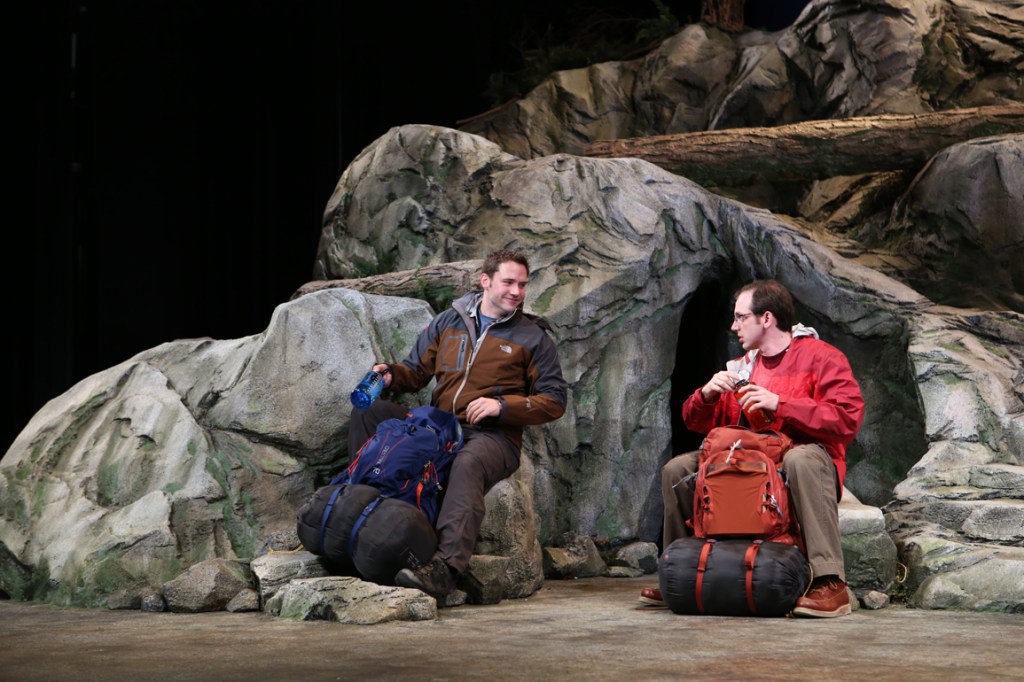
“How do we tell a story about walking for six months?” asked lyricist Jordan Mann when first presented with the idea for the musical Trails, now receiving its premiere staging at Village Theatre. The creators shrewdly figured out exactly how—by making the show mostly backstory. The hikers are Joshua Carter and Dane Stokinger as Seth and Mike—friends since childhood, now 34—who are walking the Appalachian Trail’s 2,175 miles to put their gradually revealed past behind them. (Kirsten deLohr Helland is the strong-willed Amy, the focal point of that past.) Village Theatre’s workshop process for developing and polishing new musicals ensured that the flashback structure, potentially confusing, never is, and that Christy Hall’s book turned out masterfully paced and dramatically effective, especially as directed by Eric Ankrim. (All the reminiscing, though, also reminds us that adult actors can never, on stage or screen, play children convincingly.)
All I found problematic about the show was Jeff Thomson’s score, which brings in only hints of the roots music you’d expect—most strongly in songs performed by John Patrick Lowrie and Bobbi Kotula, longtime Seattle theater MVPs who over the years have brightened shows I haven’t been crazy about and, in shows I have been crazy about, were among the reasons. With the charming Sarah Rose Davis, they play a Greek chorus and, individually, colorful characters met along the hike.
If you object that Americana would’ve been too easy a choice—well, so is the neo-Stephen Schwartz path taken here instead. I left wondering why a show so rooted in a specific, real place—offering a wealth of possibilities, four magnificently rich centuries of vernacular music—did so little to evoke it. No law says a musical set in Appalachia has to sound Appalachian, but why would you settle on a less-vivid musical style? It’d be like deciding to leave the trail behind and just drive up I-95 instead. Gavin Borchert
E
stage@seattleweekly.com