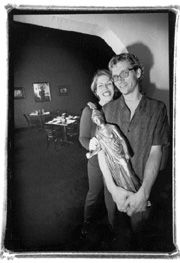
ELEGANCE WITHOUT pretense. A place you can believe in. You just might find these in Greenwood, of all places. The Stumbling Goat Bistro, opened in August by chef Craig Serbousek (formerly of the Herb Farm and the Ruins) and actor Erin Fetridge-Serbousek, features the relaxed and inviting spirit usually found more commonly in the dining room of a good friend’s house. Standing lamps light the rooms; mirrors are used liberally; filmy white curtains on floor-to-ceiling windows block out the traffic; textured, deep red walls and dark green carpeting round out the homey ambience. The wonderfully simple tables were built by Fetridge-Serbousek’s father, who happens to be a set designer for the Seattle Children’s Theater. Indeed, there’s a theatricality in the air, the sense that something great’s about to happen.
Stumbling Goat Bistro 6722 Greenwood N, 784-3535 dinner Tue-Sun 5-10pm MC, V; beer, wine
Between our dining companions and ourselves, we’ve had eight separate exposures to the Stumbling Goat’s food, and each encounter was equally exhilarating. Such consistency is rare, particularly for such a fledgling restaurant, but each and every item we tried warrants unconditional recommendation.
Serbousek’s love affair with top-notch produce (many of the menu items come from his giant home garden) shines in appetizers such as the beet salad with Stilton cheese and mixed greens ($8), which salutes Serbousek’s gardening skills with mellow, sweet burgundy beets and appropriately conservative cheesing. A tomato plate with Caspian pink, golden Roma, and zebra tomatoes ($9) showcases inviting varieties of tomatoes grown in the heirloom tradition from seeds of proven winners. On one of our visits, specials included the cold-smoked salmon plate ($8), an unmitigated success. Thin slices of cold-smoked salmon come propped up, nuclear reactor-style, around a creamy cucumber salad over a bed of gorgeous arugula; the whole thing looked like a volcano about to erupt with cucumber lava.
Two pizzas du jour (on two different jours) could only come from a self-assured kitchen with nothing to prove: asparagus with fontina cheese and a drizzle of truffle oil ($9), and caramelized onions, ni篩se olives, and thyme ($9). Simplicity reigns, allowing well-chosen flavors to stand on their own; on the latter pizza, the caramelized onions were given top billing while the olives played a secondary role.
ENTREES ONLY AUGMENT the can’t-miss state of affairs at the Goat and illustrate what Serbousek calls his “pro-flavor” approach: “What I want to do with each dish is select one or two distinctive flavors, and then use everything else on the dish to enhance those flavors.” According to Serbousek, “The fusion-cooking trend toward throwing too many flavors together can result in con-fusion, resulting in a mishmash of flavors and overwhelmed eaters.” Serbousek makes his point with the moist and flaky hoisin-glazed halibut ($15), which is nicely dressed in the rich purple and slightly sweet hoisin sauce. The large cut of fish sits like a boat on the plate, with sails of chives on a sea of sesame-flavored baby bok choy and shiitakes.
Eggplant caponata with baked polenta, haricots vert, and roasted cherry tomatoes ($13) appears to be a tribute to “Against, Adjacent, Upon,” the massive sculpture in Myrtle Edwards Park. Wedges of firm polenta shelter garlic-infused caponata, while three orderly little piles of green beans sit on the sideline, topped with a crunchy dusting of toasted garlic and cornmeal. Chanterelle and asparagus risotto ($14) is predictably creamy and delicious, with an ample mound of risotto studded with sticks of asparagus and scattered with shaved Asiago cheese. This dish’s comfort-food texture adds both a depth and a touch of familiarity to the heartier menu items. Other down-home dishes include the pan-roasted chicken with mashed potatoes ($14), which had us nodding and chewing at the same time, with its juicy character and naturalistic mashed potatoes. Spaghetti and meatballs ($12) provides a bountiful serving of large meatballs, full-bodied al dente pasta, and a restrained but tasty red sauce.
WHILE PRESENTATION plays a prominent role at the Stumbling Goat, one thing that saves it from design-heavy pretension is generous portioning. Such “beautiful” food often serves as self-parody, with a small and weird-looking pile of food in the middle of a large plate. Serbousek’s equation adds volume to design. The lack of pretension at the Goat is further demonstrated by the simple nature of the food, its emphasis on fresh, simple, and regional ingredients. The homelike feel was solidified by our server’s mastery at treating each table individually. If you want to stay a while and talk after dinner, you’re welcome. Conversely, if you need to scram, it’s just as easy to get your check and leave. And when the check comes, you can exhale: These are, for what you’re getting, extremely reasonable prices. You may find yourself wondering if they forgot to add something. Affordable wines, such as a ’97 Hyatt Merlot ($29), add even more value to the Goat’s smartly compact menu.
Desserts, of course, keep the pleasures coming. The baked pear with vanilla Marsala sauce ($6) is served with a perfect oval of French vanilla ice cream and looks like a painting. The marvelously crusty cr譥 brl饠($6) comes in a large bowl, providing more of the coveted brl饠crust than you ever thought possible.
Perhaps “push-button” best describes not only the desserts, but the Goat’s entire ultraconsistent menu. It doesn’t really matter which item you select, just push the button and out comes excellence, done with a dash of whim, a dollop of style, and a heavy pour of sincerity.
E-mail: food@seattleweekly.com